Laboratory for Zero-Carbon Energy, Institute of Innovative Research, Tokyo Institute of Technology, Tokyo 152-8550, Japan.
Genes (Basel). 2021 Jul 27;12(8):1143. doi: 10.3390/genes12081143.
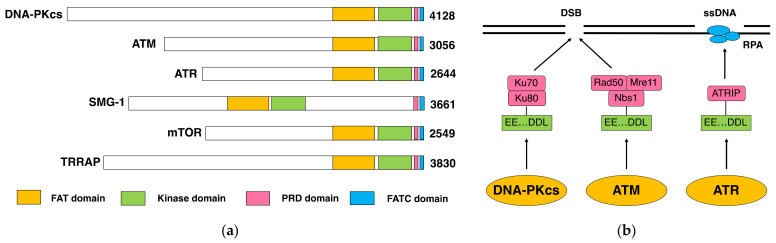
The DNA-dependent protein kinase (DNA-PK) is composed of a DNA-dependent protein kinase catalytic subunit (DNA-PKcs) and Ku70/Ku80 heterodimer. DNA-PK is thought to act as the "sensor" for DNA double-stranded breaks (DSB), which are considered the most deleterious type of DNA damage. In particular, DNA-PKcs and Ku are shown to be essential for DSB repair through nonhomologous end joining (NHEJ). The phenotypes of animals and human individuals with defective DNA-PKcs or Ku functions indicate their essential roles in these developments, especially in neuronal and immune systems. DNA-PKcs are structurally related to Ataxia-telangiectasia mutated (ATM), which is also implicated in the cellular responses to DSBs. DNA-PKcs and ATM constitute the phosphatidylinositol 3-kinase-like kinases (PIKKs) family with several other molecules. Here, we review the accumulated knowledge on the functions of DNA-PKcs, mainly based on the phenotypes of DNA-PKcs-deficient cells in animals and human individuals, and also discuss its relationship with ATM in the maintenance of genomic stability.
DNA 依赖性蛋白激酶(DNA-PK)由 DNA 依赖性蛋白激酶催化亚基(DNA-PKcs)和 Ku70/Ku80 异二聚体组成。DNA-PK 被认为是 DNA 双链断裂(DSB)的“传感器”,DSB 被认为是最具破坏性的 DNA 损伤类型。特别是,DNA-PKcs 和 Ku 被证明对非同源末端连接(NHEJ)的 DSB 修复至关重要。具有缺陷 DNA-PKcs 或 Ku 功能的动物和人类个体的表型表明它们在这些发育过程中,尤其是在神经元和免疫系统中的重要作用。DNA-PKcs 在结构上与共济失调毛细血管扩张突变(ATM)相关,ATM 也参与细胞对 DSB 的反应。DNA-PKcs 和 ATM 与其他几个分子一起构成了磷脂酰肌醇 3-激酶样激酶(PIKKs)家族。在这里,我们主要基于动物和人类个体中 DNA-PKcs 缺陷细胞的表型,综述了 DNA-PKcs 功能的相关知识,并讨论了其与 ATM 在维持基因组稳定性方面的关系。