
不同来源植物蛋白用于挤压应用时的流变学特性比较
Comparison of the Rheological Properties of Plant Proteins from Various Sources for Extrusion Applications.
作者信息
Wittek Patrick, Walther Goeran, Karbstein Heike P, Emin M Azad
机构信息
Institute of Process Engineering in Life Sciences, Chair of Food Process Engineering, Karlsruhe Institute of Technology, 76131 Karlsruhe, Germany.
General Mills, R&D, James Ford Bell Technical Center, Golden Valley, MN 55427, USA.
出版信息
Foods. 2021 Jul 22;10(8):1700. doi: 10.3390/foods10081700.
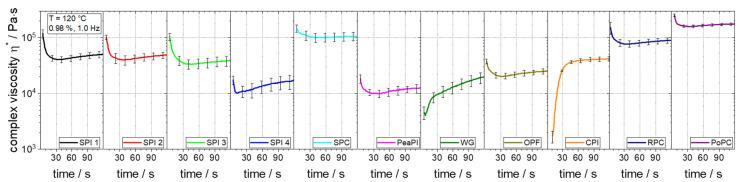
Plant proteins in foods are becoming increasingly popular with consumers. However, their application in extruded products remains a major challenge, as the various protein-rich raw materials (e.g., from different plant origins) exhibit very different material properties. In particular, the rheological properties of these raw materials have a distinct influence on the extrusion process and must be known in order to be able to control the process and adjust the product properties. In this study, process-relevant rheological properties of 11 plant-based protein-rich raw materials (differing in plant origin, protein content, and manufacturer) are determined and compared. The results demonstrate distinct differences in the rheological properties, even when plant origin and protein content are identical. Time sweeps reveal not only large differences in development of viscosity over time, but also in magnitude of viscosity (up to 15-fold difference). All materials exhibit gel behaviour and strain thinning behaviour in the strain sweeps, whereas their behaviour in the non-linear viscoelastic range differs greatly. Typical relaxation behaviour of viscoelastic materials could be observed in the stress relaxation tests for all materials. Comparison of the maximum achieved shear stress, which correlates with the elastic properties, reveals an up to 53-fold difference. The results of this study could serve as a starting point for adapting raw material selection and composition to process and product design requirements and help to meet the challenge of applying plant-based proteins in food extrusion.
食品中的植物蛋白越来越受消费者欢迎。然而,它们在挤压产品中的应用仍然是一个重大挑战,因为各种富含蛋白质的原材料(例如,来自不同植物来源)表现出非常不同的材料特性。特别是,这些原材料的流变特性对挤压过程有显著影响,为了能够控制该过程并调整产品特性,必须了解这些特性。在本研究中,测定并比较了11种富含植物蛋白的原材料(植物来源、蛋白质含量和制造商不同)与工艺相关的流变特性。结果表明,即使植物来源和蛋白质含量相同,流变特性也存在明显差异。时间扫描不仅揭示了粘度随时间变化的巨大差异,还揭示了粘度大小的差异(相差高达15倍)。在应变扫描中,所有材料均表现出凝胶行为和应变稀化行为,而它们在非线性粘弹性范围内的行为差异很大。在所有材料的应力松弛试验中都可以观察到粘弹性材料的典型松弛行为。与弹性特性相关的最大剪切应力的比较显示相差高达53倍。本研究结果可作为根据工艺和产品设计要求调整原材料选择和组成的起点,并有助于应对在食品挤压中应用植物蛋白的挑战。



 Zotero 插件