Department of Medicine, Division of Nephrology, Taipei Veterans General Hospital, Taipei 11217, Taiwan.
Institute of Clinical Medicine, School of Medicine, National Yang Ming Chiao Tung University, Taipei 11221, Taiwan.
Nutrients. 2021 Aug 16;13(8):2803. doi: 10.3390/nu13082803.
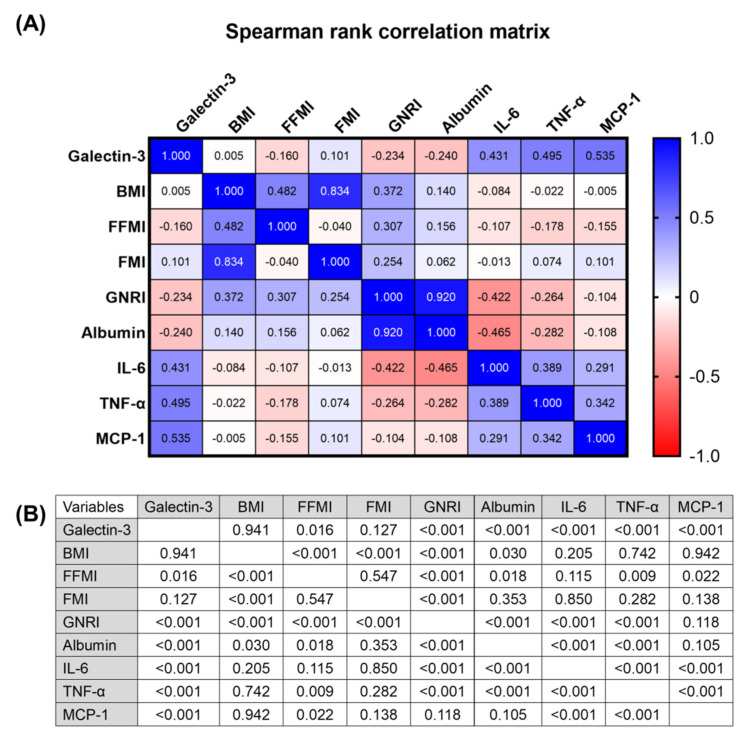
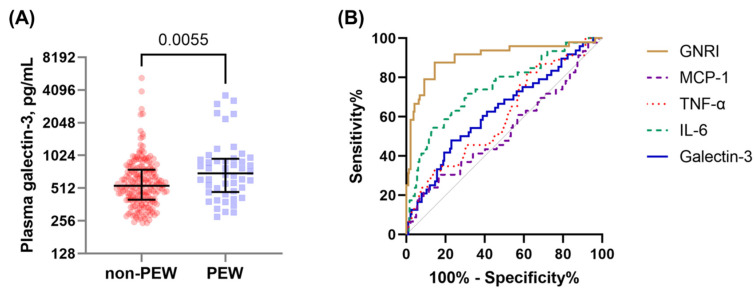
Galectin-3 reportedly participates in the inflammatory process that causes insulin resistance in the target tissues. However, the role of high plasma galectin-3 levels as an indicator of protein-energy wasting (PEW) in patients undergoing maintenance hemodialysis remains unclear. This study included 240 hemodialysis patients (64.5 [55.3-74.0] years, 35.8% women) from a tertiary medical center. A baseline assessment of demographic and clinical data, biochemical parameters, and body composition was conducted. Plasma galectin-3 and other biomarkers were measured using a multiplex bead-based immunoassay. Participants were then divided into two subgroups depending on the median value of plasma galectin-3. Malnutrition was identified using the geriatric nutritional risk index (GNRI) and the criteria of the International Society of Renal Nutrition and Metabolism. Independent risk factors for elevated plasma galectin-3 and malnutrition were identified by multivariate logistic regression. The high galectin-3 group was more likely to be older, have lower lean tissue mass and GNRI scores, be diagnosed with PEW, dialyze through a tunneled catheter, and have higher circulating IL-6, TNF-α, and MCP-1 concentrations than the low galectin-3 group. After multivariate adjustment, only low mean arterial pressure, dialyzing with tunneled cuffed catheters, and elevated systemic inflammatory markers correlated with high galectin-3 levels. Plasma galectin-3 concentrations also increased significantly in hemodialysis patients with PEW. However, compared with other commonly used nutritional indicators, galectin-3 did not show superiority in predicting PEW. Although the plasma galectin-3 levels correlated with PEW severity, this correlation disappeared after adjustment for potential confounding variables (OR, 1.000; 95% CI, 0.999-1.001). In conclusion, plasma galectin-3 is a valuable biomarker for systemic inflammation but is less prominent for PEW in patients with maintenance hemodialysis. Further identification of novel biomarkers is required to detect patients at risk for malnutrition and implement appropriate interventions.
半乳糖凝集素-3 据报道参与了导致靶组织胰岛素抵抗的炎症过程。然而,在接受维持性血液透析的患者中,高血浆半乳糖凝集素-3 水平作为蛋白质能量消耗(PEW)的指标的作用尚不清楚。本研究纳入了一家三级医疗中心的 240 名血液透析患者(64.5[55.3-74.0]岁,35.8%为女性)。进行了人口统计学和临床数据、生化参数和身体成分的基线评估。使用基于多重微珠的免疫测定法测量了血浆半乳糖凝集素-3 和其他生物标志物。然后根据血浆半乳糖凝集素-3 的中位数将参与者分为两组。使用老年营养风险指数(GNRI)和国际肾脏营养与代谢学会的标准确定营养不良。通过多变量逻辑回归确定升高的血浆半乳糖凝集素-3 和营养不良的独立危险因素。高半乳糖凝集素-3 组更可能年龄较大,瘦组织质量和 GNRI 评分较低,被诊断为 PEW,通过隧道导管透析,循环白细胞介素 6(IL-6)、肿瘤坏死因子-α(TNF-α)和单核细胞趋化蛋白-1(MCP-1)浓度较高。在多变量调整后,只有低平均动脉压、隧道带袖套导管透析和升高的全身炎症标志物与高半乳糖凝集素-3 水平相关。PEW 的血液透析患者的血浆半乳糖凝集素-3 浓度也显著升高。然而,与其他常用的营养指标相比,半乳糖凝集素-3 在预测 PEW 方面没有优势。虽然血浆半乳糖凝集素-3 水平与 PEW 严重程度相关,但在调整潜在混杂变量后,这种相关性消失(OR,1.000;95%CI,0.999-1.001)。总之,血浆半乳糖凝集素-3 是全身性炎症的有价值的生物标志物,但在接受维持性血液透析的患者中,对 PEW 的作用不明显。需要进一步确定新的生物标志物来检测有营养不良风险的患者,并实施适当的干预措施。