Buhler Stéphane, Baldomero Helen, Ferrari-Lacraz Sylvie, Mamez Anne-Claire, Masouridi-Levrat Stavroula, Heim Dominik, Halter Jörg, Nair Gayathri, Chalandon Yves, Schanz Urs, Güngör Tayfun, Nicoloso Grazia, Passweg Jakob R, Villard Jean
Transplantation Immunology Unit and National Reference Laboratory for Histocompatibility, Department of Diagnostic, Geneva University Hospitals, Geneva, Switzerland.
Division of Hematology, Basel University Hospital, Basel, Switzerland.
Blood Adv. 2021 Sep 14;5(17):3377-3386. doi: 10.1182/bloodadvances.2020003998.
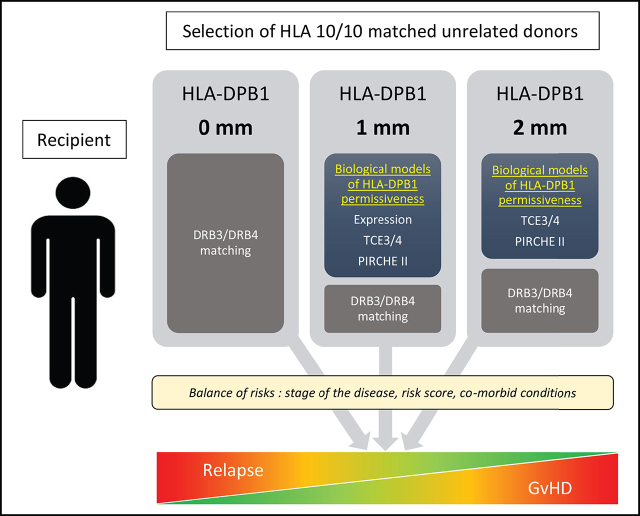
HLA compatibility is a key factor for survival after unrelated hematopoietic stem cell transplantation (HSCT). HLA-A, -B, -C, -DRB1, and -DQB1 are usually matched between donor and recipient. By contrast, HLA-DPB1 mismatches are frequent, although it is feasible to optimize donor selection and DPB1 matching with prospective typing. Because classical DPB1 allele mismatches are often unavoidable, however, several biological models have been developed to predict the optimal DPB1 mismatch combination for less graft-versus-host disease (GVHD) and better overall survival. In 909 recipient/donor pairs, we analyzed the role of 3 biological models: T-cell epitopes (TCEs) based on the immunogenicity of DPB1, cell surface expression of DPB1 molecules based on a single-nucleotide polymorphism located in the 3' untranslated region, and the Predicted Indirectly ReCognizable HLA Epitopes (PIRCHE) model based on the presentation of allogeneic peptides derived from mismatched HLA, compared with the classical allele mismatch. Matching for both DPB1 alleles remains the best option to prevent acute GVHD. In the situation of one DPB1 allele mismatch, the donor associated with the lowest acute GVHD risks is mismatched for an allele with a low expression profile in the recipient, followed by a permissive TCE3/4 mismatch and/or the absence of PIRCHE II potential against the recipient. In the context of 2 DPB1 mismatches, the same considerations apply for a permissive TCE3/4 mismatch and no PIRCHE II. By combining the biological models, the most favorable DPB1 constellation can be defined. This approach will help optimize donor selection and improve post-HSCT complications and patient prognosis.
HLA相容性是无关供者造血干细胞移植(HSCT)后生存的关键因素。供者和受者之间通常要匹配HLA-A、-B、-C、-DRB1和-DQB1。相比之下,HLA-DPB1不匹配很常见,尽管通过前瞻性分型优化供者选择和DPB1匹配是可行的。然而,由于经典的DPB1等位基因不匹配往往不可避免,因此已经开发了几种生物学模型来预测最佳的DPB1不匹配组合,以减少移植物抗宿主病(GVHD)并提高总体生存率。在909对受者/供者中,我们分析了三种生物学模型的作用:基于DPB1免疫原性的T细胞表位(TCE)、基于3'非翻译区单核苷酸多态性的DPB1分子细胞表面表达,以及基于错配HLA衍生的同种异体肽呈递的预测间接可识别HLA表位(PIRCHE)模型,并与经典等位基因不匹配进行比较。两个DPB1等位基因都匹配仍然是预防急性GVHD的最佳选择。在一个DPB1等位基因不匹配的情况下,急性GVHD风险最低的供者与受者中低表达谱的等位基因不匹配,其次是允许的TCE3/4不匹配和/或不存在针对受者的PIRCHE II潜能。在两个DPB1不匹配的情况下,对于允许的TCE3/4不匹配且不存在PIRCHE II,同样的考虑因素适用。通过结合生物学模型,可以定义最有利的DPB1组合。这种方法将有助于优化供者选择,改善HSCT后的并发症和患者预后。