
一种基于 SpyTag/SpyCatcher 连接和 Split-GFP 二聚化设计的用于同时检测两个基因表达的 Split-Cre 系统。
A Split-Cre system designed to detect simultaneous expression of two genes based on SpyTag/SpyCatcher conjugation and Split-GFP dimerization.
机构信息
Center of Biotherapy, Beijing Hospital, National Center of Gerontology, Institute of Geriatric Medicine, Chinese Academy of Medical Sciences, Beijing, China; Savaid Medical School, University of Chinese Academy of Sciences, Beijing, China.
Savaid Medical School, University of Chinese Academy of Sciences, Beijing, China; CAS Key Laboratory of Pathogenic Microbiology and Immunology, Institute of Microbiology, Chinese Academy of Sciences (CAS), Beijing, China.
出版信息
J Biol Chem. 2021 Oct;297(4):101119. doi: 10.1016/j.jbc.2021.101119. Epub 2021 Aug 25.
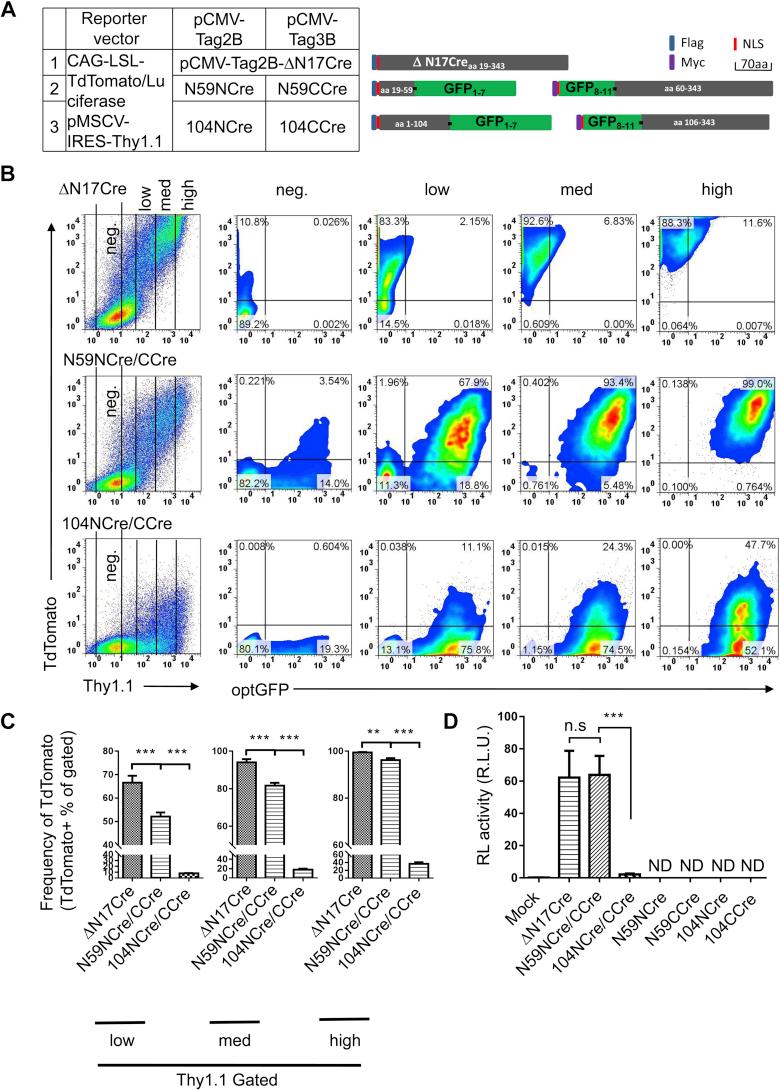
The Split-Cre system is a powerful tool for genetic manipulation and can be used to spatiotemporally control gene expression in vivo. However, the low activity of the reconstituted NCre/CCre recombinase in the Split-Cre system limits its application as an indicator of the simultaneous expression of a pair of genes of interest. Here, we describe two approaches for improving the activity of the Split-Cre system after Cre reconstitution based on self-associating split GFP (Split-GFP) and SpyTag/SpyCatcher conjugation. First, we created the Split-GFP-Cre system by constructing fusion proteins of NCre and CCre with the N-terminal and C-terminal subunits of GFP, respectively. Reconstitution of Cre by GFP-mediated dimerization of the two fusion proteins resulted in recombinase activity approaching that of full-length Cre in living cells. Second, to further increase recombinase activity at low levels of Split-Cre expression, the Split-Spy-GCre system was established by incorporating the sequences for SpyTag and SpyCatcher into the components of the Split-GFP-Cre system. As anticipated, covalent conjugation of the SpyTag and SpyCatcher segments improved Split-GFP dimerization to further increase Cre recombinase activity in living cells. The increased efficiency and robustness of this dual-split system (Split-Cre and Split-GFP) minimize the problems of incomplete double gene-specific KO or low labeling efficiency due to poor NCre/CCre recombinase activity. Thus, this Split-Spy-GCre system allows more precise gene manipulation of cell subpopulations, which will provide advanced analysis of genes and cell functions in complex tissue such as the immune system.
Split-Cre 系统是一种强大的遗传操作工具,可以用于时空控制体内基因的表达。然而,重构的 NCre/CCre 重组酶在 Split-Cre 系统中的低活性限制了其作为一对感兴趣基因同时表达的指示剂的应用。在这里,我们描述了两种基于自组装分裂 GFP(Split-GFP)和 SpyTag/SpyCatcher 缀合来提高 Split-Cre 系统在 Cre 重构后活性的方法。首先,我们通过分别将 NCre 和 CCre 与 GFP 的 N 端和 C 端亚基融合,构建了 Split-GFP-Cre 系统。通过 GFP 介导的两个融合蛋白的二聚化来重构 Cre,导致重组酶活性接近活细胞中全长 Cre 的活性。其次,为了进一步提高低水平 Split-Cre 表达时的重组酶活性,我们将 SpyTag 和 SpyCatcher 的序列整合到 Split-GFP-Cre 系统的组件中,建立了 Split-Spy-GCre 系统。正如预期的那样,SpyTag 和 SpyCatcher 片段的共价缀合改善了 Split-GFP 的二聚化,从而进一步提高了活细胞中 Cre 重组酶的活性。这种双分裂系统(Split-Cre 和 Split-GFP)的效率和稳健性的提高最大限度地减少了由于 NCre/CCre 重组酶活性差而导致的不完全双基因特异性 KO 或低标记效率的问题。因此,这种 Split-Spy-GCre 系统允许对细胞亚群进行更精确的基因操作,这将为免疫系统等复杂组织中的基因和细胞功能提供先进的分析。




 Zotero 插件