Department of Pharmacology, University of Colorado School of Medicine, Aurora, CO 80045, USA.
Department of Anesthesiology, Division of Basic Research, Washington University School of Medicine, St Louis, MO 63110, USA.
Nucleic Acids Res. 2019 Sep 26;47(17):e97. doi: 10.1093/nar/gkz585.
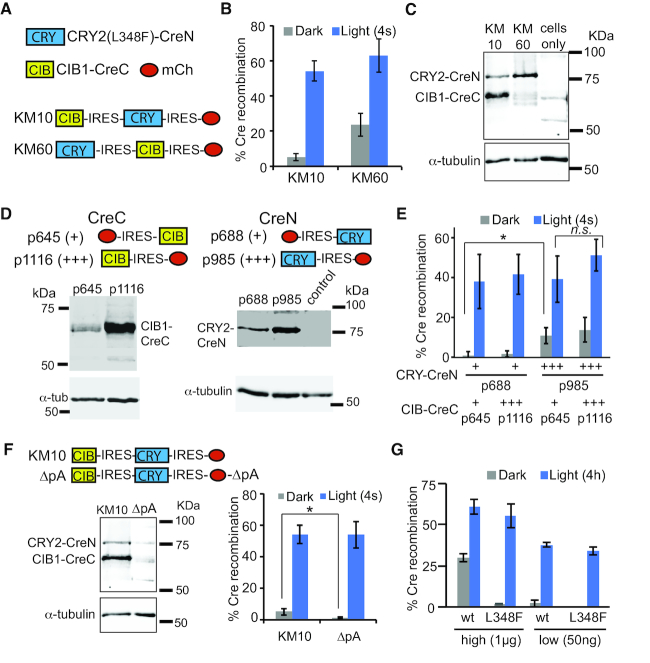
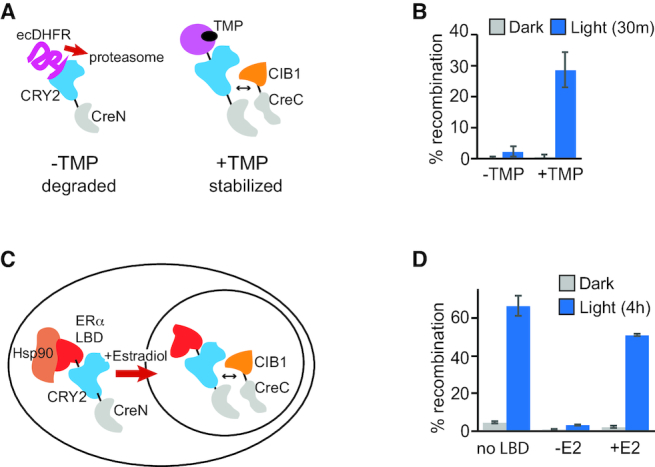
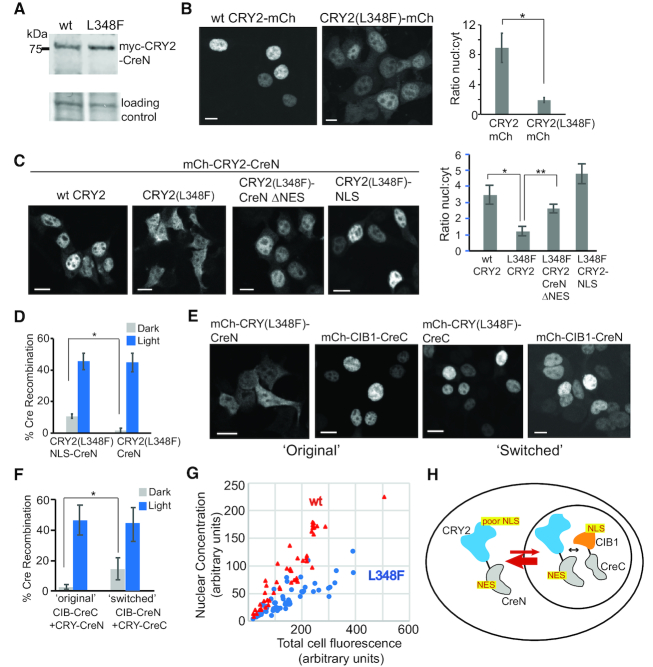
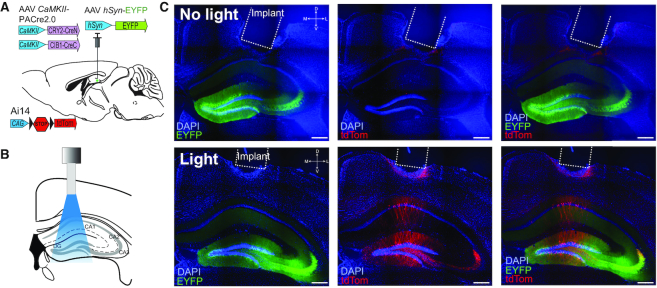
A common mechanism for inducibly controlling protein function relies on reconstitution of split protein fragments using chemical or light-induced dimerization domains. A protein is split into fragments that are inactive on their own, but can be reconstituted after dimerization. As many split proteins retain affinity for their complementary half, maintaining low activity in the absence of an inducer remains a challenge. Here, we systematically explore methods to achieve tight regulation of inducible proteins that are effective despite variation in protein expression level. We characterize a previously developed split Cre recombinase (PA-Cre2.0) that is reconstituted upon light-induced CRY2-CIB1 dimerization, in cultured cells and in vivo in rodent brain. In culture, PA-Cre2.0 shows low background and high induced activity over a wide range of expression levels, while in vivo the system also shows low background and sensitive response to brief light inputs. The consistent activity stems from fragment compartmentalization that shifts localization toward the cytosol. Extending this work, we exploit nuclear compartmentalization to generate light-and-chemical regulated versions of Cre recombinase. This work demonstrates in vivo functionality of PA-Cre2.0, describes new approaches to achieve tight inducible control of Cre DNA recombinase, and provides general guidelines for further engineering and application of split protein fragments.
一种常见的诱导控制蛋白质功能的机制依赖于使用化学或光诱导二聚化结构域重新组装分裂的蛋白质片段。将蛋白质分割成自身无活性的片段,但在二聚化后可以重新组装。由于许多分裂的蛋白质保留了与其互补片段的亲和力,因此在没有诱导剂的情况下保持低活性仍然是一个挑战。在这里,我们系统地探索了实现诱导蛋白紧密调控的方法,即使在蛋白质表达水平存在差异的情况下,这些方法仍然有效。我们对先前开发的、在光诱导 CRY2-CIB1 二聚化时重新组装的分裂 Cre 重组酶(PA-Cre2.0)进行了表征,该酶在培养的细胞中和啮齿动物大脑的体内均有活性。在培养中,PA-Cre2.0 在广泛的表达水平范围内表现出低背景和高诱导活性,而在体内,该系统也表现出低背景和对短暂光输入的敏感反应。一致的活性源于片段分隔,该分隔将定位向细胞质转移。扩展这项工作,我们利用核区室化来生成光和化学调节的 Cre 重组酶。这项工作证明了 PA-Cre2.0 的体内功能,描述了实现 Cre DNA 重组酶紧密诱导控制的新方法,并为进一步工程化和应用分裂蛋白质片段提供了一般指导原则。