Tiako Max Jordan Nguemeni, McCarthy Clare, Meisel Zachary F, Elovitz Michal A, Burris Heather H, South Eugenia
Department of Emergency Medicine, Center for Emergency Care and Policy Research, University of Pennsylvania Perelman School of Medicine, Philadelphia, Pennsylvania.
Urban Health Lab, University of Pennsylvania Perelman School of Medicine, Philadelphia, Pennsylvania.
Am J Perinatol. 2023 Aug;40(11):1185-1192. doi: 10.1055/s-0041-1733786. Epub 2021 Aug 27.
Urban neighborhood greenness is associated with greater cardiovascular health in the general population, and with better pregnancy and neonatal outcomes. Hypertension in pregnancy is a leading cause of maternal mortality and long-term cardiovascular morbidity and mortality in women. We sought to examine the association between greenness and hypertensive disorders of pregnancy.
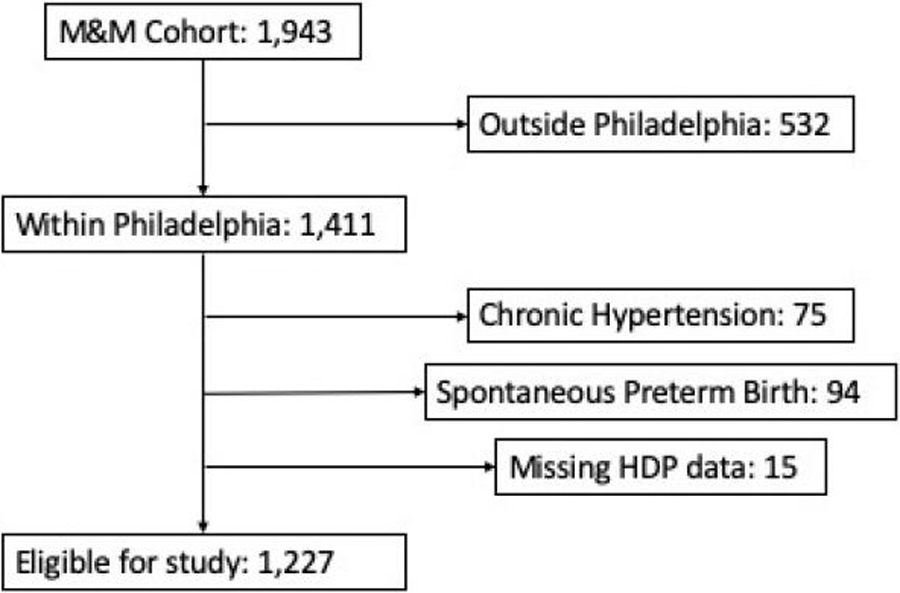
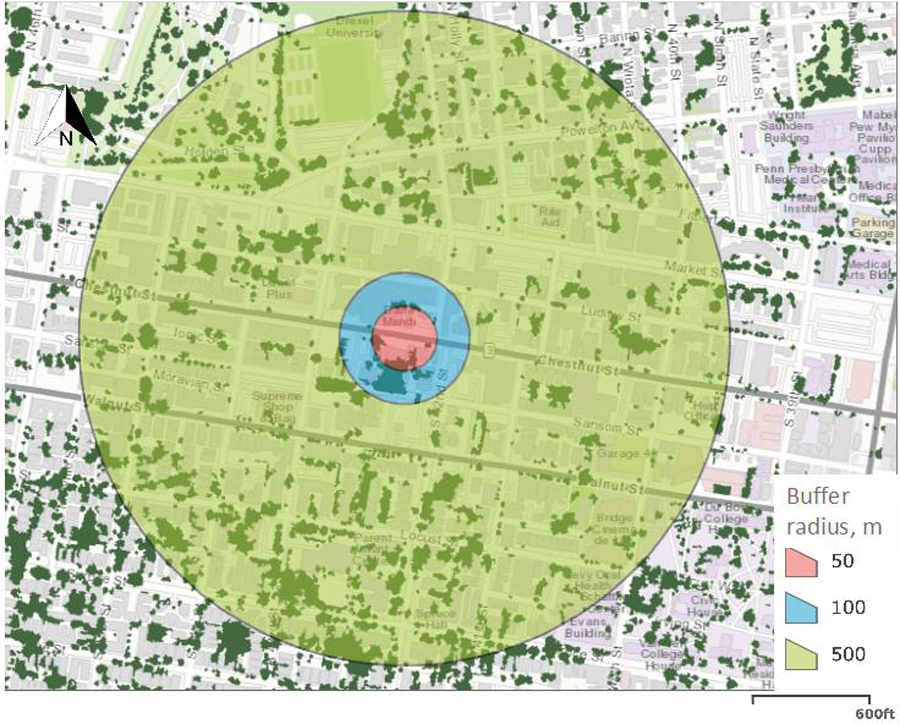
This study is a secondary analysis of a prospective cohort study of 1,943 women who received prenatal care from December 2013 to December 2016 at a single, urban, and tertiary academic medical center in Philadelphia, PA. Greenness measure was quantified via residential tree canopy cover within circumferential buffers of 100- and 500-meter radii around participants' homes. Associations between greenness and hypertensive disorders of pregnancy (defined as gestational hypertension or preeclampsia) were estimated by using multilevel logistic regression accounting for maternal sociodemographic information (race-ethnicity, insurance status, and age) medical history (diabetes, body mass index, smoking history, and parity), neighborhood deprivation index, and including 1,225 Philadelphia residents for whom key exposure and outcome data were available.
At baseline, the participants' mean (SD) age was 27.5 (5.9) years, (range: 14-44 years). The majority of participants were non-Hispanic Black (857, 70.2%). Participants with less residential tree canopy cover were significantly more likely to have hypertensive disorders of pregnancy. The multivariable-adjusted odds ratio of hypertensive disorders of pregnancy among participants with less than 10% compared with those with greater than 30% tree canopy cover was 2.14 (95% confidence interval [CI]: 1.11-4.15) within 100-meter buffer.
In our cohort, greenness was associated with lower hypertensive disorders of pregnancy odds. Our findings add to evidence that greenness may confer health benefits and warrant further investigations in identifying whether there is a causal pathway through which greenness may be protective against hypertensive disorders of pregnancy.
· Low residential tree canopy is associated with increased risk of hypertensive disorders of pregnancy. · 100-meter buffers are most sensitive in identifying associations between tree canopy and HDP risk. · The role of greenness against hypertensive disorders of pregnancy should be further studied experimentally.
城市社区绿化与普通人群更好的心血管健康相关,也与更好的妊娠和新生儿结局相关。妊娠高血压是孕产妇死亡以及女性长期心血管疾病发病和死亡的主要原因。我们试图研究绿化与妊娠高血压疾病之间的关联。
本研究是一项前瞻性队列研究的二次分析,该队列研究纳入了1943名于2013年12月至2016年12月在宾夕法尼亚州费城的一家单一的城市三级学术医疗中心接受产前护理的女性。绿化程度通过参与者家周围半径100米和500米的圆周缓冲区内的住宅树冠覆盖率进行量化。绿化与妊娠高血压疾病(定义为妊娠期高血压或先兆子痫)之间的关联通过使用多水平逻辑回归进行估计,该回归考虑了孕产妇的社会人口学信息(种族、保险状况和年龄)、病史(糖尿病、体重指数、吸烟史和产次)、社区贫困指数,纳入了1225名有关键暴露和结局数据的费城居民。
在基线时,参与者的平均(标准差)年龄为27.5(5.9)岁(范围:14 - 44岁)。大多数参与者是非西班牙裔黑人(857人,70.2%)。住宅树冠覆盖率较低的参与者患妊娠高血压疾病的可能性显著更高。在100米缓冲区内,树冠覆盖率低于10%的参与者与高于30%的参与者相比,妊娠高血压疾病的多变量调整优势比为2.14(95%置信区间[CI]:1.11 - 4.15)。
在我们的队列中,绿化与较低的妊娠高血压疾病患病几率相关。我们的研究结果进一步证明绿化可能带来健康益处,并且有必要进一步研究以确定绿化是否存在一条因果途径来预防妊娠高血压疾病。
· 住宅树冠覆盖率低与妊娠高血压疾病风险增加相关。· 100米缓冲区在识别树冠与妊娠高血压疾病风险之间的关联方面最为敏感。· 绿化对妊娠高血压疾病的作用应通过实验进一步研究。