Gavelli Francesco, Beurton Alexandra, Teboul Jean-Louis, De Vita Nello, Azzolina Danila, Shi Rui, Pavot Arthur, Monnet Xavier
Service de Médecine Intensive-Réanimation, Université Paris-Saclay, AP-HP, Hôpital de Bicêtre, DMU CORREVE, Inserm UMR S_999, FHU SEPSIS, CARMAS, 78, Rue du Général Leclerc, 94 270, Le Kremlin-Bicêtre, France.
Emergency Medicine Unit, Department of Translational Medicine, Università degli Studi del Piemonte Orientale, 28100, Novara, Italy.
Ann Intensive Care. 2021 Aug 28;11(1):133. doi: 10.1186/s13613-021-00920-7.
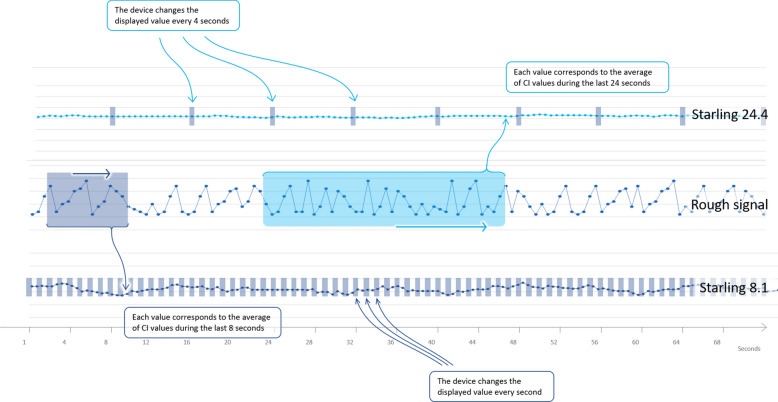
The end-expiratory occlusion (EEXPO) test detects preload responsiveness, but it is 15 s long and induces small changes in cardiac index (CI). It is doubtful whether the Starling bioreactance device, which averages CI over 24 s and refreshes the displayed value every 4 s (Starling-24.4), can detect the EEXPO-induced changes in CI (ΔCI). Our primary goal was to test whether this Starling device version detects preload responsiveness through EEXPO. We also tested whether shortening the averaging and refresh times to 8 s and one second, respectively, (Starling-8.1) improves the accuracy of the device in detecting preload responsiveness using EEXPO.
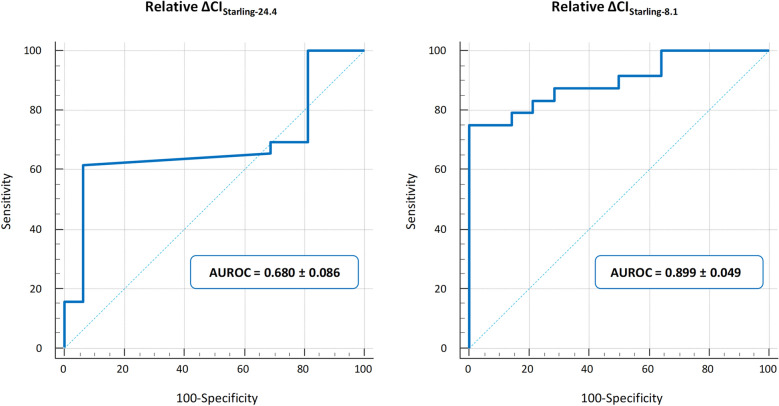
In 42 mechanically ventilated patients, during a 15-s EEXPO, we measured ∆CI through calibrated pulse contour analysis (CI, PiCCO2 device) and using the Starling device. For the latter, we considered both CI from the commercial version and CI derived from the raw data. For relative ∆CI and ∆CI during EEXPO, we calculated the area under the receiver operating characteristic curve (AUROC) to detect preload responsiveness, defined as an increase in CI ≥ 10% during passive leg raising (PLR). For both methods, the correlation coefficient vs. ∆CI was calculated.
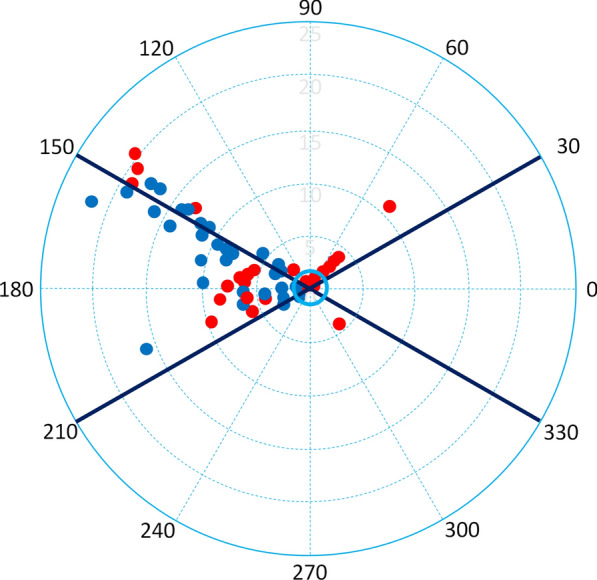
Twenty-six patients were preload responders and sixteen non preload-responders. The AUROC for ∆CI was significantly lower compared to ∆CI (0.680 ± 0.086 vs. 0.899 ± 0.049, respectively; p = 0.027). A significant correlation was observed between ∆CI and ∆CI (r = 0.42; p = 0.009), but not between ∆CI and ∆CI. During PLR, both ∆CI and ∆CI reliably detected preload responsiveness.
Shortening the averaging and refresh times of the bioreactance signal to 8 s and one second, respectively, increases the reliability of the Starling device in detection of EEXPO-induced ∆CI.
No.
2018-A02825-50. Registered 13 December 2018.
呼气末阻断(EEXPO)试验可检测前负荷反应性,但该试验持续15秒,且导致心脏指数(CI)的变化较小。目前尚不清楚平均24秒CI并每4秒更新显示值的Starling生物反应装置(Starling-24.4)能否检测到EEXPO引起的CI变化(ΔCI)。我们的主要目标是测试这种Starling装置版本能否通过EEXPO检测前负荷反应性。我们还测试了分别将平均时间和更新时间缩短至8秒和1秒(Starling-8.1)是否能提高该装置使用EEXPO检测前负荷反应性的准确性。
在42例机械通气患者中,在15秒的EEXPO期间,我们通过校准脉搏轮廓分析(CI,PiCCO2装置)和使用Starling装置测量ΔCI。对于后者,我们考虑了商业版本的CI和从原始数据得出的CI。对于EEXPO期间的相对ΔCI和ΔCI,我们计算了受试者工作特征曲线下面积(AUROC)以检测前负荷反应性,前负荷反应性定义为被动抬腿(PLR)期间CI增加≥10%。对于这两种方法,均计算了与ΔCI的相关系数。
26例患者为前负荷反应者,16例为非前负荷反应者。与ΔCI相比,ΔCI的AUROC显著更低(分别为0.680±0.086和0.899±0.049;p = 0.027)。观察到ΔCI与ΔCI之间存在显著相关性(r = 0.42;p = 0.009),但ΔCI与ΔCI之间无相关性。在PLR期间,ΔCI和ΔCI均能可靠地检测前负荷反应性。
将生物反应信号的平均时间和更新时间分别缩短至8秒和1秒,可提高Starling装置检测EEXPO诱导的ΔCI的可靠性。
无。
2018 - A02825 - 50。于2018年12月13日注册。