Kennedy Krieger Institute, Baltimore, MD, USA; Johns Hopkins University, Baltimore, MD, USA.
Johns Hopkins University, Baltimore, MD, USA.
Clin Neurophysiol. 2021 Oct;132(10):2440-2446. doi: 10.1016/j.clinph.2021.06.030. Epub 2021 Aug 5.
Port-wine birthmark (PWB) is a common occurrence in the newborn, and general pediatricians, dermatologists, and ophthalmologists are often called on to make an assessment of risk for Sturge-Weber syndrome (SWS) due to workforce shortages in pediatric neurologists and MRI's low sensitivity for SWS brain involvement in infants. We therefore aimed to develop a quantitative EEG (qEEG) approach to safely screen young infants with PWB for SWS risk and optimal timing of diagnostic MRI.
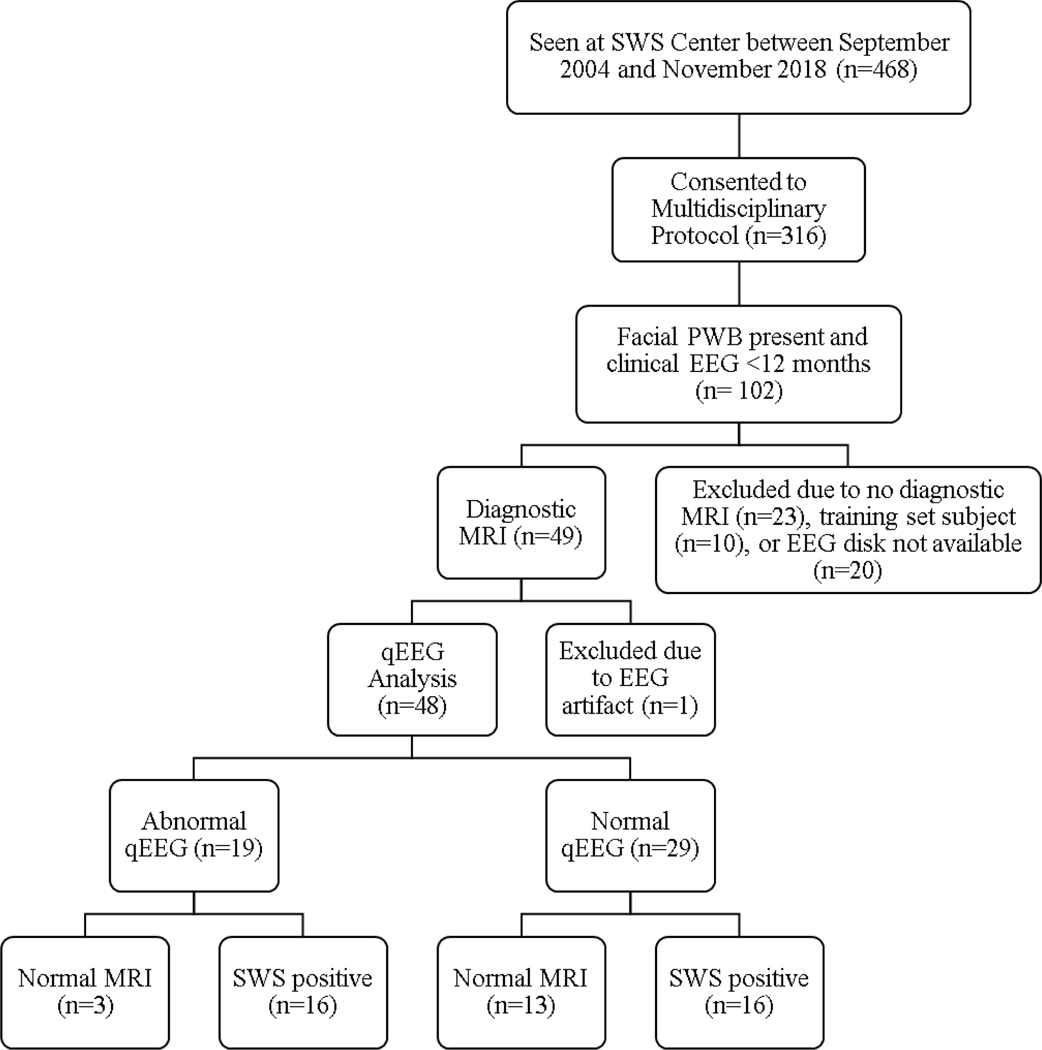
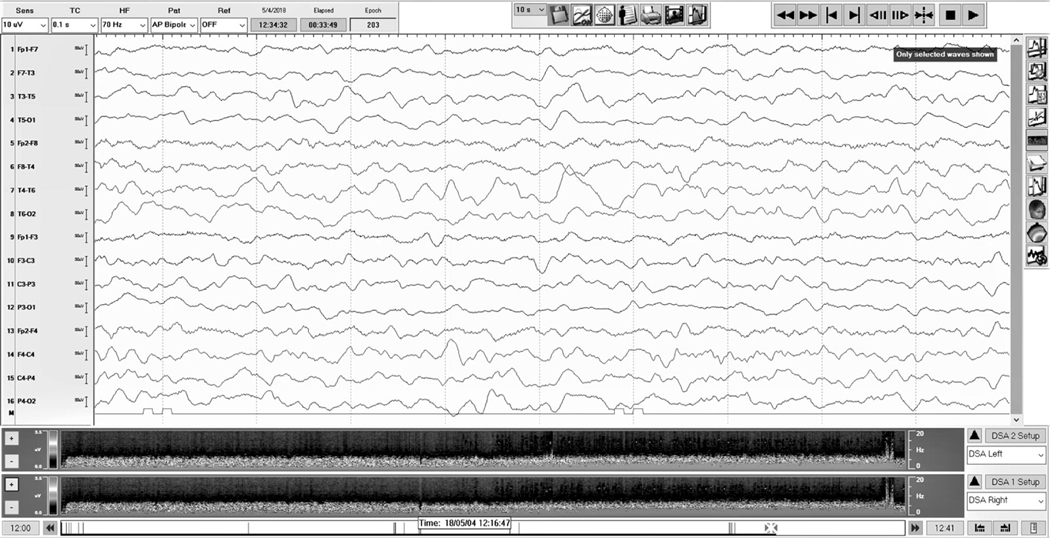
Forty-eight infants (prior to first birthday) underwent EEG recording. Signal processing methods compared voltage between left and right sides using a previously defined pipeline and diagnostic threshold. In this test sample, we compared sensitivity/specificity of the qEEG metric against MRI performed after the first birthday. We also used likelihood ratio testing to determine whether qEEG adds incremental information beyond topographical extent of PWB, another risk marker of brain involvement.
qEEG helped predict SWS risk in the first year of life (p = 0.031), with a sensitivity of 50% and a specificity of 81%. It added about 40% incremental information beyond PWB extent alone (p = 0.042).
qEEG adds information to risk prediction in infants with facial PWB.
qEEG can be used to help determine whether to obtain an MRI in the first year of life. The data collected can assist in developing a predictive model risk calculator that incorporates both PWB extent and qEEG results, which can be validated and then employed in the community.
葡萄酒色斑(PWB)在新生儿中很常见,由于儿科神经科医生的劳动力短缺以及 MRI 对婴儿期 Sturge-Weber 综合征(SWS)脑受累的敏感性低,普通儿科医生、皮肤科医生和眼科医生经常被要求评估 SWS 的风险。因此,我们旨在开发一种定量脑电图(qEEG)方法,以便安全地筛查患有 PWB 的婴儿 SWS 风险,并确定最佳的 MRI 诊断时间。
48 名婴儿(一岁生日前)接受了 EEG 记录。使用先前定义的管道和诊断阈值,信号处理方法比较了左右两侧的电压。在这个测试样本中,我们比较了 qEEG 指标与一岁后进行的 MRI 的敏感性/特异性。我们还使用似然比检验来确定 qEEG 是否在 PWB 的另一个脑受累风险标志物——病变范围之外提供了额外的信息。
qEEG 有助于预测婴儿期第一年的 SWS 风险(p=0.031),其敏感性为 50%,特异性为 81%。它比 PWB 范围 alone 单独增加了约 40%的额外信息(p=0.042)。
qEEG 为面部 PWB 婴儿的风险预测提供了信息。
qEEG 可用于帮助确定是否在婴儿期第一年获得 MRI。收集的数据可以帮助开发一个预测模型风险计算器,该计算器可以将 PWB 范围和 qEEG 结果结合起来,并进行验证,然后在社区中使用。