School of Life Sciences, Northeast Normal University, Changchun, 130024, China.
Bio-Intelligence Co. Ltd, Shenzhen, 518000, China.
BMC Ecol Evol. 2021 Aug 28;21(1):162. doi: 10.1186/s12862-021-01888-5.
Core landbirds undergo adaptive radiation with different ecological niches, but the genomic bases that underlie their ecological diversification remain unclear.
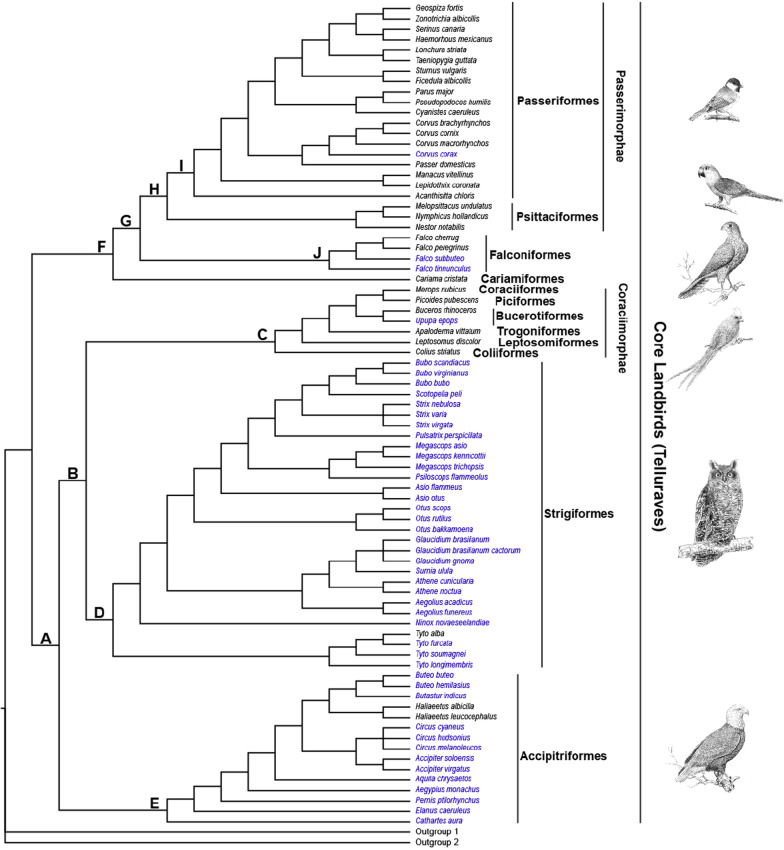
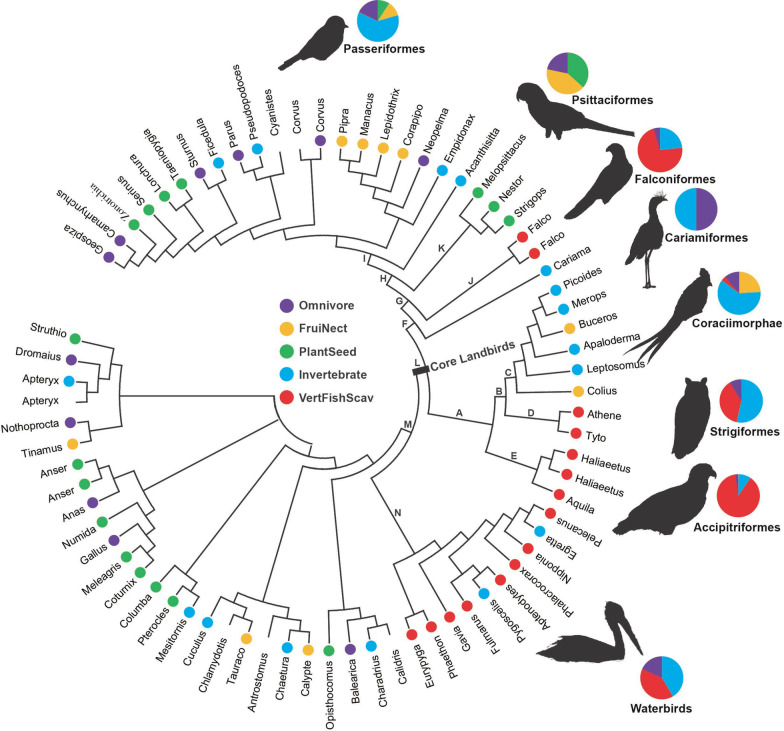
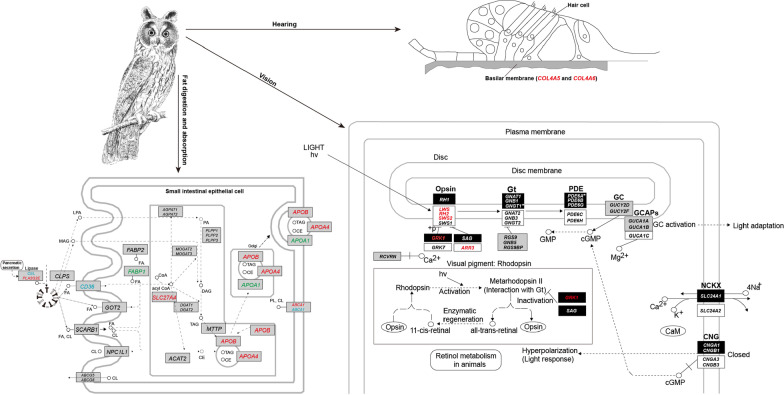
Here we used the genome-wide target enrichment sequencing of the genes related to vision, hearing, language, temperature sensation, beak shape, taste transduction, and carbohydrate, protein and fat digestion and absorption to examine the genomic bases underlying their ecological diversification. Our comparative molecular phyloecological analyses show that different core landbirds present adaptive enhancement in different aspects, and two general patterns emerge. First, all three raptorial birds (Accipitriformes, Strigiformes, and Falconiformes) show a convergent adaptive enhancement for fat digestion and absorption, while non-raptorial birds tend to exhibit a promoted capability for protein and carbohydrate digestion and absorption. Using this as a molecular marker, our results show relatively strong support for the raptorial lifestyle of the common ancestor of core landbirds, consequently suggesting a single origin of raptors, followed by two secondary losses of raptorial lifestyle within core landbirds. In addition to the dietary niche, we find at temporal niche that diurnal birds tend to exhibit an adaptive enhancement in bright-light vision, while nocturnal birds show an increased adaption in dim-light vision, in line with previous findings.
Our molecular phyloecological study reveals the genome-wide adaptive differentiations underlying the ecological diversification of core landbirds.
核心陆鸟经历了不同生态位的适应性辐射,但支持它们生态多样化的基因组基础仍不清楚。
在这里,我们使用了与视觉、听觉、语言、温度感知、喙形、味觉转导以及碳水化合物、蛋白质和脂肪消化吸收相关的基因的全基因组靶向富集测序,来研究支持它们生态多样化的基因组基础。我们的比较分子系统生态分析表明,不同的核心陆鸟在不同方面表现出适应性增强,并且出现了两种一般模式。首先,所有三种猛禽(鹰形目、鸮形目和隼形目)都表现出对脂肪消化和吸收的趋同适应性增强,而非猛禽则倾向于表现出对蛋白质和碳水化合物消化和吸收能力的提高。使用这个作为分子标记,我们的结果相对有力地支持了核心陆鸟共同祖先的猛禽生活方式,因此暗示了猛禽的单一起源,随后在核心陆鸟内部发生了两次猛禽生活方式的次生丧失。除了饮食生态位,我们还发现,在时间生态位上,昼行性鸟类往往在明亮光视觉方面表现出适应性增强,而夜行性鸟类则在暗光视觉方面表现出更强的适应性,这与之前的发现一致。
我们的分子系统生态研究揭示了核心陆鸟生态多样化的全基因组适应性分化。