Grupo de Investigación en Ciencias Animales-GRICA. Facultad de Medicina Veterinaria y Zootecnia, Universidad Cooperativa de Colombia, Bucaramanga, Colombia.
Laboratorio de Investigaciones Fitoquímicas y Farmacológicas de la Universidad de Cartagena - LIFFUC, Universidad de Cartagena, Cartagena, Colombia.
BMC Complement Med Ther. 2021 Aug 28;21(1):216. doi: 10.1186/s12906-021-03386-z.
In recent years, an increase in the occurrence of illnesses caused by two clinically- important arboviruses has been reported: Zika virus (ZIKV) and Chikungunya virus (CHIKV). There is no licensed antiviral treatment for either of the two abovementioned viruses. Bearing in mind that the antiviral effect of indole alkaloids has been reported for other arboviral models, the present study proposed to evaluate the antiviral in vitro and in silico effects of four indole alkaloids on infections by these two viruses in different cell lines.
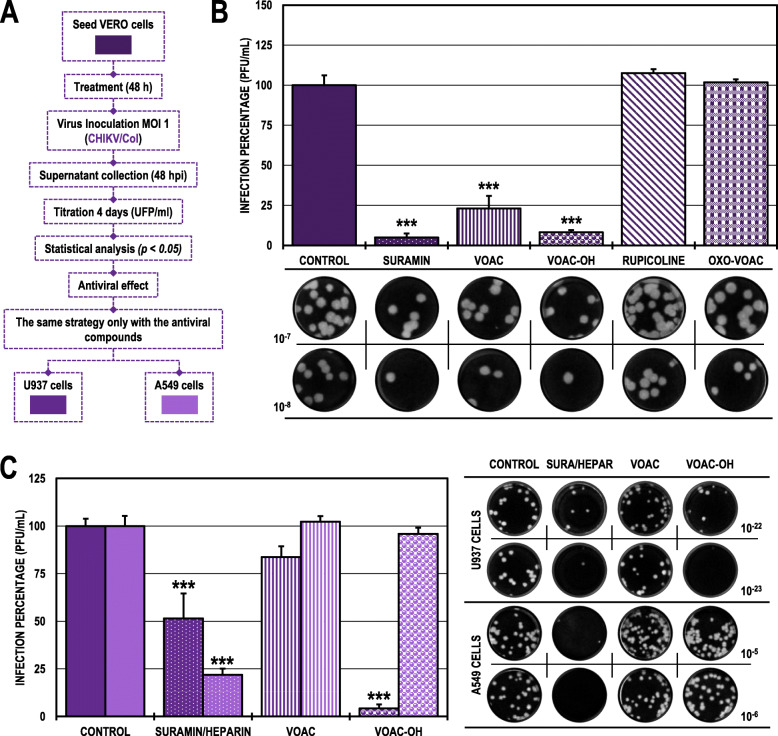
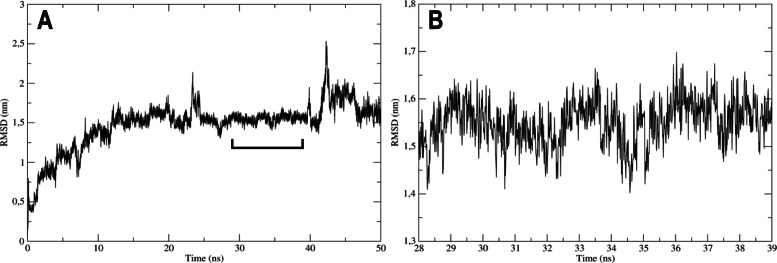
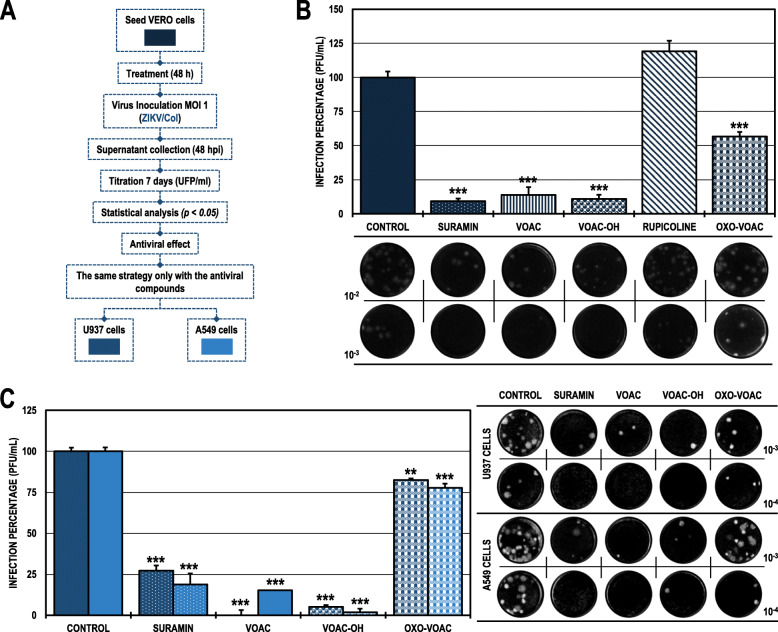
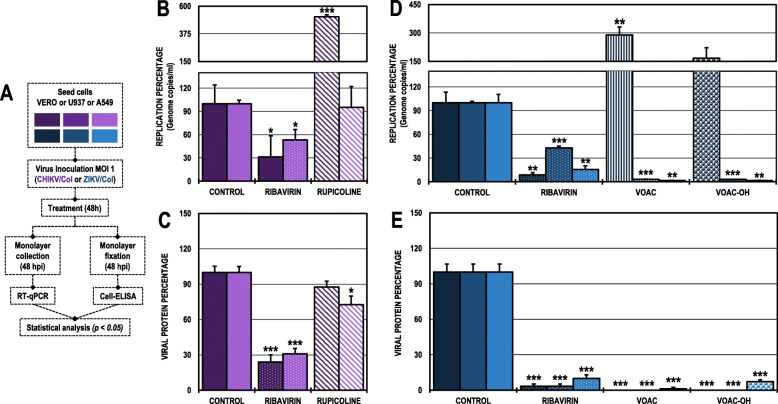
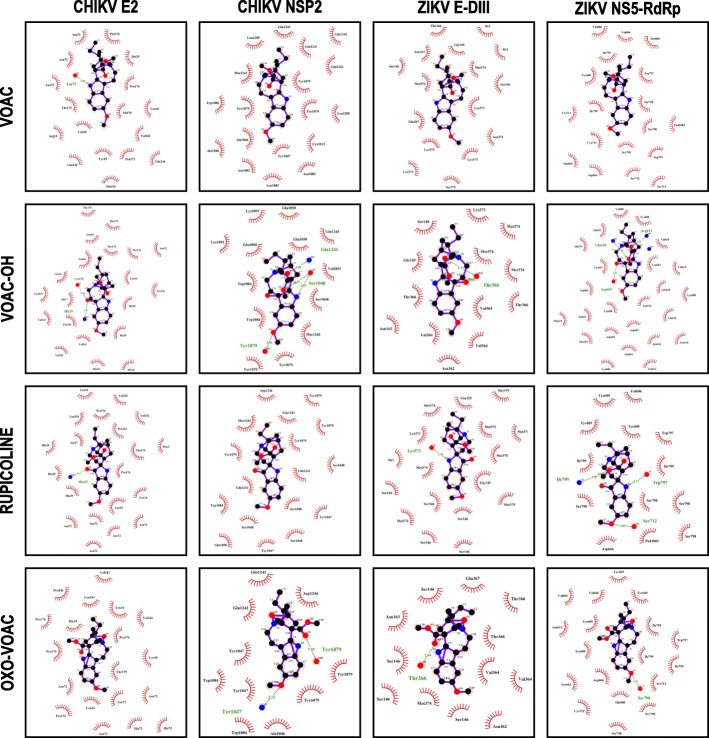
The antiviral effects of voacangine (VOAC), voacangine-7-hydroxyindolenine (VOAC-OH), rupicoline and 3-oxo voacangine (OXO-VOAC) were evaluated in Vero, U937 and A549 cells using different experimental strategies (Pre, Trans, Post and combined treatment). Viral infection was quantified by different methodologies, including infectious viral particles by plating, viral genome by RT-qPCR, and viral protein by cell ELISA. Moreover, molecular docking was used to evaluate the possible interactions between structural and nonstructural viral proteins and the compounds. The results obtained from the antiviral strategies for each experimental condition were compared in all cases with the untreated controls. Statistically significant differences were identified using a parametric Student's t-test. In all cases, p values below 0.05 (p < 0.05) were considered statistically significant.
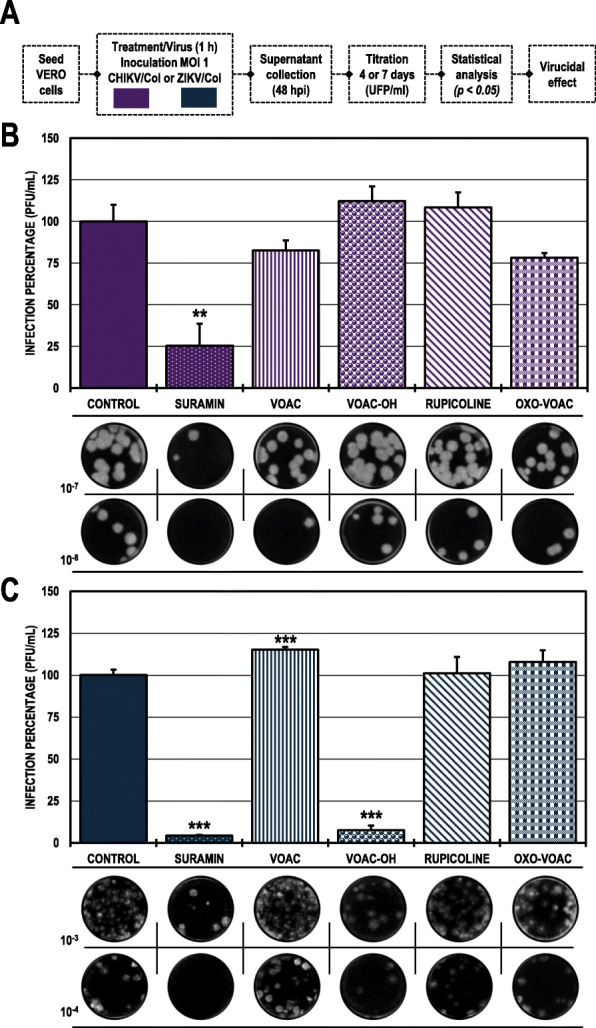
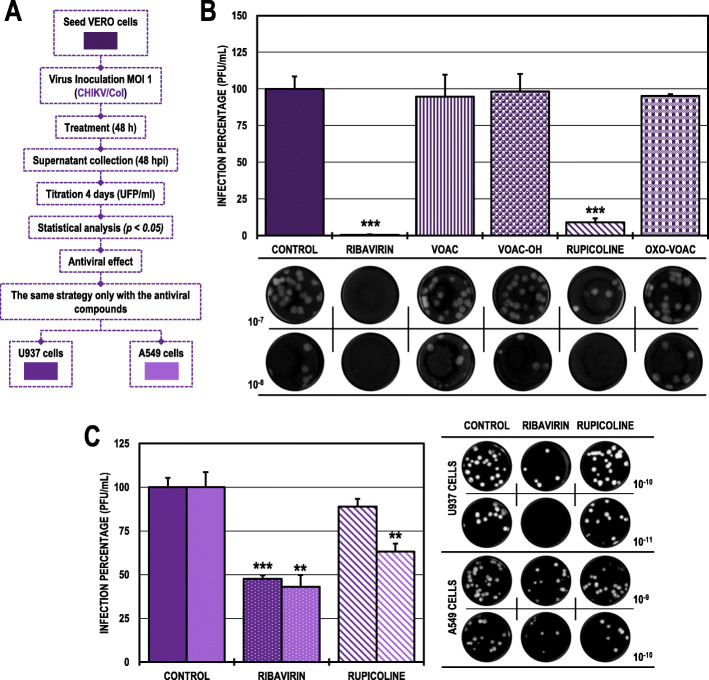
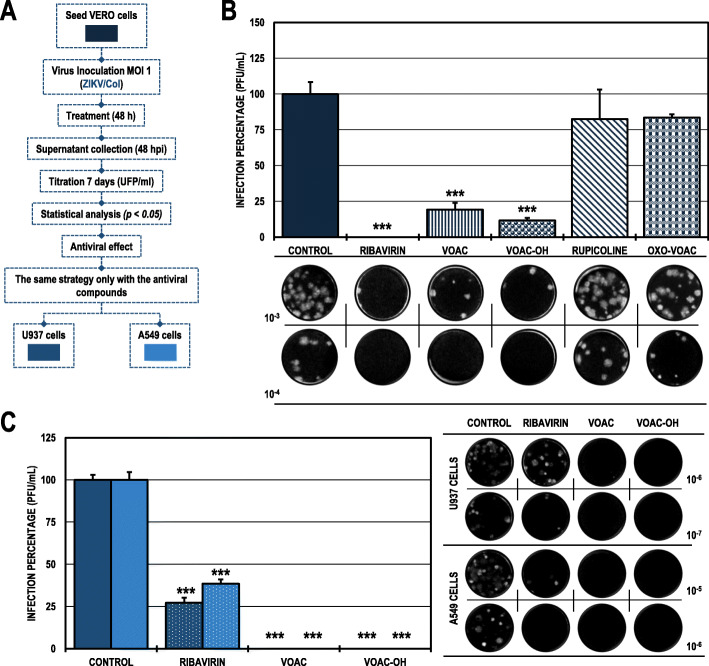
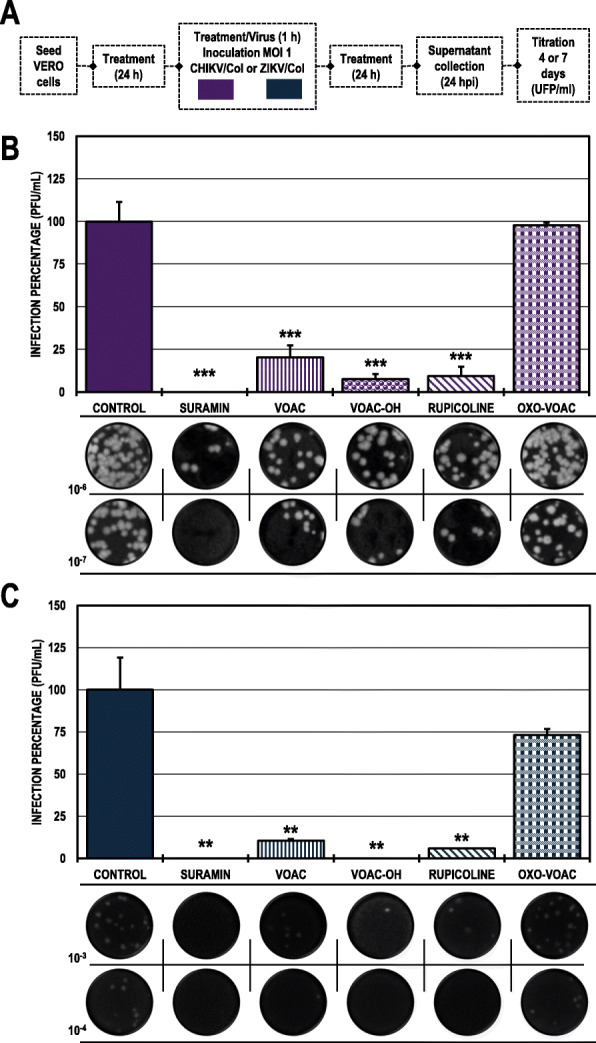
In the pre-treatment strategy in Vero cells, VOAC and VOAC-OH inhibited both viral models and OXO-VOAC inhibited only ZIKV; in U937 cells infected with CHIKV/Col, only VOAC-OH inhibited infection, but none of the compounds had activity in A549 cells; in U937 cells and A549 cells infected with ZIKV/Col, the three compounds that were effective in Vero cells also had antiviral activity. In the trans-treatment strategy, only VOAC-OH was virucidal against ZIKV/Col. In the post-treatment strategy, only rupicoline was effective in the CHIKV/Col model in Vero and A549 cells, whereas VOAC and VOAC-OH inhibited ZIKV infection in all three cell lines. In the combined strategy, VOAC, VOAC-OH and rupicoline inhibited CHIKV/Col and ZIKV/Col, but only rupicoline improved the antiviral effect of ZIKV/Col-infected cultures with respect to the individual strategies. Molecular docking showed that all the compounds had favorable binding energies with the structural proteins E2 and NSP2 (CHIKV) and E and NS5 (ZIKV).
The present study demonstrates that indole alkaloids are promising antiviral drugs in the process of ZIKV and CHIKV infection; however, the mechanisms of action evaluated in this study would indicate that the effect is different in each viral model and, in turn, dependent on the cell line.
近年来,两种具有临床重要性的虫媒病毒(寨卡病毒[ZIKV]和基孔肯雅热病毒[CHIKV])引起的疾病发病率有所上升。对于上述两种病毒,目前尚无获得许可的抗病毒治疗方法。鉴于吲哚生物碱对其他虫媒病毒模型具有抗病毒作用,本研究拟评估四种吲哚生物碱在不同细胞系中对这两种病毒感染的体外和计算机模拟抗病毒作用。
在不同的实验策略(预、转、后和联合治疗)下,用 Vero、U937 和 A549 细胞评估了瓦卡宁(VOAC)、瓦卡宁-7-羟基吲哚林(VOAC-OH)、鲁皮科林和 3-氧瓦卡宁(OXO-VOAC)对这两种病毒的抗病毒作用。通过不同的方法学来定量病毒感染,包括通过平板测定感染性病毒颗粒、通过 RT-qPCR 测定病毒基因组和通过细胞 ELISA 测定病毒蛋白。此外,还进行了分子对接,以评估结构和非结构病毒蛋白与化合物之间的可能相互作用。在所有情况下,将每种实验条件下的抗病毒策略的结果与未经处理的对照进行比较。使用参数学生 t 检验确定统计学上的显著差异。在所有情况下,p 值低于 0.05(p<0.05)被认为具有统计学意义。
在 Vero 细胞的预处理策略中,VOAC 和 VOAC-OH 抑制了两种病毒模型,而 OXO-VOAC 仅抑制 ZIKV;在感染 CHIKV/Col 的 U937 细胞中,只有 VOAC-OH 抑制了感染,但在 A549 细胞中没有任何化合物具有活性;在感染 ZIKV/Col 的 U937 细胞和 A549 细胞中,在 Vero 细胞中有效的三种化合物也具有抗病毒活性。在转处理策略中,只有 VOAC-OH 对 ZIKV/Col 具有杀病毒活性。在后续处理策略中,只有鲁皮科林在 Vero 和 A549 细胞中的 CHIKV/Col 模型中有效,而 VOAC 和 VOAC-OH 抑制了所有三种细胞系中的 ZIKV 感染。在联合处理策略中,VOAC、VOAC-OH 和鲁皮科林抑制了 CHIKV/Col 和 ZIKV/Col,但只有鲁皮科林提高了 ZIKV/Col 感染培养物的抗病毒效果,优于单独处理。分子对接表明,所有化合物与结构蛋白 E2 和 NSP2(CHIKV)和 E 和 NS5(ZIKV)都具有有利的结合能。
本研究表明,吲哚生物碱是 ZIKV 和 CHIKV 感染过程中有前途的抗病毒药物;然而,本研究评估的作用机制表明,每种病毒模型的作用不同,并且取决于细胞系。