Government Institute of Medical Sciences (GIMS), Greater Noida, India.
Siddha Clinical Research Unit, Safdarjung Hospital, New Delhi, India.
Trials. 2021 Aug 28;22(1):570. doi: 10.1186/s13063-021-05478-0.
Globally, the ongoing pursuit in exploring an effective drug to combat severe acute respiratory syndrome coronavirus-2 (SARS-CoV-2) virus has not met with significant success to date. Indian traditional medicines, especially polyherbal formulations like Nilavembu Kudineer (NVK) and Kaba Sura Kudineer (KSK) of the Siddha system of medicine, have been used as public health interventions for controlling viral epidemics like dengue and Chikungunya. These traditional therapies have been found safe, effective, and widely accepted. The current study evaluates the comparative efficacy of NVK and KSK as opposed to the placebo, in the management of mild to moderate COVID-19 disease.
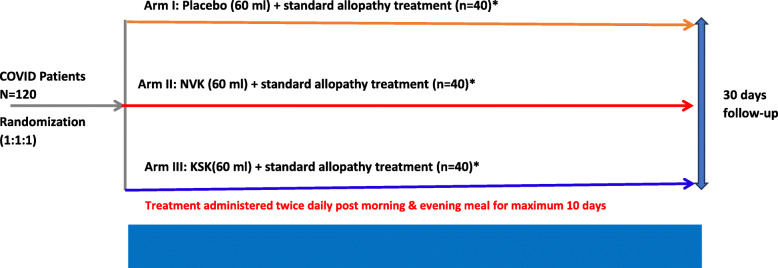
The study was a double-blind, placebo-controlled comparative clinical trial, with the primary objective of determining the efficacy of KSK and NVK. Patients (n=125) diagnosed with mild to moderate COVID-19 symptoms were enrolled in the study over a period of 4 months (Aug 2020-Dec 2020). Participants were randomized into 3 arms; placebo-decaffeinated tea in Arm I, NVK in Arm II, and KSK in Arm III. Each arm received 60 ml of the respective treatment twice a day, post morning and evening meals, along with standard allopathy treatment for a maximum of 10 days. The main outcome measures of the study were the reduction in SARS-CoV-2 viral load, hospital stay, and time taken by the patients to become asymptomatic from symptomatic. Efficacy assessments included clinical symptoms (fever, cough, and breathlessness) each day and real-time reverse transcription-polymerase chain reaction (RT-PCR), liver function test (LFT), renal function test (RFT), and electrolytes and electrocardiogram (ECG) at baseline (day 0) and days 3, 6, and 10. Post-treatment, participants were followed up for 30 days via phone for adverse effects if any. Effects of drugs on inflammatory markers (IL6) at the end of treatment were also recorded. Adverse events (AE) were monitored throughout the study.
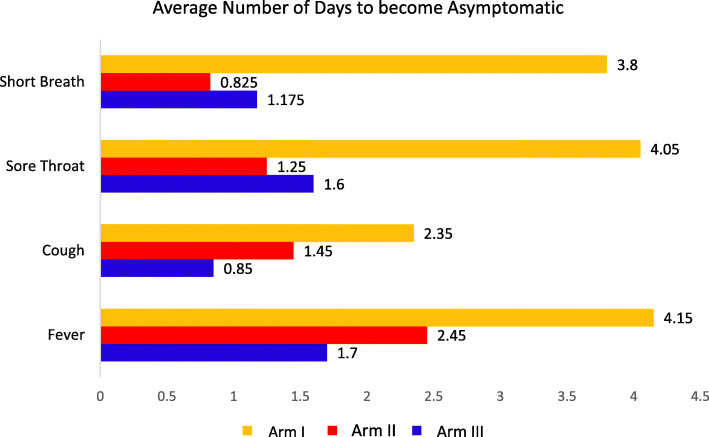
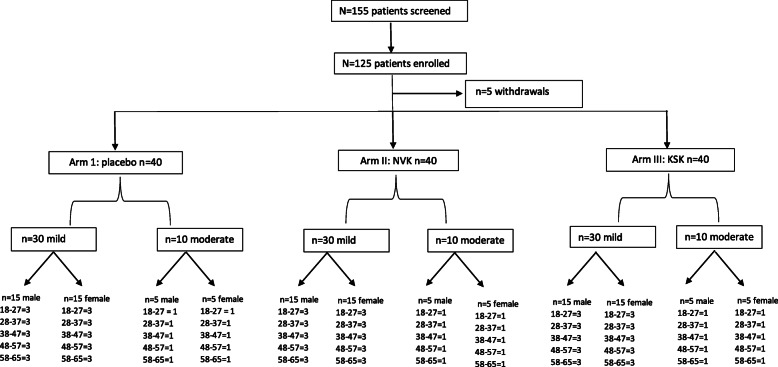
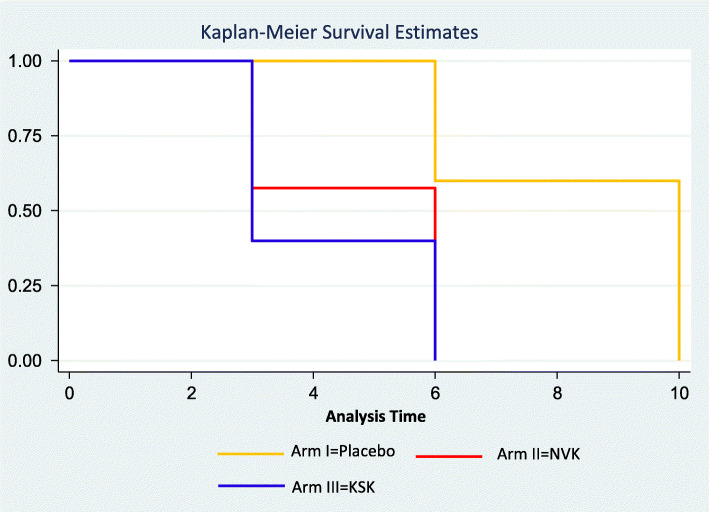
The results revealed that when compared to patients in the placebo arm, those in NVK and KSK arms showed a statistically significant reduction in hospital stay time, reduction in viral load of SARS-CoV-2, and the time taken to become symptomatic from asymptomatic. Out of 125 COVID-19 patients recruited, 120 completed the study; two from the placebo group developed severe symptoms and were shifted to the intensive care unit (ICU) and three patients from Arms II and III withdrew from the study. The mean age of females (n=60) and males (n=60) enrolled was between 40.2 and 44.3 years, respectively. Results were more promising for all the patients in NVK and KSK arms as all enrolled participants (100%) under this group got discharged by day 6 as compared to only 42.5% (n=17) from the placebo group on that day. The hospital stay time for patients in Arm I was significantly longer (mean [SD]=8.4 [2.0] days) as compared to the Arms II and III (mean [SD]=4.7 [1.5] and 4.2 [1.5] days, respectively (Kruskal-Wallis test, P=0.0001). Patients in the three groups took a significantly different number of days to become asymptomatic. While Arm II and III patients took mean of 2.5 and 1.7 days, respectively, Arm I, patients took a mean of 4.2 days (Kruskal-Wallis test, P=0.0001). In all, two adverse events were recorded, one for vomiting and one for diarrhea lasting a day in Arm I and Arm II, respectively. The mean value of interleukin-6 (IL6) was significantly different in comparison to the placebo-decaffeinated tea arm (NVK=2.6 and KSK=2.2, placebo=4.0, P=0.02). The other blood biochemical parameters like C-reactive protein (CRP), lactate dehydrogenase (LDH), ferritin, and D-dimer that were analyzed at the baseline and at the time of discharge from the hospital, were not significantly different in the three arms.
NVK and KSK arms showed a statistically significant reduction in hospital stay time, reduction in viral load of SARS-CoV-2, and time taken for patients to become asymptomatic from symptomatic, when compared to the placebo (decaffeinated tea). The primary outcome measures of the KSK arm were significantly better than those in the NVK arm.
在全球范围内,探索有效药物来对抗严重急性呼吸综合征冠状病毒 2 (SARS-CoV-2)病毒的持续努力迄今尚未取得重大成功。印度传统药物,特别是 Siddha 医学体系的多种草药制剂,如 Nilavembu Kudineer(NVK)和 Kaba Sura Kudineer(KSK),已被用作控制登革热和基孔肯雅热等病毒流行的公共卫生干预措施。这些传统疗法已被证明是安全、有效且广泛接受的。本研究评估了 NVK 和 KSK 与安慰剂相比在治疗轻度至中度 COVID-19 疾病方面的比较疗效。
本研究是一项双盲、安慰剂对照的临床对照试验,主要目的是确定 KSK 和 NVK 的疗效。在 4 个月的时间内(2020 年 8 月至 2020 年 12 月),招募了 125 名被诊断为轻度至中度 COVID-19 症状的患者参加研究。参与者被随机分为 3 组;第 I 组为安慰剂去咖啡因茶,第 II 组为 NVK,第 III 组为 KSK。每组每天接受 60 毫升各自的治疗,早晚饭后服用,同时接受最大 10 天的标准西医疗法。本研究的主要终点是 SARS-CoV-2 病毒载量的降低、住院时间和患者从有症状到无症状的时间。疗效评估包括每天的临床症状(发热、咳嗽和呼吸急促)以及实时逆转录-聚合酶链反应(RT-PCR)、肝功能检查(LFT)、肾功能检查(RFT)和电解质及心电图(ECG),在基线(第 0 天)和第 3、6 和 10 天进行。治疗结束后,通过电话对参与者进行 30 天的随访,以了解任何不良反应。还记录了药物对炎症标志物(IL6)的影响。在整个研究过程中监测不良事件(AE)。
结果表明,与安慰剂组相比,NVK 和 KSK 组的住院时间、SARS-CoV-2 病毒载量的降低以及从有症状到无症状的时间均有统计学意义。在招募的 125 名 COVID-19 患者中,有 120 名完成了研究;安慰剂组的两名患者出现严重症状并转入重症监护病房(ICU),第三组的三名患者退出了研究。女性(n=60)和男性(n=60)的平均年龄分别在 40.2 岁至 44.3 岁之间。NVK 和 KSK 组的所有患者的结果都更加乐观,因为所有入组的患者(100%)在第 6 天就出院了,而安慰剂组只有 42.5%(n=17)在那天出院。第 I 组的住院时间明显较长(平均值[SD]=8.4[2.0]天),而第 II 组和第 III 组的住院时间分别为 4.7[1.5]天和 4.2[1.5]天(Kruskal-Wallis 检验,P=0.0001)。三组患者从有症状到无症状的时间明显不同。第 II 组和第 III 组患者的平均时间分别为 2.5 天和 1.7 天,而第 I 组患者的平均时间为 4.2 天(Kruskal-Wallis 检验,P=0.0001)。总共有 2 例不良事件记录,第 I 组和第 II 组分别有 1 例呕吐和 1 例腹泻,持续 1 天。与安慰剂去咖啡因茶组(NVK=2.6 和 KSK=2.2,安慰剂=4.0,P=0.02)相比,白细胞介素-6(IL6)的平均数值明显不同。在基线和出院时分析的其他血液生化参数,如 C 反应蛋白(CRP)、乳酸脱氢酶(LDH)、铁蛋白和 D-二聚体,在三组之间没有显著差异。
与安慰剂(去咖啡因茶)相比,NVK 和 KSK 组在住院时间、SARS-CoV-2 病毒载量降低以及患者从有症状到无症状的时间方面均有统计学意义上的显著降低。KSK 组的主要终点指标明显优于 NVK 组。