Amaya Yusaku, Abe Tetsuya, Kanbara Kenji, Shizuma Hisaharu, Akiyama Yasushi, Fukunaga Mikihiko
Department of Psychosomatic and General Internal Medicine, Kansai Medical University, 2-5-1 Shinmachi, Hirakata, Osaka, 573-1010, Japan.
Faculty of Rehabilitation, Shijonawate Gakuen University, Osaka, Japan.
BMC Sports Sci Med Rehabil. 2021 Aug 28;13(1):99. doi: 10.1186/s13102-021-00332-x.
Interoception refers to the body's physiological responses that occur in response to emotions. This phenomenon influences decision-making, an important cognitive ability that affects the maintenance of an exercise routine. However, it is controversial whether interoception is a reliable measure of an individual's traits or their response to emotion. Given this evidence, we hypothesized that performing an exercise with positive feelings could improve interoception and that the rational decision-making capabilities acquired by improved interoception would, in turn, help in maintaining an exercise routine. Persistent aerobic exercise is essential for improving cognitive and musculoskeletal function in the long term. Therefore, we aimed to investigate changes in interoception during moderate-intensity aerobic exercise at a level that might potentially improve cognitive function.
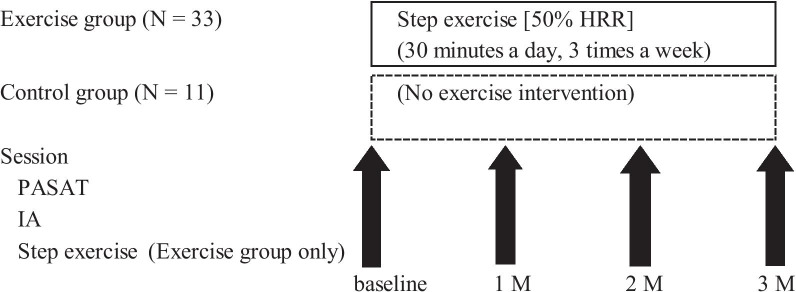
We devided 48 healthy university students into an exercise group (n = 37) and a control group (n = 11). The control group did not perform any exercises, while the exercise group performed bench step exercises at an intensity of 50% of heart rate reserve for 30 min a day, three times a week, for three months. We assessed their cognitive function by measuring their auditory information/working memory processing speed using a paced auditory serial addition task (PASAT) and evaluated their interoceptive accuracy (IA) using a heartbeat tracking task at baseline and 1, 2, and 3 months after the start of the exercise intervention.
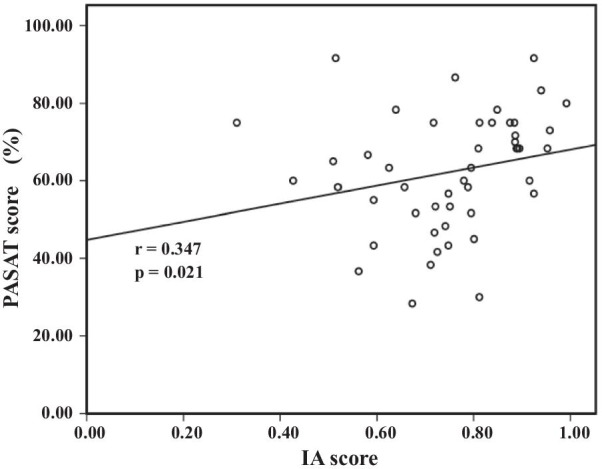
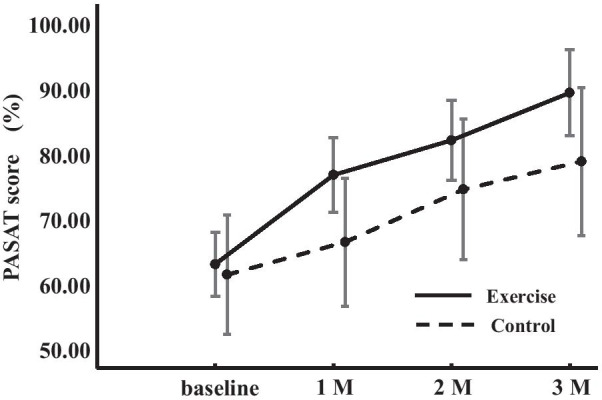
There was a significant positive correlation between IA and PASAT scores at baseline. However, exercise did not lead to a significant increase in PASAT scores of the exercise group as compared with the control group. IA scores increased at 2 and 3 months after the start of exercise only in the exercise group.
This preliminary study showed an improvement in interoception after persistent moderate-intensity aerobic exercise. We believe that exercise-induced improvement of interoception may facilitate exercise maintenance through improved cognitive function. Statistical analysis did not explain the non-uniformity of sample sizes, therefore, future studies should have larger sample sizes with equal subjects in each group to allow for better comparability and generalizability.
UMIN, UMIN000042891. 04/01/2021, retrospectively registered.
内感受是指身体因情绪产生的生理反应。这种现象会影响决策,而决策是一种重要的认知能力,会影响日常锻炼习惯的维持。然而,内感受是否是衡量个体特质或其对情绪反应的可靠指标仍存在争议。基于此证据,我们假设进行带有积极感受的锻炼可以改善内感受,而通过改善内感受获得的理性决策能力反过来又有助于维持日常锻炼习惯。长期坚持有氧运动对于改善认知和肌肉骨骼功能至关重要。因此,我们旨在研究中等强度有氧运动过程中内感受的变化,该强度可能会潜在改善认知功能。
我们将48名健康大学生分为运动组(n = 37)和对照组(n = 11)。对照组不进行任何运动,而运动组以心率储备的50%强度进行台阶练习,每天30分钟,每周三次,持续三个月。我们通过使用定速听觉连续加法任务(PASAT)测量他们的听觉信息/工作记忆处理速度来评估其认知功能,并在运动干预开始时、第1、2和3个月使用心跳追踪任务评估他们的内感受准确性(IA)。
基线时IA与PASAT分数之间存在显著正相关。然而,与对照组相比,运动并未使运动组的PASAT分数显著增加。仅运动组在运动开始后2个月和3个月时IA分数增加。
这项初步研究表明,持续进行中等强度有氧运动后内感受得到改善。我们认为,运动引起的内感受改善可能通过改善认知功能促进运动维持。统计分析未解释样本量的不均衡性,因此,未来研究应具有更大的样本量,且每组受试者数量相等,以实现更好的可比性和普遍性。
UMIN,UMIN000042891。2021年1月4日,追溯注册。