Weippert Matthias, Rickler Michel, Kluck Steffen, Behrens Kristin, Bastian Manuela, Mau-Moeller Anett, Bruhn Sven, Lischke Alexander
Institute of Sport Science, Faculty of Philosophy, University of Rostock, Rostock, Germany.
Institute of Philosophy, Faculty of Philosophy, University of Rostock, Rostock, Germany.
Front Behav Neurosci. 2018 Nov 23;12:268. doi: 10.3389/fnbeh.2018.00268. eCollection 2018.
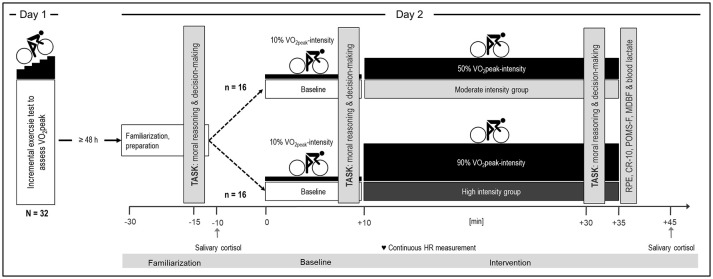
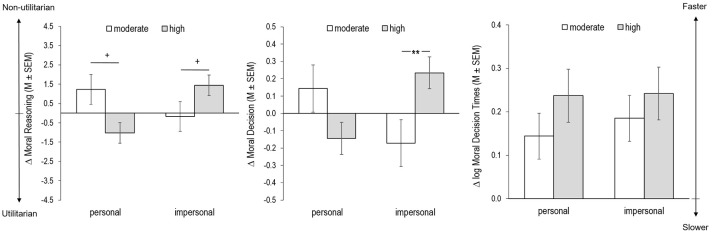
Despite the prevalence of physical exertion and fatigue during military, firefighting and disaster medicine operations, sports or even daily life, their acute effects on moral reasoning and moral decision-making have never been systematically investigated. To test the effects of physical exertion on moral reasoning and moral decision-making, we administered a moral dilemma task to 32 male participants during a moderate or high intensity cycling intervention. Participants in the high intensity cycling group tended to show more non-utilitarian reasoning and more non-utilitarian decision-making on impersonal but not on personal dilemmas than participants in the moderate intensity cycling group. Exercise-induced exertion and fatigue, thus, shifted moral reasoning and moral decision-making in a non-utilitarian rather than utilitarian direction, presumably due to an exercise-induced limitation of prefrontally mediated executive resources that are more relevant for utilitarian than non-utilitarian reasoning and decision-making.
尽管在军事、消防和灾难医学行动、体育运动甚至日常生活中,身体劳累和疲劳都很常见,但它们对道德推理和道德决策的急性影响从未得到系统研究。为了测试身体劳累对道德推理和道德决策的影响,我们在中等强度或高强度自行车运动干预期间,对32名男性参与者进行了道德困境任务测试。与中等强度自行车运动组的参与者相比,高强度自行车运动组的参与者在面对非个人困境而非个人困境时,往往表现出更多的非功利性推理和更多的非功利性决策。因此,运动引起的劳累和疲劳使道德推理和道德决策朝着非功利性而非功利性的方向转变,这可能是由于运动导致前额叶介导的执行资源受到限制,而这些资源与功利性推理和决策相比,与非功利性推理和决策更为相关。