Sodavarapu Praveen, Sudesh Pebam, Gopinathan Nirmal Raj, Jayashree Muralidharan, Kumar Praveen, Rangasamy Karthick
Department of Orthopaedics, Post Graduate Institute of Medical Education and Research, Sector 12, Chandigarh, 160012 India.
Department of Pediatrics, Post Graduate Institute of Medical Education and Research, Sector 12, Chandigarh, 160012 India.
Indian J Orthop. 2021 Aug 21;56(2):345-352. doi: 10.1007/s43465-021-00488-1. eCollection 2022 Feb.
Pediatric bone and joint infections account for one of the major causes of childhood morbidity. Disseminated sepsis being a systemic disorder with multisystem involvement, overshadows the timely recognition of bone and joint infections. Hence, we did this cross sectional study to evaluate the prevalence of septic arthritis and osteomyelitis in disseminated sepsis in children, the organisms implicated, and their antibiotic sensitivities.
We prospectively collected data from 1st July 2016 to 31st September 2017 of children aged less than 12 years with disseminated sepsis, i.e., patients with fever and two or more sites of focal infection of anatomically non-contiguous tissues.
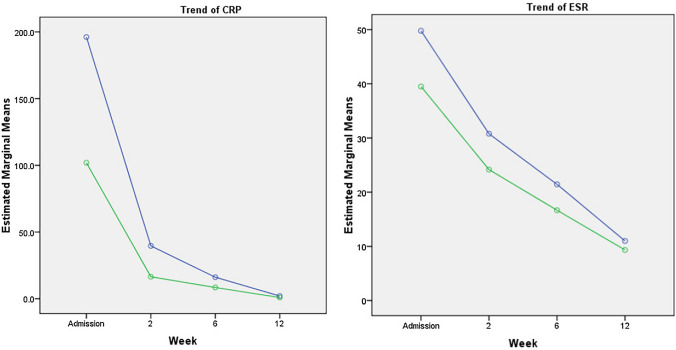
Fifty-four patients of disseminated disease were included, of which 25 patients (46.3%) had osteoarticular infections. Septic arthritis was seen in 17 patients, and osteomyelitis was seen in 12 patients. The most common joint was hip (41.6%), and the most common bone involved was femur (53.8%). Blood culture showed MRSA in 28% and MSSA in 20%. Joint and bone aspirates showed S. aureus in 56% with 28% of MRSA and MSSA each. All organisms were found sensitive to vancomycin and teicoplanin. The mean values of CRP, duration of stay and duration of intravenous antibiotic was higher in MRSA infected patients compared to MSSA patients.
is the most prevalent organism in musculoskeletal infection in disseminated sepsis children, with vancomycin sensitivity of 100% and methicillin sensitivity of 46.2% only. Cases of osteoarticular involvement with MRSA were higher compared to MSSA among the cases of disseminated disease. The prevalence of osteoarticular involvement is high in disseminated sepsis in children and increased clinical suspicion for such must be maintained.
儿童骨与关节感染是儿童发病的主要原因之一。播散性脓毒症是一种累及多系统的全身性疾病,会影响对骨与关节感染的及时识别。因此,我们开展了这项横断面研究,以评估儿童播散性脓毒症中化脓性关节炎和骨髓炎的患病率、相关病原体及其抗生素敏感性。
我们前瞻性收集了2016年7月1日至2017年9月31日期间年龄小于12岁的播散性脓毒症儿童的数据,即发热且有两个或更多解剖学上不连续组织部位局部感染的患者。
纳入了54例播散性疾病患者,其中25例(46.3%)患有骨关节炎感染。17例患者出现化脓性关节炎,12例患者出现骨髓炎。最常见的关节是髋关节(41.6%),最常受累的骨骼是股骨(53.8%)。血培养显示28%为耐甲氧西林金黄色葡萄球菌(MRSA),20%为甲氧西林敏感金黄色葡萄球菌(MSSA)。关节和骨穿刺液显示56%为金黄色葡萄球菌,其中MRSA和MSSA各占28%。所有病原体对万古霉素和替考拉宁敏感。与MSSA感染患者相比,MRSA感染患者的C反应蛋白平均值、住院时间和静脉使用抗生素时间更高。
在播散性脓毒症儿童的肌肉骨骼感染中,MRSA是最常见的病原体,万古霉素敏感性为100%,甲氧西林敏感性仅为46.2%。在播散性疾病病例中,MRSA导致的骨关节炎受累病例比MSSA更高。儿童播散性脓毒症中骨关节炎受累的患病率较高,必须保持对此类情况的临床高度怀疑。