Children's Hospital of Soochow University, Department of Orthopaedics, Suzhou, Jiangsu Province, China.
Children's Hospital of Soochow University, Pediatrics Research Institute, Suzhou, Jiangsu Province, China.
J Pediatr (Rio J). 2024 Mar-Apr;100(2):156-162. doi: 10.1016/j.jped.2023.09.003. Epub 2023 Oct 12.
Studies focusing on bone and joint infections (BJIs) in young infants are rare. Some cases of BJI are accompanied by sepsis. This study aimed to identify the clinical and bacteriological features of sepsis in neonates and young infants with BJIs.
Neonates and infants younger than 3 months diagnosed with BJI in the present institution from 2014 to 2021 were retrospectively reviewed. Patient characteristics, clinical data, and outcomes were documented and compared between those with and without sepsis.
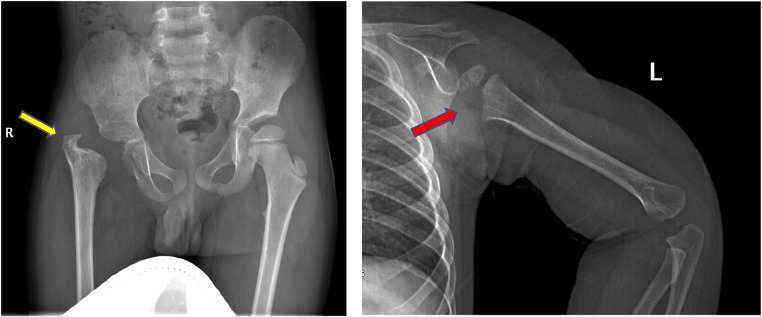
Twenty-five patients with a mean age of 34.8 days were included. Nine BJI cases had concomitant sepsis (group A), and 16 had BJI without sepsis (group B). Within group A, staphylococcus aureus was the major pathogenic germ (5 cases, of which 4 were of the methicillin-resistant staphylococcus aureus (MRSA) type). There was no statistical difference in male-to-female ratio, age, history of hospitalization, anemia, birth asphyxia, peripheral leukocyte counts, C-reactive protein on admission, and sequelae between groups. Univariate analyses indicated a significant difference in the incidence of septic arthritis (SA) combined with osteomyelitis (OM) (88.9% vs 37.5%), congenital deformities (44.4% vs 0%), and mean duration of symptoms (2.83 days vs 9.21 days) in comparisons between groups A and B.
Staphylococcus aureus is the main pathogenic bacteria in BJI cases complicated with sepsis in neonates and young infants. Among infants younger than 3 months diagnosed with BJI, those with concurrent SA and OM, MRSA infection, or congenital deformities are more likely to develop sepsis.
针对婴幼儿骨与关节感染(BJI)的研究较为少见。部分 BJI 合并脓毒症。本研究旨在明确新生儿和<3 个月龄婴儿 BJI 合并脓毒症的临床及细菌学特征。
回顾性分析 2014 年至 2021 年本机构诊断为 BJI 的新生儿和<3 个月龄婴儿,记录患者特征、临床资料及结局,并比较脓毒症组和非脓毒症组的差异。
共纳入 25 例患儿,平均年龄 34.8 天。9 例 BJI 合并脓毒症(A 组),16 例 BJI 无脓毒症(B 组)。A 组中金黄色葡萄球菌是主要致病菌(5 例,其中 4 例为耐甲氧西林金黄色葡萄球菌(MRSA))。两组间男女性别比、年龄、住院史、贫血、出生窒息、外周白细胞计数、入院时 C 反应蛋白、后遗症差异均无统计学意义。单因素分析显示 A 组与 B 组间合并化脓性关节炎(SA)合并骨髓炎(OM)(88.9% vs. 37.5%)、先天畸形(44.4% vs. 0%)、症状持续时间(2.83 天 vs. 9.21 天)的差异有统计学意义。
金黄色葡萄球菌是新生儿和<3 个月龄婴儿 BJI 合并脓毒症的主要致病菌。对于诊断为 BJI 的<3 个月龄婴儿,如合并 SA 和 OM、MRSA 感染或先天畸形,更易发生脓毒症。