Ramírez-Correa Patricio E, Rondán-Cataluña F Javier, Arenas-Gaitán Jorge, Grandón Elizabeth E, Alfaro-Pérez Jorge L, Ramírez-Santana Muriel
School of Engineering, Catholic University of the North, Coquimbo, Chile.
Department of Business Administration and Marketing, University of Seville, Seville, Spain.
Front Psychol. 2021 Aug 11;12:705715. doi: 10.3389/fpsyg.2021.705715. eCollection 2021.
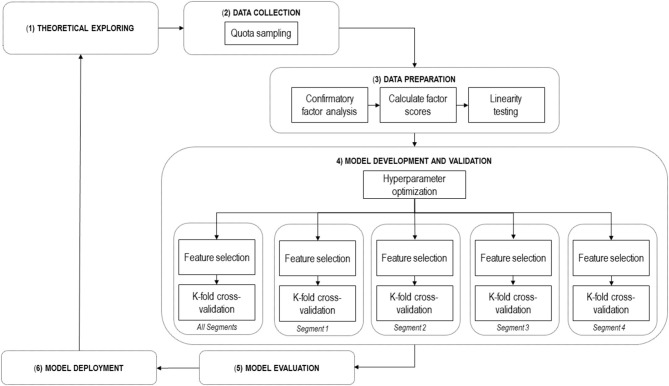
This study analyzes the most important predictors of acceptance of social network sites in a sample of Chilean elder people (over 60). We employ a novelty procedure to explore this phenomenon. This procedure performs apriori segmentation based on gender and generation. It then applies the deep learning technique to identify the predictors (performance expectancy, effort expectancy, altruism, telepresence, social identity, facilitating conditions, hedonic motivation, perceived physical condition, social norms, habit, and trust) by segments. The predictor variables were taken from the literature on the use of social network sites, and an empirical study was carried out by quota sampling with a sample size of 395 older people. The results show different predictors of social network sites considering all the samples, baby boomer (born between 1947 and 1966) males and females, silent (born between 1927 and 1946) males and females. The high heterogeneity among older people is confirmed; this means that dealing with older adults as a uniform set of users of social network sites is a mistake. This study demonstrates that the four segments behave differently, and many diverse variables influence the acceptance of social network sites.
本研究分析了智利老年人群体(60岁以上)中接受社交网站的最重要预测因素。我们采用了一种新颖的程序来探究这一现象。该程序基于性别和代际进行先验分割。然后应用深度学习技术按细分群体识别预测因素(绩效期望、努力期望、利他主义、临场感、社会认同、便利条件、享乐动机、感知身体状况、社会规范、习惯和信任)。预测变量取自关于社交网站使用的文献,并通过配额抽样对395名老年人进行了实证研究。结果显示,考虑所有样本、婴儿潮一代(出生于1947年至1966年)的男性和女性、沉默一代(出生于1927年至1946年)的男性和女性时,社交网站的预测因素各不相同。老年人之间的高度异质性得到了证实;这意味着将老年人视为社交网站的统一用户群体是错误的。本研究表明,这四个细分群体的行为方式不同,许多不同的变量会影响社交网站的接受度。