Morozov Dmitry, Mironov Vladimir, Moryachkov Roman V, Shchugoreva Irina A, Artyushenko Polina V, Zamay Galina S, Kolovskaya Olga S, Zamay Tatiana N, Krat Alexey V, Molodenskiy Dmitry S, Zabluda Vladimir N, Veprintsev Dmitry V, Sokolov Alexey E, Zukov Ruslan A, Berezovski Maxim V, Tomilin Felix N, Fedorov Dmitri G, Alexeev Yuri, Kichkailo Anna S
Nanoscience Center and Department of Chemistry, University of Jyväskylä, P.O. Box 35, 40014 Jyväskylä, Finland.
Department of Chemistry, Lomonosov Moscow State University, Moscow, Russia.
Mol Ther Nucleic Acids. 2021 Jul 29;25:316-327. doi: 10.1016/j.omtn.2021.07.015. eCollection 2021 Sep 3.
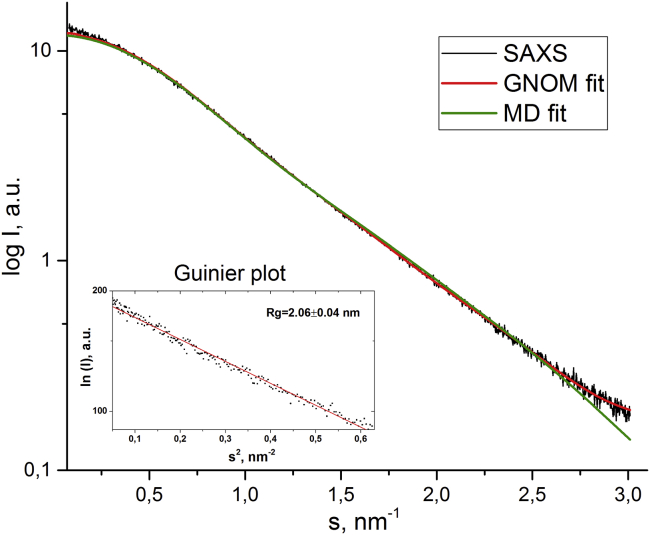
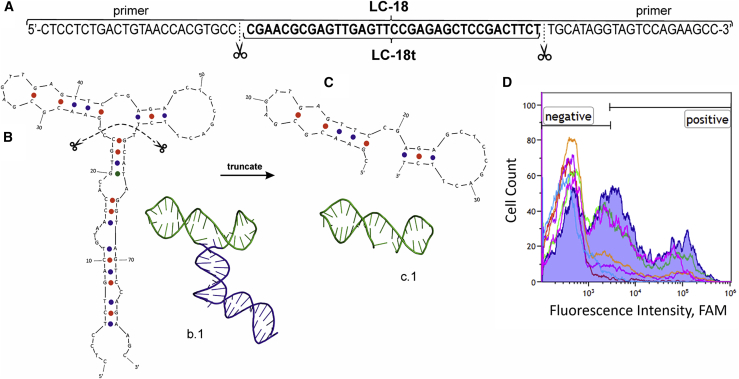
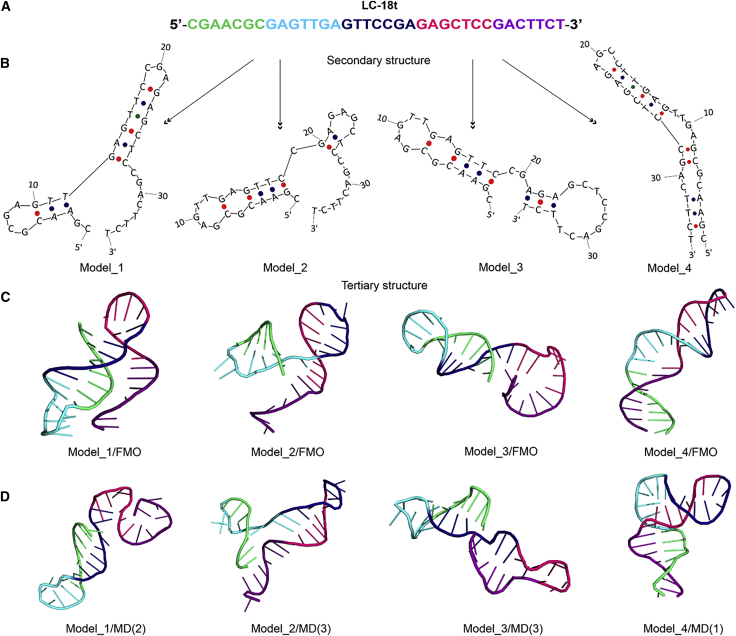
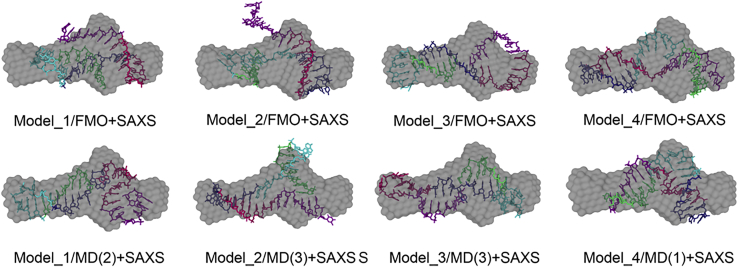
Aptamers are short, single-stranded DNA or RNA oligonucleotide molecules that function as synthetic analogs of antibodies and bind to a target molecule with high specificity. Aptamer affinity entirely depends on its tertiary structure and charge distribution. Therefore, length and structure optimization are essential for increasing aptamer specificity and affinity. Here, we present a general optimization procedure for finding the most populated atomistic structures of DNA aptamers. Based on the existed aptamer LC-18 for lung adenocarcinoma, a new truncated LC-18 (LC-18t) aptamer LC-18t was developed. A three-dimensional (3D) shape of LC-18t was reported based on small-angle X-ray scattering (SAXS) experiments and molecular modeling by fragment molecular orbital or molecular dynamic methods. Molecular simulations revealed an ensemble of possible aptamer conformations in solution that were in close agreement with measured SAXS data. The aptamer LC-18t had stronger binding to cancerous cells in lung tumor tissues and shared the binding site with the original larger aptamer. The suggested approach reveals 3D shapes of aptamers and helps in designing better affinity probes.
适体是短的单链DNA或RNA寡核苷酸分子,其作为抗体的合成类似物发挥作用,并以高特异性结合靶分子。适体亲和力完全取决于其三级结构和电荷分布。因此,长度和结构优化对于提高适体特异性和亲和力至关重要。在此,我们提出了一种通用的优化程序,用于寻找DNA适体最丰富的原子结构。基于现有的用于肺腺癌的适体LC-18,开发了一种新的截短型LC-18(LC-18t)适体。基于小角X射线散射(SAXS)实验以及通过片段分子轨道或分子动力学方法进行的分子建模,报道了LC-18t的三维(3D)形状。分子模拟揭示了溶液中可能的适体构象集合,这些构象与测得的SAXS数据密切吻合。适体LC-18t与肺肿瘤组织中的癌细胞具有更强的结合力,并且与原始的较大适体共享结合位点。所建议的方法揭示了适体的3D形状,并有助于设计更好的亲和探针。