Nikolaus Cassandra J, Sinclair Ka'imi, Buchwald Dedra, Suchy-Dicey Astrid M
Institute for Research and Education to Advance Community Health, Elson S. Floyd College of Medicine, Washington State University, USA.
Institute for Research and Education to Advance Community Health, College of Nursing, Washington State University, USA.
Prev Med Rep. 2021 Aug 12;24:101517. doi: 10.1016/j.pmedr.2021.101517. eCollection 2021 Dec.
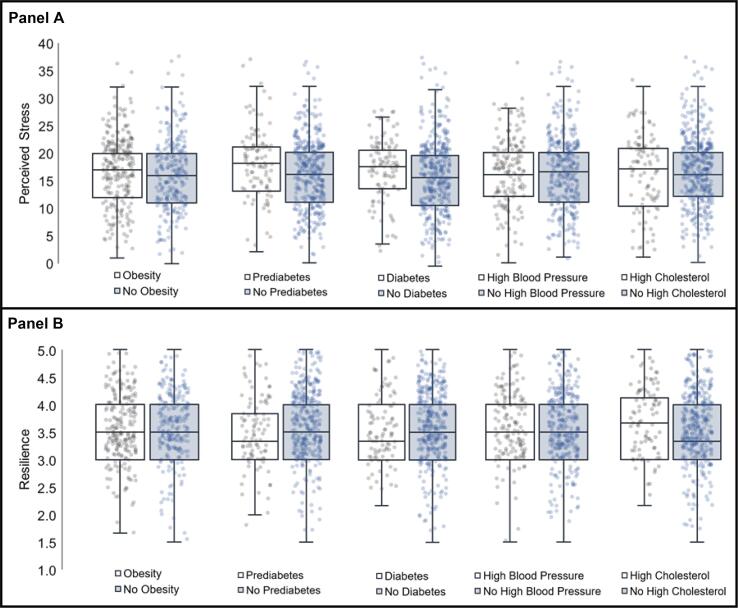
Evidence suggests that perceived stress and psychological resilience are related to the presence and severity of cardiometabolic disease. Despite increased stress and cardiometabolic disease burden among American Indian and Alaska Native (AI/AN) people, the relationships between these factors are not well established in these populations. The objective of this study was to evaluate the relationships of stress with five cardiometabolic health indicators and to assess whether psychological resilience mediates these relationships in AI/AN adults. Four hundred and ninety-six AI/AN attendees were surveyed at three powwows. The questionnaire included sociodemographic items, questions on self-reported obesity, prediabetes, diabetes, high blood pressure, and high cholesterol, the Perceived Stress Scale, and the Brief Resilience Scale. Multivariable logistic regression models were used to measure associations of health indicators with Perceived Stress Scale and Brief Resilience Scale scores while controlling for sociodemographic characteristics. Among respondents, obesity was the most common cardiometabolic health indicator reported (48%), followed by high blood pressure, prediabetes, diabetes, and high cholesterol. Mean Perceived Stress Scale and Brief Resilience Scale scores were 16.1 (6.4 SD) and 3.5 (0.7 SD), respectively. Higher Perceived Stress Scale scores were associated with greater odds of self-reported prediabetes and diabetes. Brief Resilience Scale scores did not serve as a mediator. These results suggest that perceived stress is associated with some self-reported indicators of cardiometabolic health among AI/AN adults, but findings are limited by the convenience sample, reliance on self-report, and cross-sectional design. Future work should capitalize on nationally representative data, longitudinal designs, and objective measures of cardiometabolic health.
有证据表明,感知压力和心理韧性与心脏代谢疾病的存在及严重程度相关。尽管美国印第安人和阿拉斯加原住民(AI/AN)人群的压力和心脏代谢疾病负担有所增加,但这些因素之间的关系在这些人群中尚未完全明确。本研究的目的是评估压力与五项心脏代谢健康指标之间的关系,并评估心理韧性是否在AI/AN成年人中调节这些关系。在三场powwow活动中对496名AI/AN参与者进行了调查。问卷包括社会人口学项目、关于自我报告的肥胖、糖尿病前期、糖尿病、高血压和高胆固醇的问题、感知压力量表和简短韧性量表。使用多变量逻辑回归模型来测量健康指标与感知压力量表和简短韧性量表得分之间的关联,同时控制社会人口学特征。在受访者中,肥胖是报告的最常见的心脏代谢健康指标(48%),其次是高血压、糖尿病前期、糖尿病和高胆固醇。感知压力量表和简短韧性量表的平均得分分别为16.1(标准差6.4)和3.5(标准差0.7)。感知压力量表得分越高,自我报告的糖尿病前期和糖尿病的几率就越大。简短韧性量表得分并未起到中介作用。这些结果表明,感知压力与AI/AN成年人中一些自我报告的心脏代谢健康指标相关,但研究结果受到便利样本、依赖自我报告和横断面设计的限制。未来的工作应利用具有全国代表性的数据、纵向设计以及心脏代谢健康的客观测量方法。