Yang Yu, Li Yuxuan, Du Xiaohui
Department of General Surgery, First Medical Center of Chinese People's Liberation Army (PLA), General Hospital, Beijing, China.
Front Oncol. 2021 Aug 11;11:716962. doi: 10.3389/fonc.2021.716962. eCollection 2021.
Hepatoid adenocarcinoma of the stomach (HAS) is a rare type of primary gastric cancer, and most previous studies have reported that HAS has a poor prognosis due to its aggressive biological behavior. The aim of this study was to compare the prognosis of HAS to that of gastric signet ring cell carcinoma (SRC).
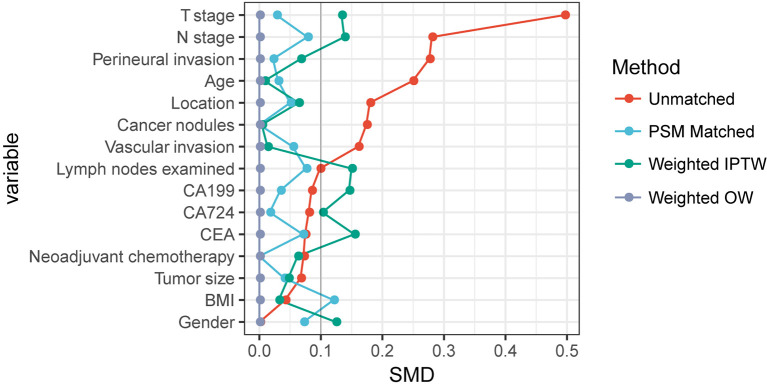
This was a single-center, retrospective, observational cohort study (January 2010 to January 2016) of gastric cancer patients with pathological HAS and SRC. Overall survival was compared between HAS and SRC patients. We used univariate Cox regression, multivariate Cox regression, propensity score matching (PSM), inverse probability of treatment weighting, standardized mortality ratio weighting, standardized mortality ratio weighting, and overlap weighting to perform a prognostic analysis.
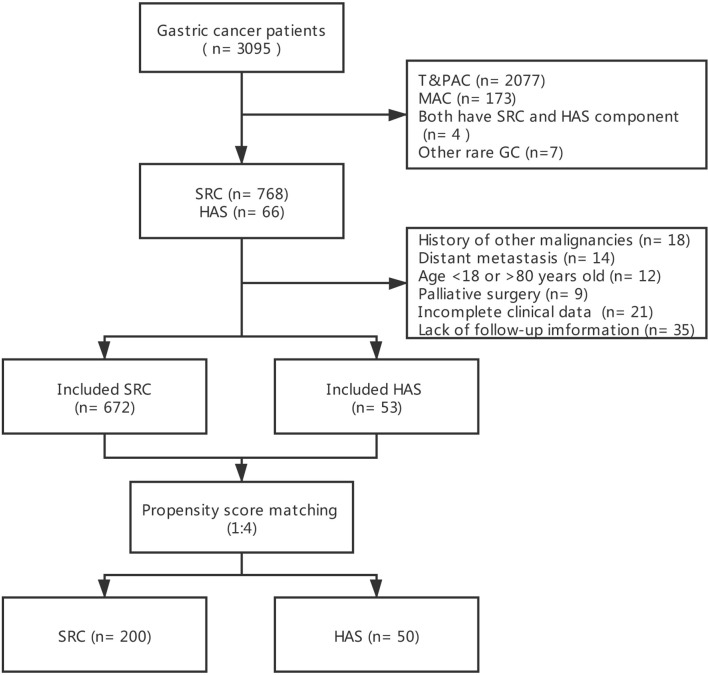
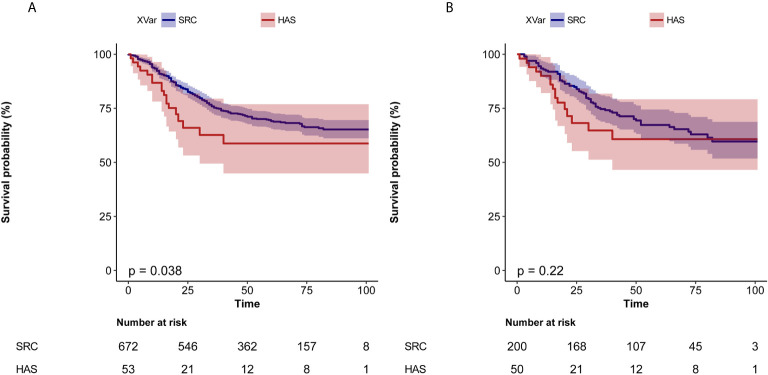
A total of 725 (672 SRC and 53 HAS) patients were included. After nearest-neighbor 1:4 PSM, 200 SRC patients and 50 HAS patients were matched. Only in univariate Cox regression analysis with the cohort before PSM did HAS show a significantly worse prognosis than SRC [hazard ratio (HR), 1.66; 95% confidence interval (CI), 1.02-2.69, = 0.040]. However, in the analysis of multivariate Cox regression with the cohort before PSM and series analysis based on the propensity score, all of the results indicated that there was no statistically significant difference in overall survival between HAS and SRC (all > 0.05). Furthermore, in the subgroup of proximal location ( = 0.027), T stage 4a & 4b ( = 0.001), N stage 3a & 3b ( = 0.022), with cancer nodules ( = 0.026), serum CEA higher than the normal value ( = 0.038), and serum CA199 higher than the normal value ( = 0.023), the prognosis of HAS was significantly worse than that of SRC.
Based on our study, there was no statistically significant difference in overall survival between HAS and gastric SRC patients. However, in patients with an advanced tumor stage, HAS may have a worse overall survival than SRC.
胃肝样腺癌(HAS)是一种罕见的原发性胃癌,既往大多数研究报道,由于其侵袭性生物学行为,HAS预后较差。本研究旨在比较HAS与胃印戒细胞癌(SRC)的预后。
这是一项对患有病理诊断为HAS和SRC的胃癌患者进行的单中心、回顾性观察队列研究(2010年1月至2016年1月)。比较了HAS和SRC患者的总生存期。我们使用单因素Cox回归、多因素Cox回归、倾向评分匹配(PSM)、治疗逆概率加权、标准化死亡比加权、标准化死亡比加权和重叠加权进行预后分析。
共纳入725例患者(672例SRC和53例HAS)。经过最近邻1:4 PSM后,匹配了200例SRC患者和50例HAS患者。仅在PSM前队列的单因素Cox回归分析中,HAS的预后显著差于SRC [风险比(HR),1.66;95%置信区间(CI),1.02 - 2.69,P = 0.040]。然而,在PSM前队列的多因素Cox回归分析和基于倾向评分的系列分析中,所有结果均表明HAS和SRC的总生存期无统计学显著差异(所有P > 0.05)。此外,在近端部位(P = 0.027)、T分期4a和4b(P = 0.001)、N分期3a和3b(P = 0.022)、有癌结节(P = 0.026)、血清癌胚抗原(CEA)高于正常值(P = 0.038)以及血清糖类抗原199(CA199)高于正常值(P = 0.023)的亚组中,HAS的预后显著差于SRC。
基于我们的研究,HAS和胃SRC患者的总生存期无统计学显著差异。然而,在肿瘤分期较晚的患者中,HAS的总生存期可能比SRC更差。