Morey Rohini, Farber Charles, McCutchen Bill, Burow Mark D, Simpson Charles, Kurouski Dmitry, Cason John
Department of Biochemistry and Biophysics Texas A&M University College Station Texas USA.
Texas A&M AgriLife Research Stephenville Texas USA.
Plant Direct. 2021 Aug 20;5(8):e342. doi: 10.1002/pld3.342. eCollection 2021 Aug.
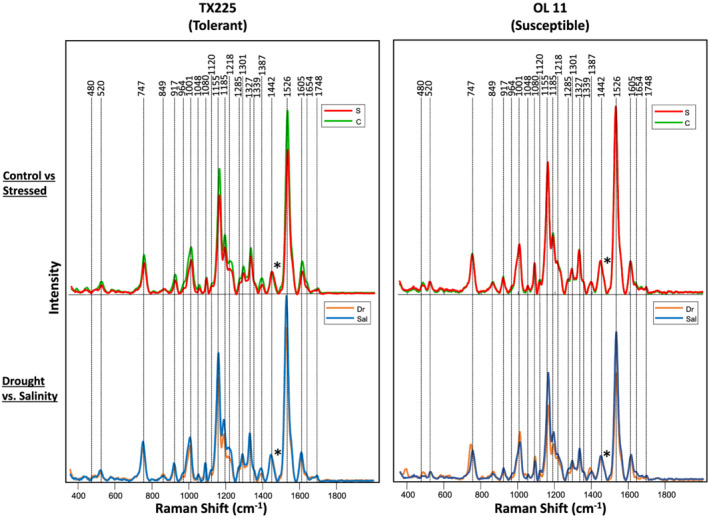
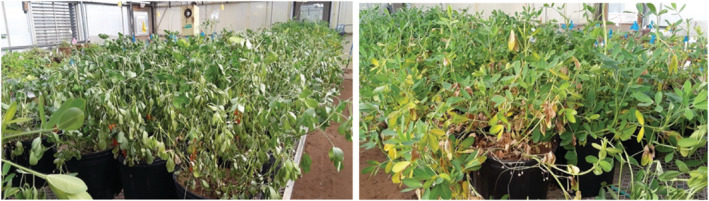
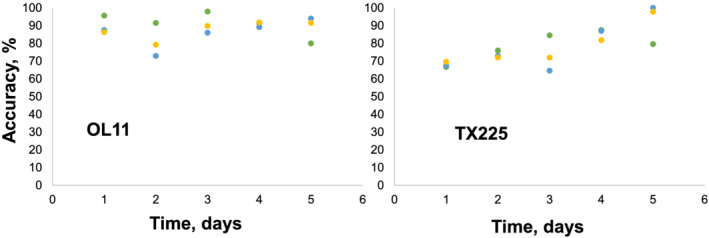
Water deficit and salinity are two major abiotic stresses that have tremendous effect on crop yield worldwide. Timely identification of these stresses can help limit associated yield loss. Confirmatory detection and identification of water deficit stress can also enable proper irrigation management. Traditionally, unmanned aerial vehicle (UAV)-based imaging and satellite-based imaging, together with visual field observation, are used for diagnostics of such stresses. However, these approaches can only detect salinity and water deficit stress at the symptomatic stage. Raman spectroscopy (RS) is a noninvasive and nondestructive technique that can identify and detect plant biotic and abiotic stress. In this study, we investigated accuracy of Raman-based diagnostics of water deficit and salinity stresses on two greenhouse-grown peanut accessions: tolerant and susceptible to water deficit. Plants were grown for 76 days prior to application of the water deficit and salinity stresses. Water deficit treatments received no irrigation for 5 days, and salinity treatments received 1.0 L of 240-mM salt water per day for the duration of 5-day sampling. Every day after the stress was imposed, plant leaves were collected and immediately analyzed by a hand-held Raman spectrometer. RS and chemometrics could identify control and stressed (either water deficit or salinity) susceptible plants with 95% and 80% accuracy just 1 day after treatment. Water deficit and salinity stressed plants could be differentiated from each other with 87% and 86% accuracy, respectively. In the tolerant accessions at the same timepoint, the identification accuracies were 66%, 65%, 67%, and 69% for control, combined stresses, water deficit, and salinity stresses, respectively. The high selectivity and specificity for presymptomatic identification of abiotic stresses in the susceptible line provide evidence for the potential of Raman-based surveillance in commercial-scale agriculture and digital farming.
水分亏缺和盐度是两种主要的非生物胁迫,对全球作物产量产生巨大影响。及时识别这些胁迫有助于减少相关的产量损失。对水分亏缺胁迫进行确证性检测和识别还能实现适当的灌溉管理。传统上,基于无人机的成像和基于卫星的成像,以及实地观察,被用于此类胁迫的诊断。然而,这些方法只能在症状出现阶段检测盐度和水分亏缺胁迫。拉曼光谱(RS)是一种非侵入性和非破坏性技术,可识别和检测植物的生物和非生物胁迫。在本研究中,我们调查了基于拉曼光谱诊断水分亏缺和盐度胁迫对两种温室种植花生品种(耐水分亏缺和对水分亏缺敏感)的准确性。在施加水分亏缺和盐度胁迫之前,植株生长了76天。水分亏缺处理在5天内不进行灌溉,盐度处理在为期5天的采样期间每天接受1.0升240毫摩尔的盐水。在施加胁迫后的每一天,采集植物叶片并立即用手持式拉曼光谱仪进行分析。拉曼光谱和化学计量学在处理后仅1天就能以95%和80%的准确率识别对照植株和受胁迫(水分亏缺或盐度)的敏感植株。水分亏缺胁迫植株和盐度胁迫植株之间的区分准确率分别为87%和86%。在同一时间点的耐胁迫品种中,对照、复合胁迫、水分亏缺和盐度胁迫的识别准确率分别为66%、65%、67%和69%。在敏感品系中对非生物胁迫进行症状前识别的高选择性和特异性为基于拉曼光谱的监测在商业规模农业和数字农业中的潜力提供了证据。