Rhinology Unit & Smell Clinic, ENT Department, Hospital Clínic, IDIBAPS, Universitat de Barcelona, CIBERES, Barcelona, Catalonia, Spain.
Division of Allergy and Clinical Immunology, Brigham and Women's Hospital, and Harvard Medical School, Boston, Massachusetts, USA.
Allergy. 2022 Apr;77(4):1231-1244. doi: 10.1111/all.15067. Epub 2021 Oct 1.
About one-tenth of patients with difficult-to-treat chronic rhinosinusitis with nasal polyps (CRSwNP) have comorbid non-steroidal anti-inflammatory drug-exacerbated respiratory disease (NSAID-ERD). Dupilumab, a fully human monoclonal antibody that blocks the shared interleukin (IL)-4/IL-13 receptor component, is an approved add-on treatment in severe CRSwNP. This post hoc analysis evaluated dupilumab efficacy and safety in patients with CRSwNP with/without NSAID-ERD.
Data were pooled from the phase 3 SINUS-24 and SINUS-52 studies in adults with uncontrolled severe CRSwNP who received dupilumab 300 mg or placebo every 2 weeks. CRSwNP, nasal airflow, lung function, and asthma control outcomes at Week 24 were evaluated, and treatment-subgroup interactions were assessed for patients with and without NSAID-ERD.
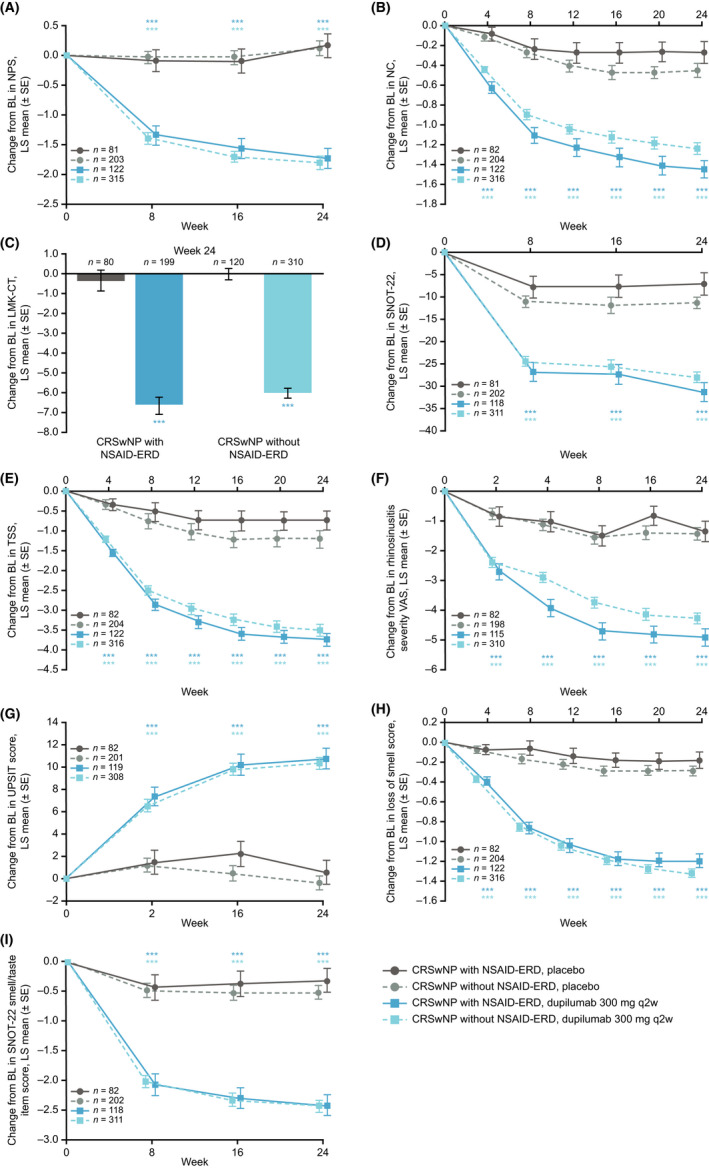
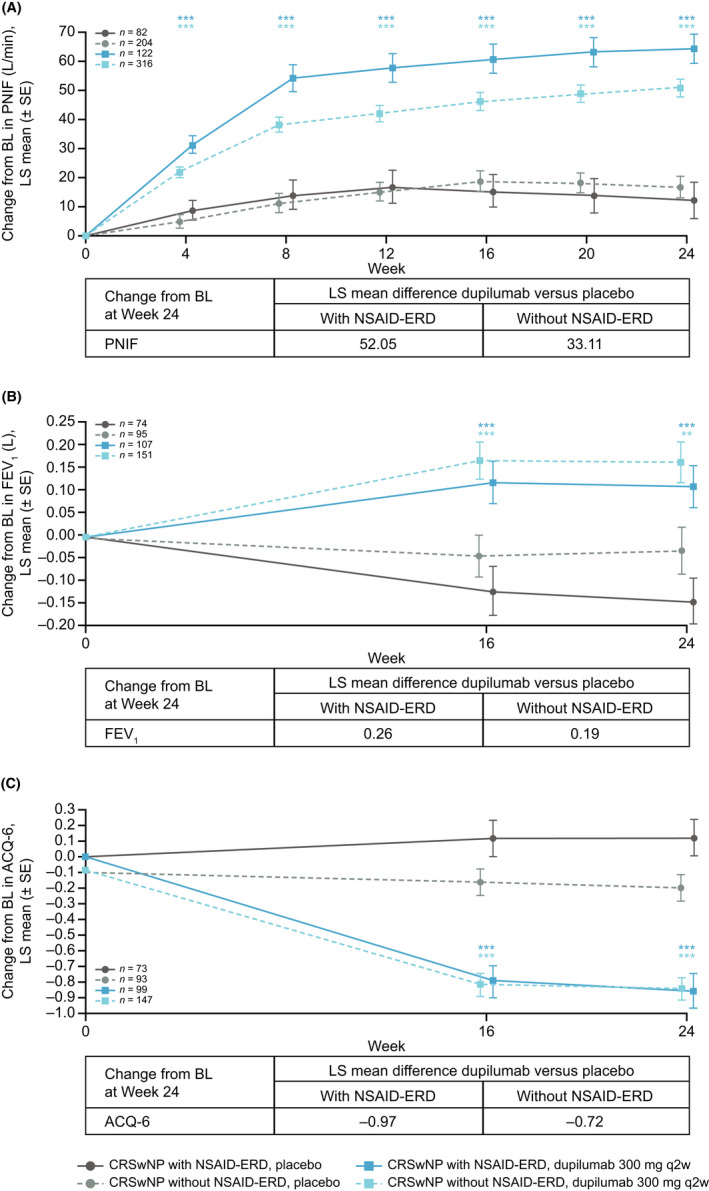
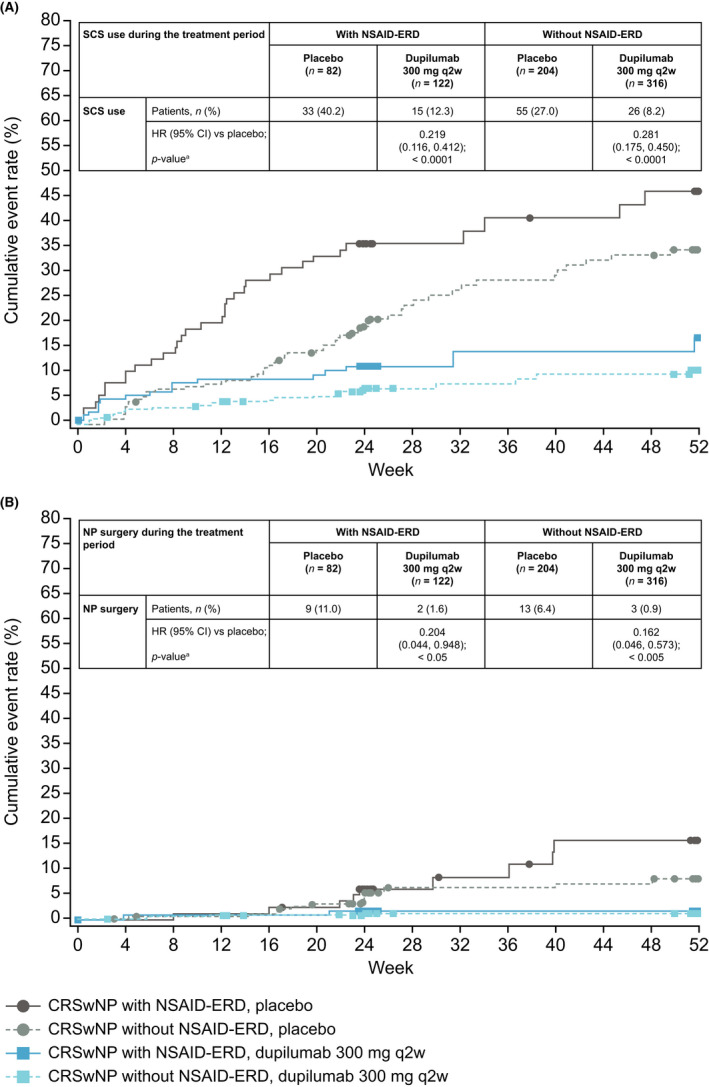
Of 724 patients, 204 (28.2%) had a diagnosis of NSAID-ERD. At Week 24, least squares mean treatment differences demonstrated significant improvements in nasal polyp score, nasal congestion (NC), Lund-Mackay computed tomography, 22-item Sinonasal Outcome Test (SNOT-22), Total Symptom Score (TSS), rhinosinusitis severity visual analog scale, peak nasal inspiratory flow (PNIF), six-item Asthma Control Questionnaire score, and improvement in smell with dupilumab versus placebo (all p < .0001) in patients with NSAID-ERD. Treatment comparisons demonstrated significantly greater improvements with dupilumab in patients with versus without NSAID-ERD for NC (p = .0044), SNOT-22 (p = .0313), TSS (p = .0425), and PNIF (p = .0123).
In patients with uncontrolled severe CRSwNP, dupilumab significantly improved objective measures and patient-reported symptoms to a greater extent in the presence of comorbid NSAID-ERD than without. Dupilumab was well tolerated in patients with/without NSAID-ERD.
大约十分之一的难治性慢性鼻-鼻窦炎伴鼻息肉(CRSwNP)患者伴有非甾体抗炎药加重的呼吸道疾病(NSAID-ERD)。度普利尤单抗是一种完全人源化的单克隆抗体,可阻断共同的白细胞介素(IL)-4/IL-13 受体成分,是一种批准的重度 CRSwNP 附加治疗药物。本事后分析评估了度普利尤单抗在伴有/不伴有 NSAID-ERD 的 CRSwNP 患者中的疗效和安全性。
来自成人未控制重度 CRSwNP 患者的 3 期 SINUS-24 和 SINUS-52 研究的数据进行了汇总,这些患者每 2 周接受 300mg 度普利尤单抗或安慰剂治疗。评估了第 24 周时的 CRSwNP、鼻气流、肺功能和哮喘控制结果,并评估了伴有和不伴有 NSAID-ERD 的患者的治疗亚组间的相互作用。
在 724 名患者中,有 204 名(28.2%)诊断为 NSAID-ERD。在第 24 周时,最小二乘均数治疗差异显示,度普利尤单抗治疗与安慰剂治疗相比,鼻息肉评分、鼻阻塞(NC)、Lund-Mackay 计算机断层扫描、22 项鼻-鼻窦炎结局测试(SNOT-22)、总症状评分(TSS)、鼻-鼻窦炎严重程度视觉模拟评分、峰值鼻吸气流量(PNIF)、6 项哮喘控制问卷评分和嗅觉改善均有显著改善(均 p<.0001)。在伴有和不伴有 NSAID-ERD 的患者中,与安慰剂相比,度普利尤单抗治疗的 NC(p=.0044)、SNOT-22(p=.0313)、TSS(p=.0425)和 PNIF(p=.0123)的改善更为显著。
在未控制的重度 CRSwNP 患者中,与不伴有 NSAID-ERD 的患者相比,度普利尤单抗显著改善了客观指标和患者报告的症状,且程度更大。在伴有和不伴有 NSAID-ERD 的患者中,度普利尤单抗均具有良好的耐受性。