• 文献检索
  • 文档翻译
  • 深度研究
  • 学术资讯
  • Suppr Zotero 插件Zotero 插件
  • 邀请有礼
  • 套餐&价格
  • 历史记录
应用&插件
Suppr Zotero 插件Zotero 插件浏览器插件Mac 客户端Windows 客户端微信小程序
定价
高级版会员购买积分包购买API积分包
服务
文献检索文档翻译深度研究API 文档MCP 服务
关于我们
关于 Suppr公司介绍联系我们用户协议隐私条款
关注我们

Suppr 超能文献

核心技术专利:CN118964589B侵权必究
粤ICP备2023148730 号-1Suppr @ 2026

文献检索

告别复杂PubMed语法,用中文像聊天一样搜索,搜遍4000万医学文献。AI智能推荐,让科研检索更轻松。

立即免费搜索

文件翻译

保留排版,准确专业,支持PDF/Word/PPT等文件格式,支持 12+语言互译。

免费翻译文档

深度研究

AI帮你快速写综述,25分钟生成高质量综述,智能提取关键信息,辅助科研写作。

立即免费体验

间隔产后宫内节育器放置后的并发症。

Complications after interval postpartum intrauterine device insertion.

机构信息

Division of Family Planning, Department of Obstetrics, Gynecology and Reproductive Sciences, University of California San Diego, San Diego, CA.

Division of Family Planning, Department of Obstetrics, Gynecology and Reproductive Sciences, University of California San Diego, San Diego, CA.

出版信息

Am J Obstet Gynecol. 2022 Jan;226(1):95.e1-95.e8. doi: 10.1016/j.ajog.2021.08.028. Epub 2021 Aug 28.

DOI:10.1016/j.ajog.2021.08.028
PMID:34461075
原文链接:https://pmc.ncbi.nlm.nih.gov/articles/PMC8940222/
Abstract

BACKGROUND

In the United States, up to 57% of women report resumption of sexual activity by the 6 week postpartum visit. Effective contraception should be addressed and provided at that time, to avoid unintended pregnancies and optimize interpregnancy intervals. Long-acting reversible contraceptives are the most effective forms of reversible contraception and are increasingly popular during the postpartum period. However, timing of postpartum intrauterine device (IUD) placement varies among providers and many delay insertion due to concerns for uterine perforation or expulsion of the IUD.

OBJECTIVE

This study aimed to evaluate uterine perforation and expulsion rates with IUD insertion at 4-8 weeks postpartum vs 9-36 weeks postpartum.

STUDY DESIGN

We performed a retrospective cohort study using the Kaiser Permanente Southern California electronic medical record from 2010 to 2016. We calculated the proportion of perforations and expulsions with IUD insertion at 4-8 weeks vs 9-36 weeks postpartum. Our primary outcome was the perforation rate. Secondarily, we evaluated the expulsion rate. For our minimum sample size calculation, to detect a difference of 0.5% in the perforation rate, with a baseline perforation rate of 0.5% for the 9-36 week postpartum IUD placement group, 80% power, and 5% alpha error rate, we would need at least 4221 participants per group, 8442 in total.

RESULTS

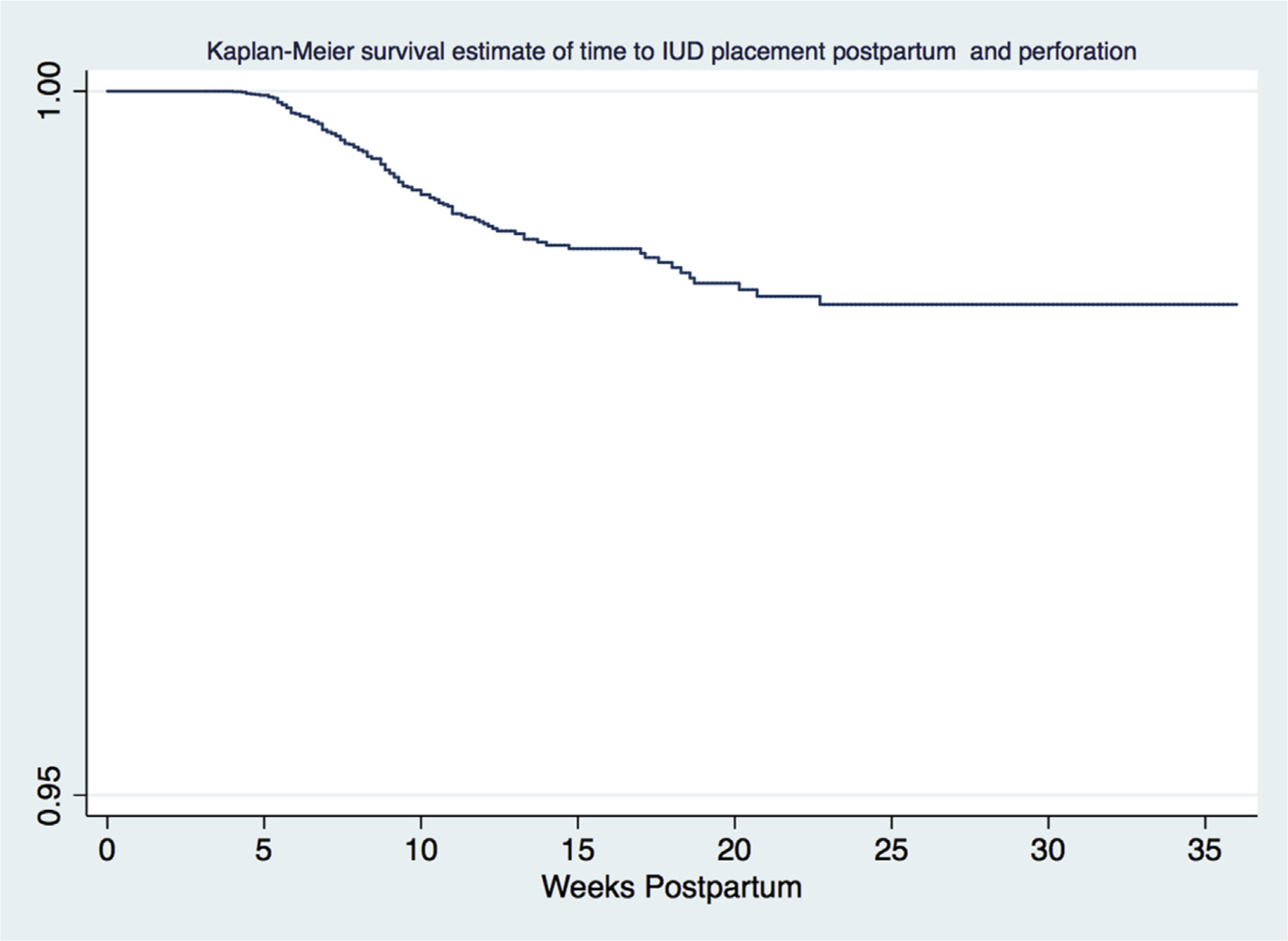
A total of 24,959 patients met inclusion criteria (n=13,180 in the 4-8 week group, n=11,777 in the 9-36 week group). Of 430 patients with a confirmed complication, 157 uterine perforations and 273 IUD expulsions were identified. Perforation rates were significantly higher with placement at 4-8 weeks than at 9-36 weeks (0.78% vs 0.46%; P=.001). After adjusting for race and ethnicity, breastfeeding, IUD type, provider type, parity, most recent delivery, and body mass index, the odds of perforation remained higher with placement at 4-8 weeks than at 9-36 weeks (adjusted odds ratio, 1.92; 95% confidence interval, 1.28-2.89). Our Kaplan-Meier survival curve showed that the risk of uterine perforation remained elevated until approximately 22-23 weeks postpartum. Expulsion rates were similar between the 2 groups (1.02 vs 1.17; P=.52).

CONCLUSION

Uterine perforation after interval postpartum IUD insertion is greater at 4-8 weeks than at 9-36 weeks, although perforation rates remain low at <1%. Expulsion rates did not differ between the groups. Because overall rates of uterine perforation are low, women can safely be offered IUDs at any interval beyond 4 weeks with minimal concern for perforation.

摘要

背景

在美国,多达 57%的女性报告在产后 6 周就诊时恢复了性行为。此时应解决并提供有效的避孕措施,以避免意外怀孕和优化妊娠间隔。长效可逆避孕方法是最有效的可逆避孕方法,在产后期间越来越受欢迎。然而,提供者之间产后宫内节育器(IUD)放置的时间不同,许多人因担心子宫穿孔或 IUD 排出而延迟插入。

目的

本研究旨在评估产后 4-8 周与 9-36 周放置 IUD 的子宫穿孔和排出率。

研究设计

我们使用 2010 年至 2016 年 Kaiser Permanente 南加州电子病历进行了回顾性队列研究。我们计算了产后 4-8 周与 9-36 周放置 IUD 时穿孔和排出的比例。我们的主要结局是穿孔率。其次,我们评估了排出率。对于我们的最小样本量计算,为了检测 9-36 周产后 IUD 放置组穿孔率 0.5%的差异,基线穿孔率为 0.5%,80%的功率和 5%的 alpha 错误率,我们每组需要至少 4221 名参与者,总共 8442 名参与者。

结果

共有 24959 名患者符合纳入标准(4-8 周组 13180 名,9-36 周组 11777 名)。在 430 名确诊并发症的患者中,发现 157 例子宫穿孔和 273 例 IUD 排出。穿孔率在产后 4-8 周放置时明显高于 9-36 周(0.78%比 0.46%;P=.001)。调整种族和民族、母乳喂养、IUD 类型、提供者类型、产次、最近分娩和体重指数后,4-8 周放置时穿孔的几率仍高于 9-36 周(调整后的优势比,1.92;95%置信区间,1.28-2.89)。我们的 Kaplan-Meier 生存曲线显示,产后 4-8 周子宫穿孔的风险仍然升高,直到大约 22-23 周。两组的排出率相似(1.02 比 1.17;P=.52)。

结论

产后间隔 IUD 插入后子宫穿孔在 4-8 周时大于 9-36 周,尽管穿孔率仍低于 1%。两组的排出率没有差异。由于子宫穿孔的总体发生率较低,因此可以在 4 周后任何时间安全地为女性提供 IUD,而无需过多担心穿孔。
https://cdn.ncbi.nlm.nih.gov/pmc/blobs/5f92/8940222/825587bbf6a4/nihms-1787716-f0001.jpg

相似文献

1
Complications after interval postpartum intrauterine device insertion.间隔产后宫内节育器放置后的并发症。
Am J Obstet Gynecol. 2022 Jan;226(1):95.e1-95.e8. doi: 10.1016/j.ajog.2021.08.028. Epub 2021 Aug 28.
2
Design of the Association of Uterine Perforation and Expulsion of Intrauterine Device study: a multisite retrospective cohort study.《子宫穿孔与宫内节育器排出相关因素研究》设计:多中心回顾性队列研究。
Am J Obstet Gynecol. 2021 Jun;224(6):599.e1-599.e18. doi: 10.1016/j.ajog.2021.01.003. Epub 2021 Jan 15.
3
Postpartum IUDS: keys for success.产后宫内节育器:成功的关键
Contraception. 1992 Apr;45(4):351-61. doi: 10.1016/0010-7824(92)90057-z.
4
Association of the Timing of Postpartum Intrauterine Device Insertion and Breastfeeding With Risks of Intrauterine Device Expulsion.产后即时放置宫内节育器与母乳喂养时间与宫内节育器脱落风险的关系。
JAMA Netw Open. 2022 Feb 1;5(2):e2148474. doi: 10.1001/jamanetworkopen.2021.48474.
5
Risks of Uterine Perforation and Expulsion Associated With Intrauterine Devices.宫内节育器相关的子宫穿孔和排出风险。
Obstet Gynecol. 2023 Sep 1;142(3):641-651. doi: 10.1097/AOG.0000000000005299. Epub 2023 Aug 3.
6
Intrauterine device-related uterine perforation incidence and risk (APEX-IUD): a large multisite cohort study.宫内节育器相关子宫穿孔的发生率和风险(APEX-IUD):一项大型多中心队列研究。
Lancet. 2022 Jun 4;399(10341):2103-2112. doi: 10.1016/S0140-6736(22)00015-0.
7
Immediate postplacental insertion of GYNE-T 380 and GYNE-T 380 postpartum intrauterine contraceptive devices: randomized study.产后即刻植入 GYNE-T 380 和 GYNE-T 380 产后宫内节育器:随机研究。
Am J Obstet Gynecol. 1996 Nov;175(5):1231-5. doi: 10.1016/s0002-9378(96)70033-9.
8
Immediate versus delayed postpartum insertion of contraceptive implant and IUD for contraception.即刻与产后延迟放置避孕埋植剂和宫内节育器避孕效果比较。
Cochrane Database Syst Rev. 2022 Oct 27;10(10):CD011913. doi: 10.1002/14651858.CD011913.pub3.
9
Association between menorrhagia and risk of intrauterine device-related uterine perforation and device expulsion: results from the Association of Uterine Perforation and Expulsion of Intrauterine Device study.月经过多与宫内节育器相关子宫穿孔和节育器脱落风险的关系:来自宫内节育器穿孔和脱落研究协会的结果。
Am J Obstet Gynecol. 2022 Jul;227(1):59.e1-59.e9. doi: 10.1016/j.ajog.2022.03.025. Epub 2022 Mar 12.
10
Early vs Interval Postpartum Intrauterine Device Placement: A Randomized Clinical Trial.早期与间隔期产后宫内节育器放置:一项随机临床试验。
JAMA. 2023 Mar 21;329(11):910-917. doi: 10.1001/jama.2023.1936.

引用本文的文献

1
A Levonorgestrel-Releasing Intrauterine Device in the Right Upper Quadrant: A Case Report.右上象限的左炔诺孕酮宫内节育器:一例报告。
Cureus. 2025 Jul 15;17(7):e87997. doi: 10.7759/cureus.87997. eCollection 2025 Jul.
2
Open surgical retrieval of intra-uterine contraceptive device perforating the ileum: A case report.经开放手术取出穿孔至回肠的宫内节育器:一例报告。
Int J Surg Case Rep. 2023 Aug;109:108635. doi: 10.1016/j.ijscr.2023.108635. Epub 2023 Aug 6.
3
Long-Term Retained Lippes Loop Intrauterine Device Causes Vesicouterine Fistula.

本文引用的文献

1
Expulsion of intrauterine devices after postpartum placement by timing of placement, delivery type, and intrauterine device type: a systematic review and meta-analysis.产后即时放置、分娩方式和宫内节育器类型与宫内节育器脱落的关系:系统评价和荟萃分析。
Am J Obstet Gynecol. 2020 Aug;223(2):177-188. doi: 10.1016/j.ajog.2020.02.045. Epub 2020 Mar 3.
2
Factors associated with postpartum use of long-acting reversible contraception.与产后使用长效可逆避孕措施相关的因素。
Am J Obstet Gynecol. 2019 Jul;221(1):43.e1-43.e11. doi: 10.1016/j.ajog.2019.03.005. Epub 2019 Mar 15.
3
Intrauterine Device Expulsion After Postpartum Placement: A Systematic Review and Meta-analysis.
长期留存的利普斯节育环导致膀胱子宫瘘。
Cureus. 2023 Apr 27;15(4):e38217. doi: 10.7759/cureus.38217. eCollection 2023 Apr.
4
Efficacy of Oral Medications or Intrauterine Device-Delivered Progestin in Patients with Endometrial Hyperplasia with or without Atypia: A Network Meta-Analysis.口服药物或宫内节育器释放孕激素治疗有或无不典型性子宫内膜增生患者的疗效:一项网状Meta分析
J Clin Med. 2023 Apr 19;12(8):2980. doi: 10.3390/jcm12082980.
产后放置宫内节育器后脱落:系统评价和荟萃分析。
Obstet Gynecol. 2018 Oct;132(4):895-905. doi: 10.1097/AOG.0000000000002822.
4
ACOG Committee Opinion No. 736: Optimizing Postpartum Care.美国妇产科医师学会委员会意见 No.736:优化产后护理。
Obstet Gynecol. 2018 May;131(5):e140-e150. doi: 10.1097/AOG.0000000000002633.
5
Contraceptive method use in the United States: trends and characteristics between 2008, 2012 and 2014.美国避孕方法的使用情况:2008年、2012年和2014年之间的趋势与特征
Contraception. 2018 Jan;97(1):14-21. doi: 10.1016/j.contraception.2017.10.003. Epub 2017 Oct 13.
6
Two-year continuation of intrauterine devices and contraceptive implants in a mixed-payer setting: a retrospective review.混合支付环境下宫内节育器和避孕植入物的两年持续使用情况:一项回顾性研究
Am J Obstet Gynecol. 2017 Jun;216(6):590.e1-590.e8. doi: 10.1016/j.ajog.2017.02.003. Epub 2017 Feb 8.
7
Unplanned pregnancy and subsequent psychological distress in partnered women: a cross-sectional study of the role of relationship quality and wider social support.伴侣关系中女性的意外怀孕及随后的心理困扰:一项关于关系质量和更广泛社会支持作用的横断面研究
BMC Pregnancy Childbirth. 2017 Jan 26;17(1):44. doi: 10.1186/s12884-017-1223-x.
8
U.S. Medical Eligibility Criteria for Contraceptive Use, 2016.美国避孕方法医学适用标准,2016 年版。
MMWR Recomm Rep. 2016 Jul 29;65(3):1-103. doi: 10.15585/mmwr.rr6503a1.
9
Three-year continuation of reversible contraception.可逆避孕法的三年持续使用
Am J Obstet Gynecol. 2015 Nov;213(5):662.e1-8. doi: 10.1016/j.ajog.2015.08.001. Epub 2015 Aug 7.
10
Preventing Unintended Pregnancy: The Contraceptive CHOICE Project in Review.预防意外怀孕:回顾避孕选择项目
J Womens Health (Larchmt). 2015 May;24(5):349-53. doi: 10.1089/jwh.2015.5191. Epub 2015 Mar 31.