• 文献检索
  • 文档翻译
  • 深度研究
  • 学术资讯
  • Suppr Zotero 插件Zotero 插件
  • 邀请有礼
  • 套餐&价格
  • 历史记录
应用&插件
Suppr Zotero 插件Zotero 插件浏览器插件Mac 客户端Windows 客户端微信小程序
定价
高级版会员购买积分包购买API积分包
服务
文献检索文档翻译深度研究API 文档MCP 服务
关于我们
关于 Suppr公司介绍联系我们用户协议隐私条款
关注我们

Suppr 超能文献

核心技术专利:CN118964589B侵权必究
粤ICP备2023148730 号-1Suppr @ 2026

文献检索

告别复杂PubMed语法,用中文像聊天一样搜索,搜遍4000万医学文献。AI智能推荐,让科研检索更轻松。

立即免费搜索

文件翻译

保留排版,准确专业,支持PDF/Word/PPT等文件格式,支持 12+语言互译。

免费翻译文档

深度研究

AI帮你快速写综述,25分钟生成高质量综述,智能提取关键信息,辅助科研写作。

立即免费体验

宫内节育器相关的子宫穿孔和排出风险。

Risks of Uterine Perforation and Expulsion Associated With Intrauterine Devices.

机构信息

Department of Obstetrics & Gynecology, Kaiser Permanente West Los Angeles Medical Center, Los Angeles, the Department of Clinical Science and the Department of Health Systems Science, Kaiser Permanente Bernard J. Tyson School of Medicine, and the Department of Research & Evaluation, Kaiser Permanente Southern California, Pasadena, and the Division of Research, Kaiser Permanente Northern California, Oakland, California; the Department of Obstetrics and Gynecology, University of Washington School of Medicine, Seattle, Washington; RTI Health Solutions, Research Triangle Park, North Carolina; Bayer AG, Berlin, Germany; Bayer AG and Bayer OY, Espoo, Finland; Bayer Pharmaceuticals, Whippany, New Jersey, and the Department of Obstetrics and Gynecology, Indiana University School of Medicine, and the Regenstrief Institute, Indianapolis, Indiana.

出版信息

Obstet Gynecol. 2023 Sep 1;142(3):641-651. doi: 10.1097/AOG.0000000000005299. Epub 2023 Aug 3.

DOI:10.1097/AOG.0000000000005299
PMID:37535968
原文链接:https://pmc.ncbi.nlm.nih.gov/articles/PMC10424817/
Abstract

OBJECTIVE

The APEX-IUD (Association of Perforation and Expulsion of Intrauterine Devices) study evaluated the association of postpartum timing of intrauterine device (IUD) insertion, breastfeeding, heavy menstrual bleeding, and IUD type (levonorgestrel-releasing vs copper) with risks of uterine perforation and IUD expulsion in usual clinical practice. We summarize the clinically important findings to inform counseling and shared decision making.

METHODS

APEX-IUD was a real-world (using U.S. health care data) retrospective cohort study of individuals aged 50 years and younger with IUD insertions between 2001 and 2018 and with electronic health record data. Cumulative incidences of uterine perforation and IUD expulsion were calculated. Adjusted hazard ratios (aHRs) and 95% CIs were estimated from proportional hazards models with control of confounding.

RESULTS

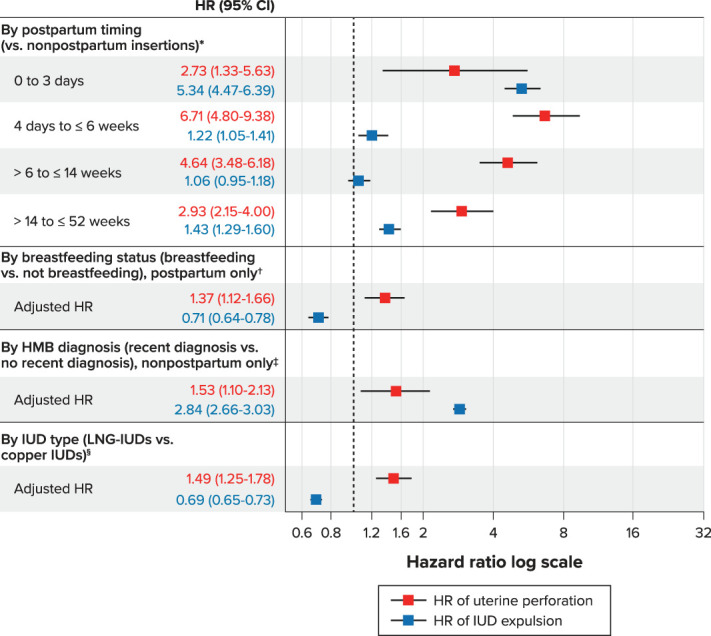
Among the study population of 326,658, absolute risk of uterine perforation was low overall (cumulative incidence, 0.21% [95% CI 0.19-0.23%] at 1 year and 0.61% [95% CI 0.56-0.66% at 5 years]) but was elevated for IUDs inserted during time intervals within 1 year postpartum, particularly among those between 4 days and 6 weeks postpartum (aHR 6.71, 95% CI 4.80-9.38), relative to nonpostpartum insertions. Among postpartum insertions, IUD expulsion risk was greatest for insertions in the immediate postpartum period (0-3 days after delivery) compared with nonpostpartum (aHR 5.34, 95% CI 4.47-6.39). Postpartum individuals who were breastfeeding had a slightly elevated risk of perforation and lowered risk of expulsion than those not breastfeeding. Among nonpostpartum individuals, those with a heavy menstrual bleeding diagnosis were at greater risk of expulsion than those without (aHR 2.84, 95% CI 2.66-3.03); heavy menstrual bleeding also was associated with a slightly elevated perforation risk. There was a slightly elevated perforation risk and slightly lower expulsion risk associated with levonorgestrel-releasing IUDs compared with copper IUDs.

CONCLUSION

Absolute risk of adverse outcomes with IUD insertion is low. Clinicians should be aware of the differences in risks of uterine perforation and expulsion associated with IUD insertion during specific postpartum time periods and with a heavy menstrual bleeding diagnosis. This information should be incorporated into counseling and decision making for patients considering IUD insertion.

FUNDING SOURCE

Bayer AG.

CLINICAL TRIAL REGISTRATION

EU PAS register, EUPAS33461.

摘要

目的

APEX-IUD(宫内节育器穿孔和脱落协会)研究评估了产后放置宫内节育器(IUD)的时间、母乳喂养、月经过多和 IUD 类型(左炔诺孕酮释放与铜)与子宫穿孔和 IUD 脱落风险之间的关联,这些都是在常规临床实践中。我们总结了这些有临床意义的发现,以便为咨询和共同决策提供信息。

方法

APEX-IUD 是一项真实世界(使用美国医疗保健数据)的回顾性队列研究,纳入了 2001 年至 2018 年间年龄在 50 岁及以下、有 IUD 植入史且有电子病历数据的个体。计算子宫穿孔和 IUD 脱落的累积发生率。采用比例风险模型估计调整后的危险比(aHR)和 95%CI,并控制混杂因素。

结果

在研究人群中(326658 例),子宫穿孔的绝对风险总体较低(1 年时的累积发生率为 0.21%[95%CI 0.19-0.23%],5 年时为 0.61%[95%CI 0.56-0.66%]),但在产后 1 年内的时间段内,IUD 插入的风险升高,尤其是产后 4 天至 6 周(aHR 6.71,95%CI 4.80-9.38)时,与非产后插入相比。在产后插入的情况下,与非产后插入相比,产后即刻(分娩后 0-3 天)的 IUD 脱落风险最高(aHR 5.34,95%CI 4.47-6.39)。与不母乳喂养的个体相比,母乳喂养的产后个体穿孔风险略有增加,而脱落风险略有降低。在非产后个体中,与无月经量大诊断的个体相比,月经过多诊断的个体脱落风险增加(aHR 2.84,95%CI 2.66-3.03);月经过多也与穿孔风险略有增加相关。与铜 IUD 相比,释放左炔诺孕酮的 IUD 与子宫穿孔风险略有增加和脱落风险略有降低相关。

结论

IUD 植入的不良事件绝对风险较低。临床医生应注意与特定产后时间段和月经过多诊断相关的 IUD 插入相关的子宫穿孔和脱落风险差异。这些信息应纳入考虑 IUD 植入的患者的咨询和决策中。

资金来源

拜耳公司。

临床试验注册

EUPAS33461,EU PAS 登记处。

https://cdn.ncbi.nlm.nih.gov/pmc/blobs/f62c/10424817/46f75a6d9afa/ong-142-641-g006.jpg
https://cdn.ncbi.nlm.nih.gov/pmc/blobs/f62c/10424817/dd0120ffeaf1/ong-142-641-g001.jpg
https://cdn.ncbi.nlm.nih.gov/pmc/blobs/f62c/10424817/46f75a6d9afa/ong-142-641-g006.jpg
https://cdn.ncbi.nlm.nih.gov/pmc/blobs/f62c/10424817/dd0120ffeaf1/ong-142-641-g001.jpg
https://cdn.ncbi.nlm.nih.gov/pmc/blobs/f62c/10424817/46f75a6d9afa/ong-142-641-g006.jpg

相似文献

1
Risks of Uterine Perforation and Expulsion Associated With Intrauterine Devices.宫内节育器相关的子宫穿孔和排出风险。
Obstet Gynecol. 2023 Sep 1;142(3):641-651. doi: 10.1097/AOG.0000000000005299. Epub 2023 Aug 3.
2
Design of the Association of Uterine Perforation and Expulsion of Intrauterine Device study: a multisite retrospective cohort study.《子宫穿孔与宫内节育器排出相关因素研究》设计:多中心回顾性队列研究。
Am J Obstet Gynecol. 2021 Jun;224(6):599.e1-599.e18. doi: 10.1016/j.ajog.2021.01.003. Epub 2021 Jan 15.
3
Association between menorrhagia and risk of intrauterine device-related uterine perforation and device expulsion: results from the Association of Uterine Perforation and Expulsion of Intrauterine Device study.月经过多与宫内节育器相关子宫穿孔和节育器脱落风险的关系:来自宫内节育器穿孔和脱落研究协会的结果。
Am J Obstet Gynecol. 2022 Jul;227(1):59.e1-59.e9. doi: 10.1016/j.ajog.2022.03.025. Epub 2022 Mar 12.
4
Demographic, Reproductive, and Medical Risk Factors for Intrauterine Device Expulsion.宫内节育器脱落的人口学、生殖和医学危险因素。
Obstet Gynecol. 2022 Dec 1;140(6):1017-1030. doi: 10.1097/AOG.0000000000005000. Epub 2022 Nov 2.
5
Association of the Timing of Postpartum Intrauterine Device Insertion and Breastfeeding With Risks of Intrauterine Device Expulsion.产后即时放置宫内节育器与母乳喂养时间与宫内节育器脱落风险的关系。
JAMA Netw Open. 2022 Feb 1;5(2):e2148474. doi: 10.1001/jamanetworkopen.2021.48474.
6
Association between intrauterine device type and risk of perforation and device expulsion: results from the Association of Perforation and Expulsion of Intrauterine Device study.宫内节育器类型与穿孔和器械脱落风险的关系:穿孔和宫内节育器脱落研究协会的研究结果。
Am J Obstet Gynecol. 2022 Jul;227(1):57.e1-57.e13. doi: 10.1016/j.ajog.2022.03.062. Epub 2022 Apr 5.
7
Intrauterine devices: an effective alternative to oral hormonal contraception.宫内节育器:口服激素避孕的有效替代方法。
Prescrire Int. 2009 Jun;18(101):125-30.
8
Intrauterine device-related uterine perforation incidence and risk (APEX-IUD): a large multisite cohort study.宫内节育器相关子宫穿孔的发生率和风险(APEX-IUD):一项大型多中心队列研究。
Lancet. 2022 Jun 4;399(10341):2103-2112. doi: 10.1016/S0140-6736(22)00015-0.
9
Postpartum IUDS: keys for success.产后宫内节育器:成功的关键
Contraception. 1992 Apr;45(4):351-61. doi: 10.1016/0010-7824(92)90057-z.
10
Complications after interval postpartum intrauterine device insertion.间隔产后宫内节育器放置后的并发症。
Am J Obstet Gynecol. 2022 Jan;226(1):95.e1-95.e8. doi: 10.1016/j.ajog.2021.08.028. Epub 2021 Aug 28.

引用本文的文献

1
A risk-based preoperative evaluation method and management strategy for removing intrauterine contraceptive devices in postmenopausal women.一种基于风险的绝经后妇女宫内节育器取出术前评估方法及管理策略。
Front Reprod Health. 2025 Aug 25;7:1576265. doi: 10.3389/frph.2025.1576265. eCollection 2025.
2
Expulsion rates 12 months after early versus interval postpartum intrauterine device placement: a randomized trial.早期与间隔期产后放置宫内节育器12个月后的排出率:一项随机试验
AJOG Glob Rep. 2025 Jul 20;5(3):100547. doi: 10.1016/j.xagr.2025.100547. eCollection 2025 Aug.
3
The rolling stone: migration of an intrauterine device leading to bladder stone formation nine years after insertion: a case report.
滚动的石头:宫内节育器移位导致放置九年后排尿结石形成:一例报告
BMC Urol. 2025 Apr 17;25(1):93. doi: 10.1186/s12894-025-01780-0.
4
Delayed diagnosis of concurrent intrauterine and intraperitoneal intrauterine devices following assumed expulsion: A case report.假定宫内节育器已排出后并发宫内和腹腔内宫内节育器的延迟诊断:一例报告。
Int J Surg Case Rep. 2025 May;130:111262. doi: 10.1016/j.ijscr.2025.111262. Epub 2025 Apr 4.
5
Development and functional evaluation of recombinant type III collagen intrauterine implant gel.重组III型胶原宫内植入凝胶的研制与功能评价
Regen Biomater. 2025 Mar 17;12:rbaf013. doi: 10.1093/rb/rbaf013. eCollection 2025.
6
Menstrual suppression to decrease intrauterine device expulsion in adolescents with inherited bleeding disorders.通过抑制月经来减少患有遗传性出血性疾病的青少年的宫内节育器排出。
Int J Gynaecol Obstet. 2025 Apr;169(1):421-423. doi: 10.1002/ijgo.16063. Epub 2024 Nov 25.
7
A Case Report of Intrauterine Device Migration: Uterine Penetration and Bladder Involvement with Secondary Stones 3 Years Post-Insertion.宫内节育器移位病例报告:插入后3年子宫穿透并累及膀胱继发结石
Int J Womens Health. 2024 Nov 9;16:1903-1907. doi: 10.2147/IJWH.S492865. eCollection 2024.