Nutrition Evidence Systematic Review, Office of Nutrition Guidance and Analysis (ONGA), Center for Nutrition Policy and Promotion (CNPP), US Department of Agriculture (USDA) Food and Nutrition Service (FNS), Alexandria, Virginia.
Panum Group, Bethesda, Maryland.
JAMA Netw Open. 2021 Aug 2;4(8):e2122277. doi: 10.1001/jamanetworkopen.2021.22277.
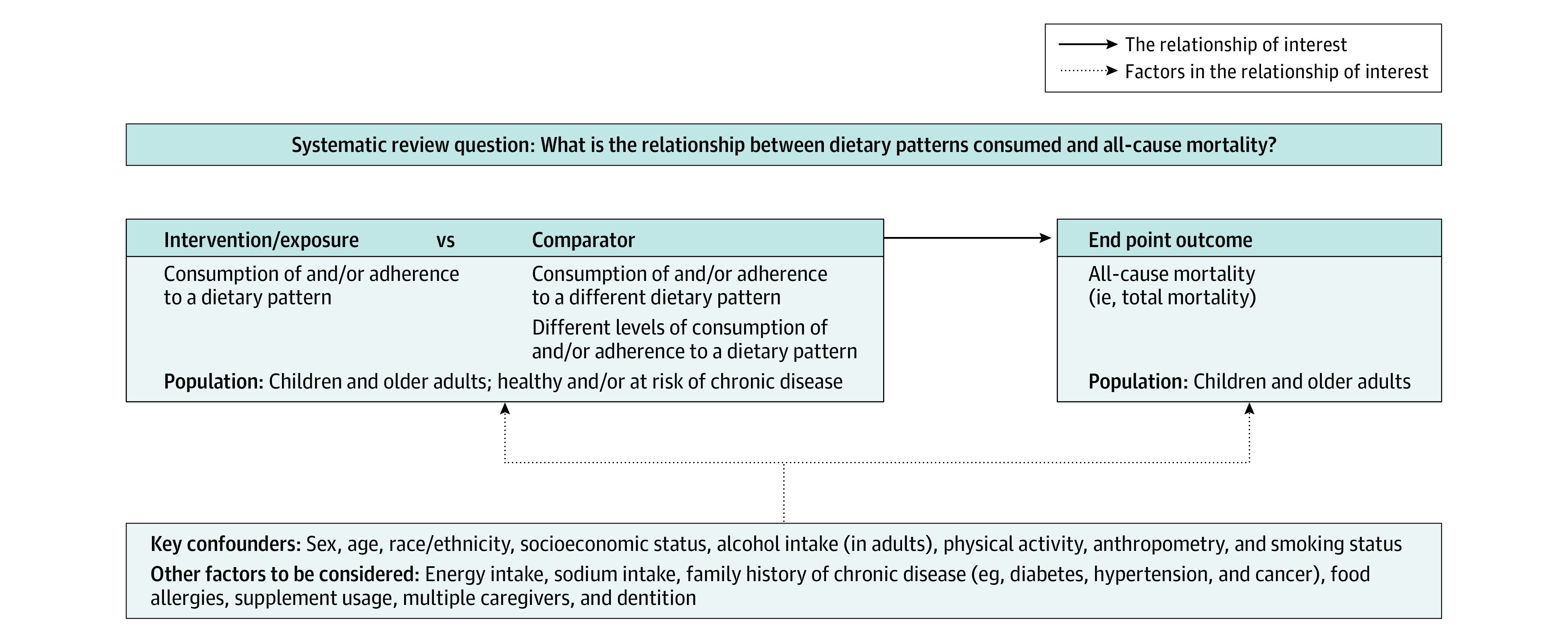
The 2020 Dietary Guidelines Advisory Committee conducted a systematic review of existing research on diet and health to inform the current Dietary Guidelines for Americans. The committee answered this public health question: what is the association between dietary patterns consumed and all-cause mortality (ACM)?
To ascertain the association between dietary patterns consumed and ACM.
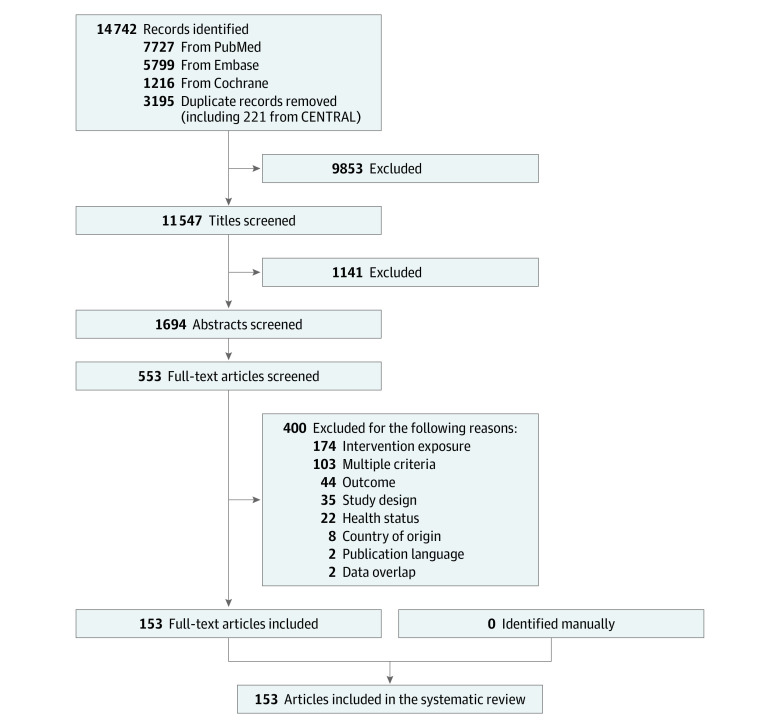
Guided by an analytical framework and predefined inclusion and exclusion criteria developed by the committee, the US Department of Agriculture's Nutrition Evidence Systematic Review (NESR) team searched PubMed, the Cochrane Central Register of Controlled Trials, and Embase and dual-screened the results to identify articles that were published between January 1, 2000, and October 4, 2019. These studies evaluated dietary patterns and ACM in participants aged 2 years and older. The NESR team extracted data from and assessed risk of bias in included studies. Committee members synthesized the evidence, developed conclusion statements, and graded the strength of the evidence supporting the conclusion statements.
A total of 1 randomized clinical trial and 152 observational studies were included in the review. Studies enrolled adults and older adults (aged 17-84 years at baseline) from 28 countries with high or very high Human Development Index; 53 studies originated from the US. Most studies were well designed, used rigorous methods, and had low or moderate risks of bias. Precision, directness, and generalizability were demonstrated across the body of evidence. Results across studies were highly consistent. Evidence suggested that dietary patterns in adults and older adults that involved higher consumption of vegetables, fruits, legumes, nuts, whole grains, unsaturated vegetable oils, fish, and lean meat or poultry (when meat was included) were associated with a decreased risk of ACM. These healthy patterns were also relatively low in red and processed meat, high-fat dairy, and refined carbohydrates or sweets. Some of these dietary patterns also included intake of alcoholic beverages in moderation. Results based on additional analyses with confounding factors generally confirmed the robustness of main findings.
In this systematic review, consuming a nutrient-dense dietary pattern was associated with reduced risk of death from all causes.
2020 年饮食指南顾问委员会对现有的饮食与健康研究进行了系统回顾,为当前的《美国人饮食指南》提供信息。委员会回答了这个公共卫生问题:消耗的饮食模式与全因死亡率(ACM)之间有什么关联?
确定消耗的饮食模式与 ACM 之间的关联。
在委员会制定的分析框架和预先确定的纳入和排除标准的指导下,美国农业部营养证据系统评价(NESR)团队搜索了 PubMed、Cochrane 对照试验中心注册库和 Embase,并对结果进行双重筛选,以确定发表于 2000 年 1 月 1 日至 2019 年 10 月 4 日的文章。这些研究评估了年龄在 2 岁及以上的参与者的饮食模式和 ACM。NESR 团队从纳入的研究中提取数据并评估偏倚风险。委员会成员综合证据,制定结论陈述,并对支持结论陈述的证据的强度进行分级。
该综述共纳入 1 项随机临床试验和 152 项观察性研究。研究纳入了来自 28 个人口发展指数较高或非常高的国家的成年人和老年人(基线时年龄为 17-84 岁);53 项研究源自美国。大多数研究设计良好,方法严谨,偏倚风险低或中度。整个证据体都显示了精确性、直接性和可推广性。研究结果高度一致。证据表明,成年人和老年人中涉及更高蔬菜、水果、豆类、坚果、全谷物、不饱和植物油、鱼类和瘦肉或禽肉(如果包含肉类)消耗的饮食模式与 ACM 风险降低有关。这些健康的模式也相对较少的红肉类和加工肉类、高脂肪乳制品以及精制碳水化合物或甜食。其中一些饮食模式还包括适量摄入酒精饮料。基于具有混杂因素的额外分析的结果通常证实了主要发现的稳健性。
在这项系统评价中,摄入营养密集型饮食模式与降低全因死亡率风险相关。