Saunders Catherine L, MacCarthy Sarah, Meads Catherine, Massou Efthalia, Mant Jonathan, Saunders Alison M, Elliott Marc N
Senior Research Associate, Primary Care Unit, Department of Public Health and Primary Care, University of Cambridge, Cambridge, UK.
Policy Researcher, RAND Corporation, Santa Monica, CA, US.
BJGP Open. 2021 Oct 26;5(5). doi: 10.3399/BJGPO.2021.0067. Print 2021 Oct.
Epidemiological evidence for specific long-term conditions is required to inform best practices regarding the substantial health inequalities experienced by sexual minority individuals compared with heterosexual peers.
To describe inequalities in long-term conditions among sexual minority (lesbian, gay, and bisexual [LGB]) adults.
DESIGN & SETTING: Cross-sectional analysis of 1 341 339 nationally representative survey responses from the English GP Patient Survey (GPPS).
Stratifying by sex, the weighted prevalence and covariate-adjusted association of 15 long-term conditions were calculated, comparing sexual minority and heterosexual adults, considering variation by sexual orientation and variation in sexual orientation inequalities by deprivation, ethnic group, region, and age.
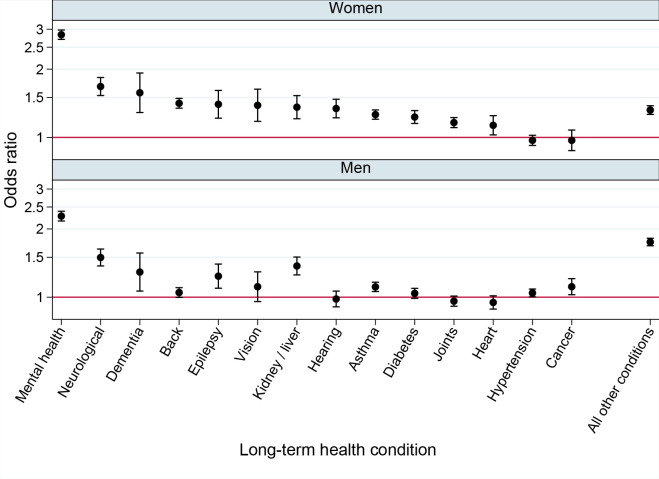
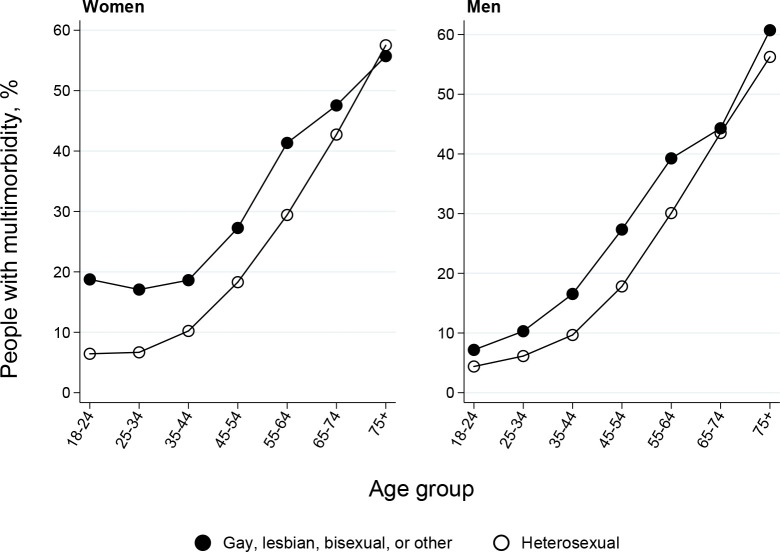
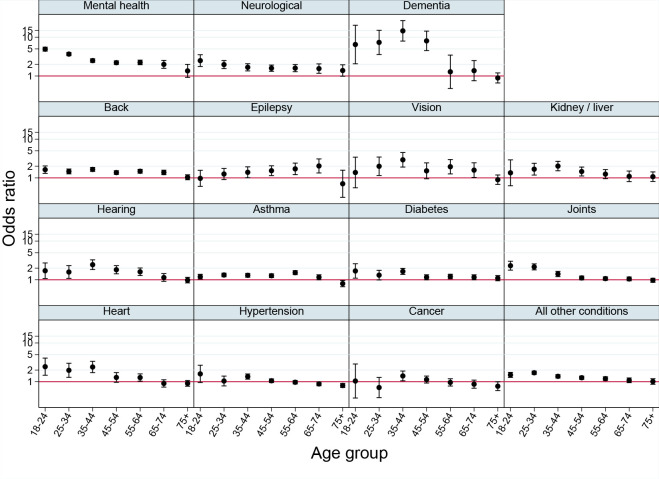
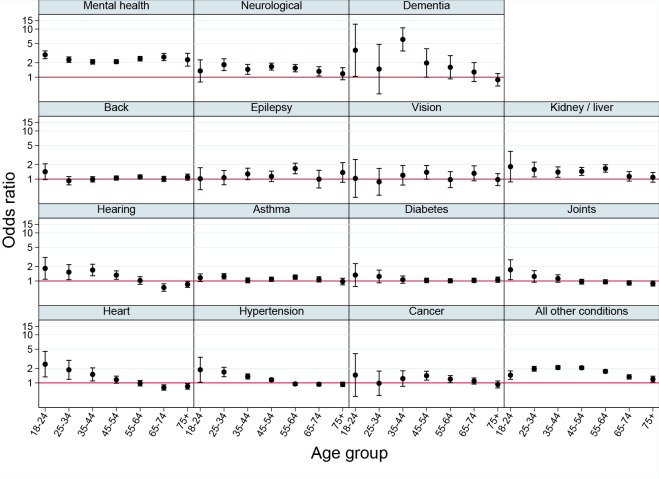
After adjusting for deprivation, ethnic group, region, and age, 13 long-term conditions (all except cancer and hypertension) were more prevalent among sexual minority women than their heterosexual peers, with the largest inequalities for mental health problems (odds ratio [OR] 2.8, 95% confidence interval [CI] = 2.7 to 3.0), neurological conditions (OR 1.7, 95% CI = 1.5 to 1.8), dementia (OR 1.6, 95% CI = 1.3 to 1.9), and back problems (OR 1.4, 95% CI = 1.3 to 1.5). It was found that nine long-term conditions were also more prevalent among sexual minority men including mental health problems (OR 2.3, 95% CI = 2.2 to 2.4), 'all other conditions' (OR 1.8, 95% CI = 1.7 to 1.8), neurological conditions (OR 1.5, 95% CI = 1.4 to 1.6), and kidney or liver disease (OR 1.4, 95% CI = 1.3 to 1.5); inequalities were often largest for bisexual adults. Inequalities did not vary significantly by deprivation, ethnic group, or region except for mental health problems. Inequalities in multimorbidity were highest at younger ages; for example, LGB women aged 18-24 years had multimorbidity at the same level (approximately 20%) as heterosexual women aged 45-54 years.
Sexual minority adults, especially bisexual adults, are at elevated risk for many long-term conditions and multimorbidity; this risk spans socioeconomic status and ethnic group, representing a significant healthcare challenge.
需要特定长期疾病的流行病学证据,以指导有关性少数群体个体与异性恋同龄人相比所经历的重大健康不平等问题的最佳实践。
描述性少数群体(女同性恋、男同性恋和双性恋[LGB])成年人在长期疾病方面的不平等情况。
对来自英国全科医生患者调查(GPPS)的1341339份具有全国代表性的调查回复进行横断面分析。
按性别分层,计算15种长期疾病的加权患病率和经协变量调整后的关联,比较性少数群体和异性恋成年人,并考虑性取向的差异以及按贫困程度、种族、地区和年龄划分的性取向不平等差异。
在对贫困程度、种族、地区和年龄进行调整后,13种长期疾病(除癌症和高血压外)在性少数群体女性中比其异性恋同龄人更为普遍,心理健康问题的不平等最为显著(优势比[OR]为2.8,95%置信区间[CI]=2.7至3.0),神经系统疾病(OR为1.7,95%CI=1.5至1.8),痴呆(OR为1.6,95%CI=1.3至1.9),以及背部问题(OR为1.4,95%CI=1.3至1.5)。研究发现,9种长期疾病在性少数群体男性中也更为普遍,包括心理健康问题(OR为2.3,95%CI=2.2至2.4),“所有其他疾病”(OR为1.8,95%CI=1.7至1.8),神经系统疾病(OR为1.5,95%CI=1.4至1.6),以及肾脏或肝脏疾病(OR为1.4,95%CI=1.3至1.5);双性恋成年人的不平等往往最为显著。除心理健康问题外,不平等在贫困程度、种族或地区方面没有显著差异。多种疾病并存的不平等在较年轻年龄段最高;例如,18 - 24岁的LGB女性的多种疾病并存水平(约20%)与45 - 54岁的异性恋女性相同。
性少数群体成年人,尤其是双性恋成年人,患多种长期疾病和多种疾病并存的风险较高;这种风险跨越社会经济地位和种族,是一个重大的医疗挑战。