Nussinov Ruth, Zhang Mingzhen, Maloney Ryan, Jang Hyunbum
Computational Structural Biology Section Leidos Biomedical Research, Inc., Frederick National Laboratory for Cancer Research in the Laboratory of Cancer Immunometabolism National Cancer Institute, 1050 Boyles St, Frederick, MD 21702 USA.
Department of Human Molecular Genetics and Biochemistry, Sackler School of Medicine Tel Aviv University, 69978 Tel Aviv, Israel.
Biophys Rev. 2021 Jul 31;13(4):489-505. doi: 10.1007/s12551-021-00817-6. eCollection 2021 Aug.
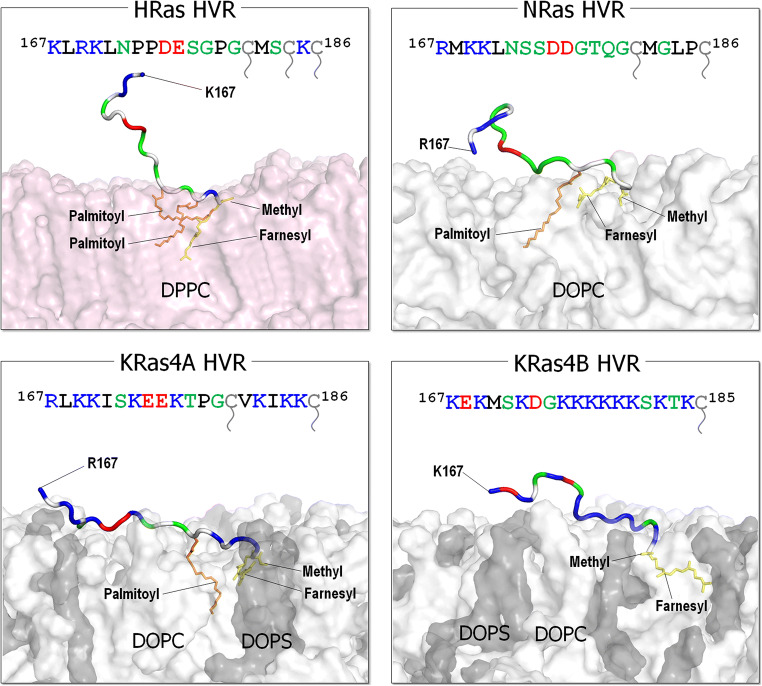
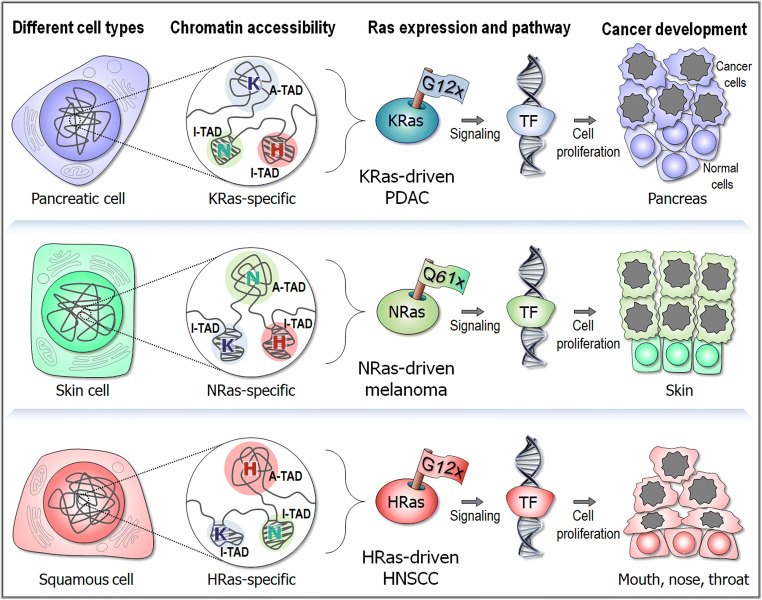
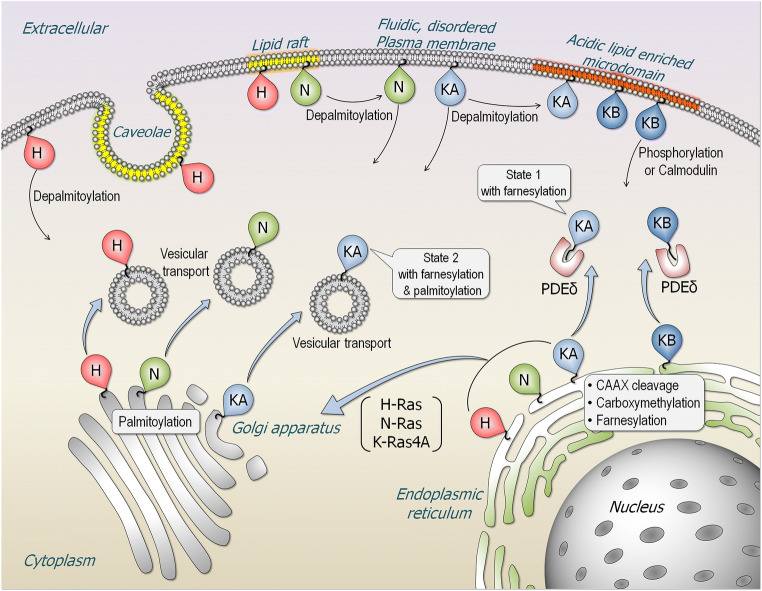
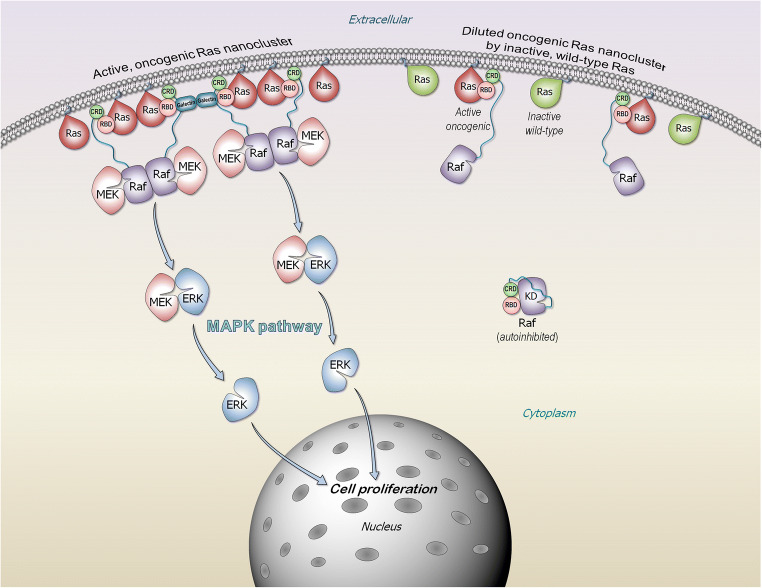
The anchorage of Ras isoforms in the membrane and their nanocluster formations have been studied extensively, including their detailed interactions, sizes, preferred membrane environments, chemistry, and geometry. However, the staggering challenge of their epigenetics and chromatin accessibility in distinct cell states and types, which we propose is a major factor determining their specific expression, still awaits unraveling. Ras isoforms are distinguished by their C-terminal hypervariable region (HVR) which acts in intracellular transport, regulation, and membrane anchorage. Here, we review some isoform-specific activities at the plasma membrane from a structural dynamic standpoint. Inspired by physics and chemistry, we recognize that understanding functional specificity requires insight into how biomolecules can organize themselves in different cellular environments. Within this framework, we suggest that isoform-specific expression may largely be controlled by the chromatin density and physical compaction, which allow (or curb) access to "chromatinized DNA." Genes are preferentially expressed in tissues: proteins expressed in pancreatic cells may not be equally expressed in lung cells. It is the rule-not an exception, and it can be at least partly understood in terms of chromatin organization and accessibility state. Genes are expressed when they can be sufficiently exposed to the transcription machinery, and they are less so when they are persistently buried in dense chromatin. Notably, chromatin accessibility can similarly determine expression of drug resistance genes.
Ras 亚型在膜中的锚定及其纳米簇的形成已得到广泛研究,包括它们的详细相互作用、大小、偏好的膜环境、化学性质和几何形状。然而,在不同细胞状态和类型中,它们的表观遗传学和染色质可及性这一巨大挑战仍有待揭示,我们认为这是决定它们特定表达的主要因素。Ras 亚型通过其 C 末端高变区(HVR)来区分,该区域在细胞内运输、调节和膜锚定中起作用。在这里,我们从结构动力学的角度回顾了一些在质膜上的亚型特异性活动。受物理和化学启发,我们认识到理解功能特异性需要深入了解生物分子如何在不同细胞环境中自我组织。在此框架内,我们认为亚型特异性表达可能很大程度上受染色质密度和物理压缩的控制,这允许(或抑制)对“染色质化 DNA”的访问。基因在组织中优先表达:胰腺细胞中表达的蛋白质在肺细胞中可能不会等量表达。这是规则而非例外,并且至少可以部分地从染色质组织和可及性状态的角度来理解。当基因能够充分暴露于转录机制时就会表达,而当它们持续埋在致密染色质中时则表达较少。值得注意的是,染色质可及性同样可以决定耐药基因的表达。