Institute of Basic Research in Clinical Medicine, China Academy of Chinese Medical Sciences, Beijing, China.
Department of Cardiology, Chinese PLA General Hospital, Beijing, China.
Signal Transduct Target Ther. 2021 Sep 1;6(1):329. doi: 10.1038/s41392-021-00741-x.
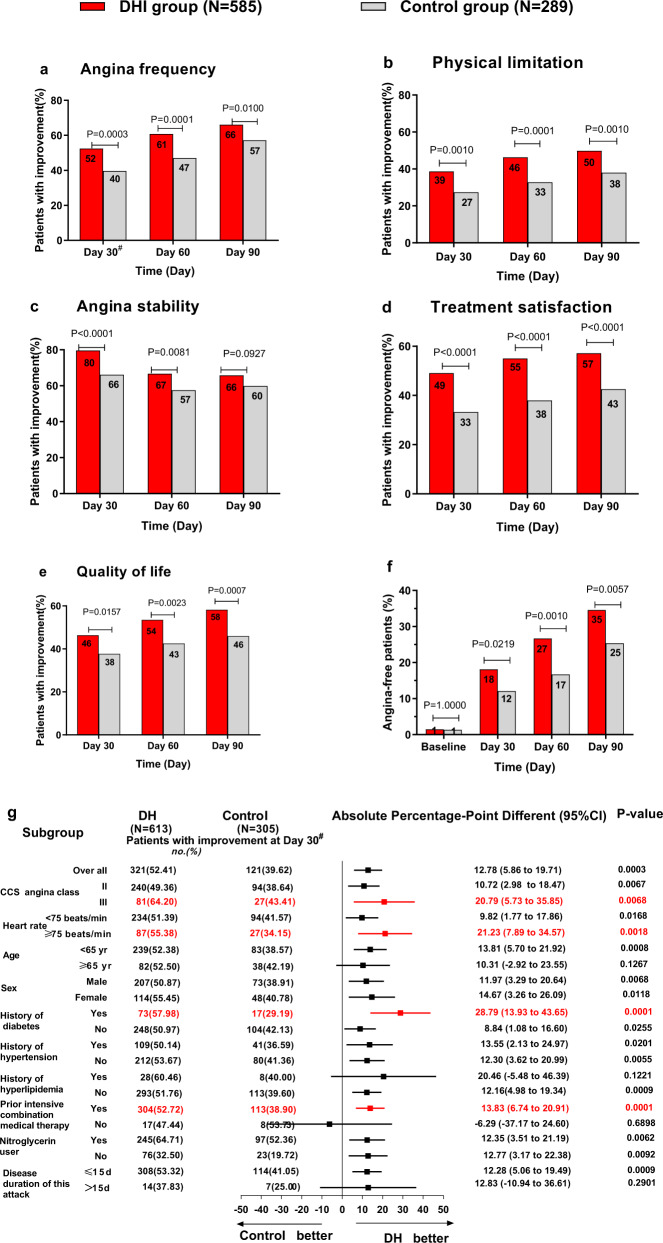
It's a challenge for detecting the therapeutic targets of a polypharmacological drug from variations in the responsed networks in the differentiated populations with complex diseases, as stable coronary heart disease. Here, in an adaptive, 31-center, randomized, double-blind trial involving 920 patients with moderate symptomatic stable angina treated by 14-day Danhong injection(DHI), a kind of polypharmacological drug with high quality control, or placebo (0.9% saline), with 76-day following-up, we firstly confirmed that DHI could increase the proportion of patients with clinically significant changes on angina-frequency assessed by Seattle Angina Questionnaire (ΔSAQ-AF ≥ 20) (12.78% at Day 30, 95% confidence interval [CI] 5.86-19.71%, P = 0.0003, 13.82% at Day 60, 95% CI 6.82-20.82%, P = 0.0001 and 8.95% at Day 90, 95% CI 2.06-15.85%, P = 0.01). We also found that there were no significant differences in new-onset major vascular events (P = 0.8502) and serious adverse events (P = 0.9105) between DHI and placebo. After performing the RNA sequencing in 62 selected patients, we developed a systemic modular approach to identify differentially expressed modules (DEMs) of DHI with the Z value less than 0 compared with the control group, calculated by weighted gene co-expression network analysis (WGCNA), and sketched out the basic framework on a modular map with 25 functional modules targeted by DHI. Furthermore, the effective therapeutic module (ETM), defined as the highest correlation value with the phenotype alteration (ΔSAQ-AF, the change in SAQ-AF at Day 30 from baseline) calculated by WGCNA, was identified in the population with the best effect (ΔSAQ-AF ≥ 40), which is related to anticoagulation and regulation of cholesterol metabolism. We assessed the modular flexibility of this ETM using the global topological D value based on Euclidean distance, which is correlated with phenotype alteration (r: 0.8204, P = 0.019) by linear regression. Our study identified the anti-angina therapeutic module in the effective population treated by the multi-target drug. Modular methods facilitate the discovery of network pharmacological mechanisms and the advancement of precision medicine. (ClinicalTrials.gov identifier: NCT01681316).
从患有复杂疾病(如稳定型冠心病)的分化人群中响应网络的变化来检测多效药物的治疗靶点,这是一项挑战。在这里,我们进行了一项适应性、31 中心、随机、双盲试验,纳入了 920 名患有中度有症状稳定型心绞痛的患者,他们接受了 14 天丹红注射液(DHI)或安慰剂(0.9%生理盐水)治疗,随访 76 天。我们首次证实 DHI 可增加西雅图心绞痛问卷(SAQ-AF)评估的心绞痛频率有临床显著变化的患者比例(第 30 天为 12.78%,95%置信区间[CI]5.86-19.71%,P=0.0003,第 60 天为 13.82%,95%CI6.82-20.82%,P=0.0001,第 90 天为 8.95%,95%CI2.06-15.85%,P=0.01)。我们还发现 DHI 与安慰剂之间新发主要血管事件(P=0.8502)和严重不良事件(P=0.9105)无显著差异。对 62 名入选患者进行 RNA 测序后,我们采用系统模块方法通过加权基因共表达网络分析(WGCNA),以 Z 值小于 0 与对照组相比,识别出 DHI 的差异表达模块(DEM),并在模块化图谱上绘制出 25 个针对 DHI 的功能模块的基本框架。此外,定义有效治疗模块(ETM)为 WGCNA 计算的与表型改变(SAQ-AF 变化,第 30 天从基线的 SAQ-AF 变化)相关性最高的模块,该模块在疗效最佳(SAQ-AF≥40)的人群中被识别出来,与抗凝和胆固醇代谢调节有关。我们使用基于欧几里得距离的全局拓扑 D 值评估了该 ETM 的模块灵活性,该值与表型改变(r:0.8204,P=0.019)相关通过线性回归。我们的研究确定了多靶药物治疗有效人群的抗心绞痛治疗模块。模块方法有助于发现网络药理学机制并推进精准医学。(临床试验.gov 标识符:NCT01681316)。