Department of Nephrology and Rheumatology, Aichi Medical University, Nagakute, Aichi, Japan.
Department of Anatomy, Aichi Medical University School of Medicine, Nagakute, Aichi, Japan.
Physiol Rep. 2021 Sep;9(17):e15019. doi: 10.14814/phy2.15019.
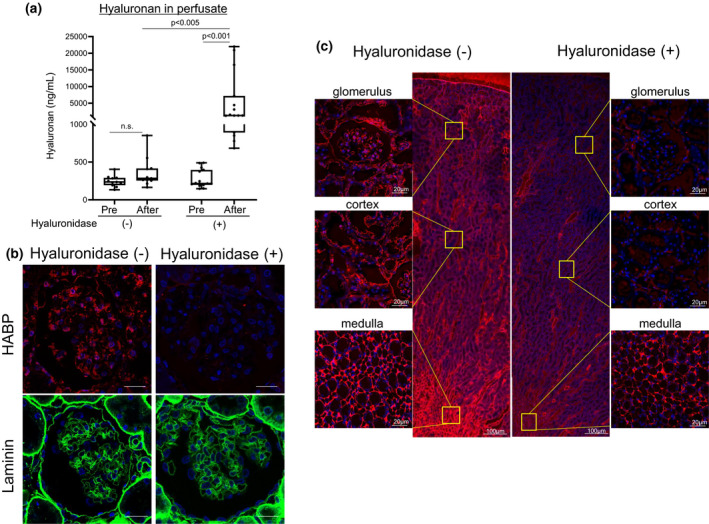
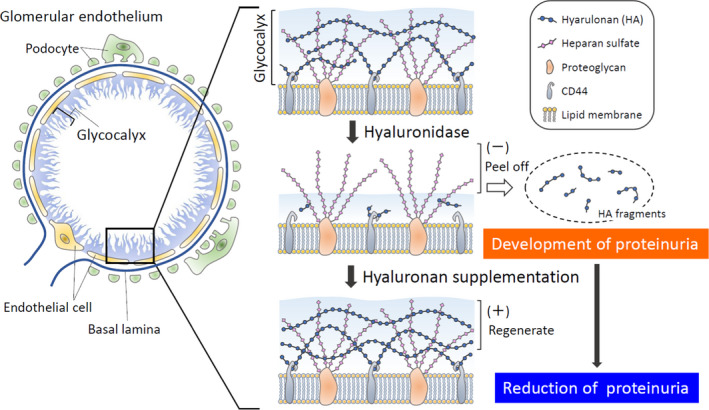
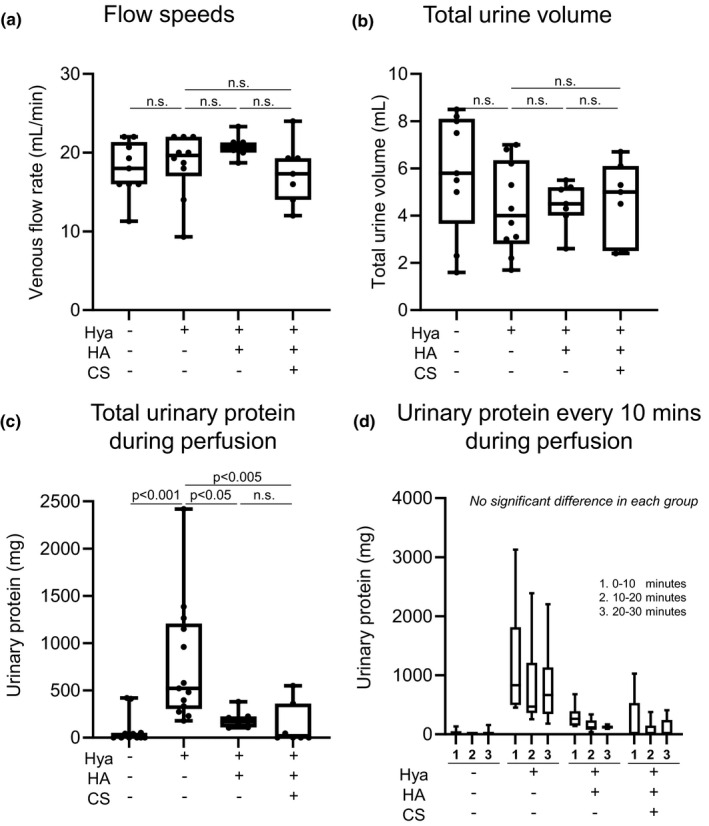
Vascular endothelial cells are covered with glycocalyx comprising heparan sulfate, hyaluronan, chondroitin sulfate, and associated proteins. Glomerular endothelial glycocalyx is involved in protecting against induction of proteinuria and structural damage, but the specific components in glycocalyx that represent therapeutic targets remain unclear. Anti-vascular endothelial growth factor (VEGF) therapy is associated with an increased risk of glomerular endothelial injury. This study investigated whether hyaluronan could provide a therapeutic target to protect against proteinuria. We conducted ex vivo and in vivo experiments to explore the effects of degrading glomerular hyaluronan by administering hyaluronidase and of supplementation with hyaluronan. We investigated hyaluronan expression using biotin-labeled hyaluronan-binding protein (HABP) in human kidney specimens or serum hyaluronan in endothelial injuries under inhibition of VEGF signaling. We directly demonstrated hyaluronan in glomerular endothelial layers using HABP staining. Ex vivo and in vivo experiments showed the development of proteinuria after digestion of hyaluronan in glomerular capillaries. Supplementation with hyaluronan after hyaluronidase treatment suppressed proteinuria. Mice in the in vivo study developed albuminuria after intraperitoneal injection of hyaluronidase with decreased glomerular hyaluronan and increased serum hyaluronan. In human kidneys with endothelial cell dysfunction and proteinuria due to inhibition of VEGF, glomerular expression of hyaluronan was reduced even in normal-appearing glomeruli. Serum hyaluronan levels were elevated in patients with pre-eclampsia with VEGF signaling inhibition. Our data suggest that hyaluronan itself plays crucial roles in preventing proteinuria and preserving the integrity of endothelial cells. Hyaluronan could provide a therapeutic target for preventing glomerular endothelial glycocalyx damage, including VEGF signaling inhibition.
血管内皮细胞被糖萼覆盖,糖萼包含肝素硫酸盐、透明质酸、硫酸软骨素和相关蛋白。肾小球内皮糖萼参与保护免受蛋白尿和结构损伤的诱导,但糖萼中代表治疗靶点的特定成分仍不清楚。抗血管内皮生长因子 (VEGF) 治疗与肾小球内皮损伤的风险增加有关。本研究探讨了透明质酸是否可以提供治疗靶点以防止蛋白尿。我们进行了离体和体内实验,以探索通过给予透明质酸酶降解肾小球透明质酸和补充透明质酸来保护免受蛋白尿的影响。我们使用生物素标记的透明质酸结合蛋白 (HABP) 研究了人类肾脏标本中的透明质酸表达,或在 VEGF 信号抑制下内皮损伤时的血清透明质酸。我们使用 HABP 染色直接显示肾小球内皮层中的透明质酸。离体和体内实验表明,在肾小球毛细血管中透明质酸消化后会发展为蛋白尿。在透明质酸酶处理后补充透明质酸可抑制蛋白尿。在体内研究中,在腹腔内注射透明质酸酶后,由于 VEGF 抑制,小鼠出现白蛋白尿,肾小球透明质酸减少,血清透明质酸增加。在由于 VEGF 抑制而导致内皮细胞功能障碍和蛋白尿的人类肾脏中,即使在外观正常的肾小球中,肾小球透明质酸的表达也减少。VEGF 信号抑制的子痫前期患者血清透明质酸水平升高。我们的数据表明,透明质酸本身在防止蛋白尿和维持内皮细胞完整性方面发挥着关键作用。透明质酸可以为预防肾小球内皮糖萼损伤提供治疗靶点,包括 VEGF 信号抑制。