Department of Pharmacology, The Third Affiliated Hospital of Sun Yat Sen University, Guangzhou, Guangdong 510630, P.R. China.
Department of Hematology, The Third Affiliated Hospital of Sun Yat Sen University, Guangzhou, Guangdong 510630, P.R. China.
Int J Oncol. 2021 Oct;59(4). doi: 10.3892/ijo.2021.5260. Epub 2021 Sep 3.
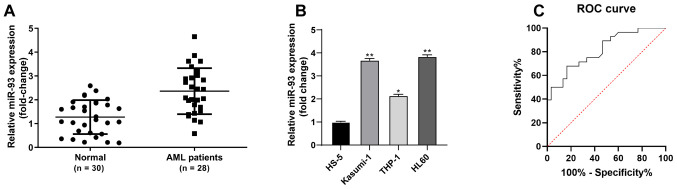
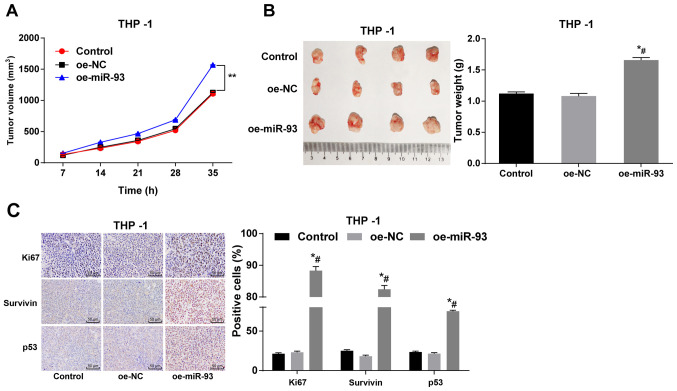
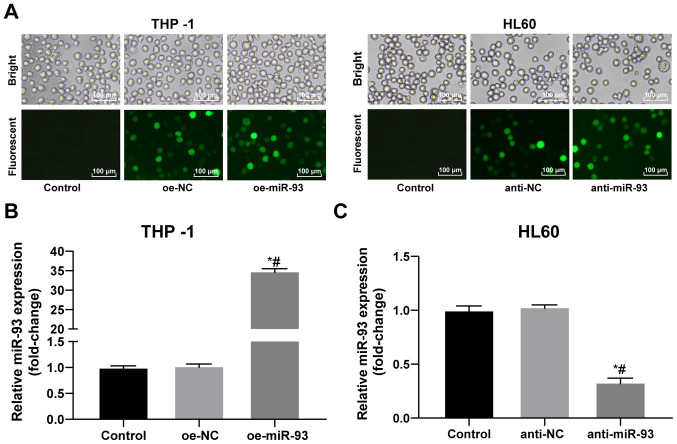
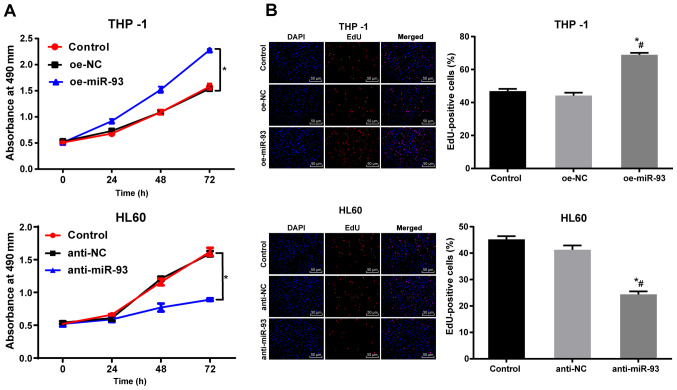
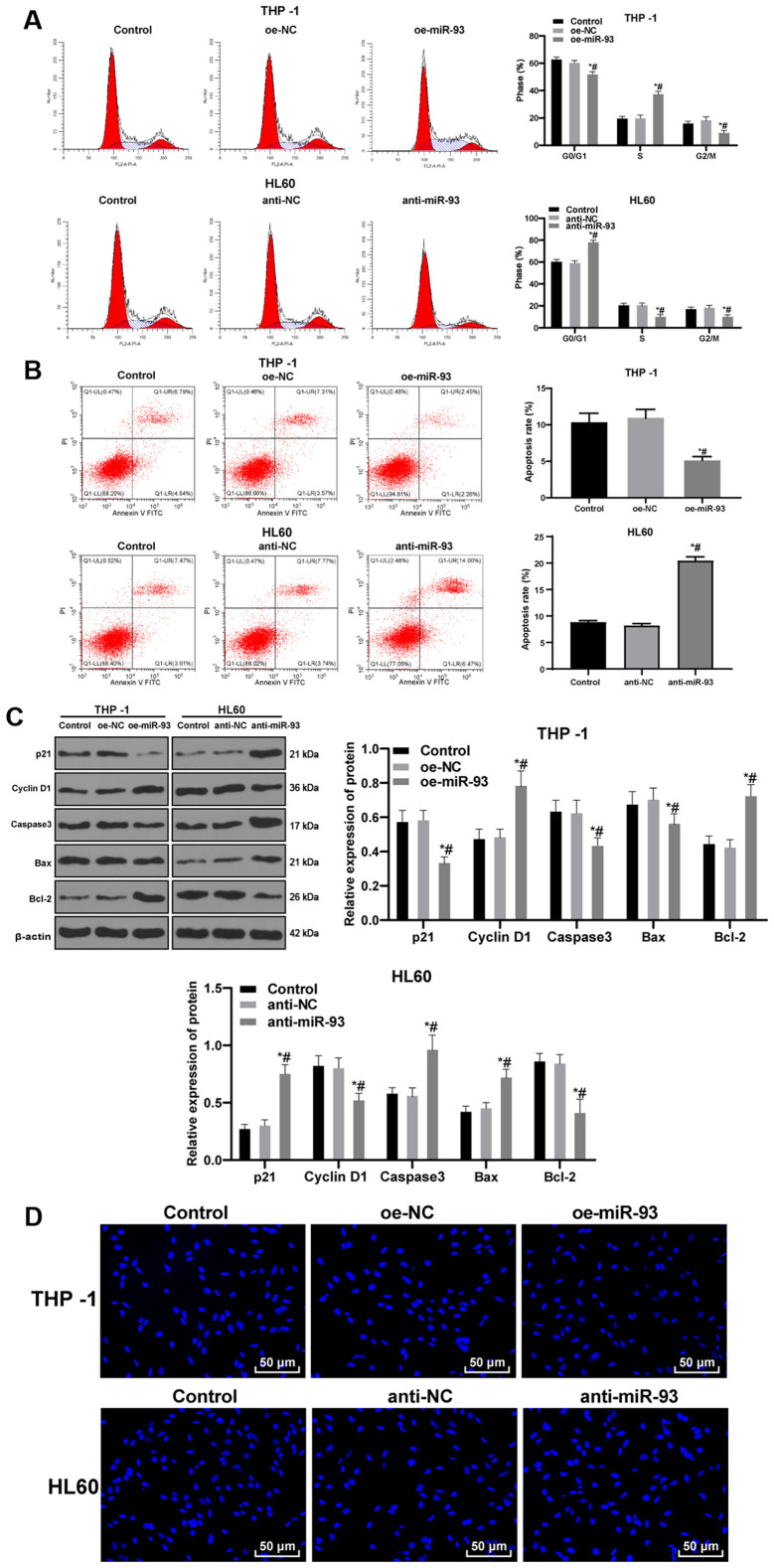
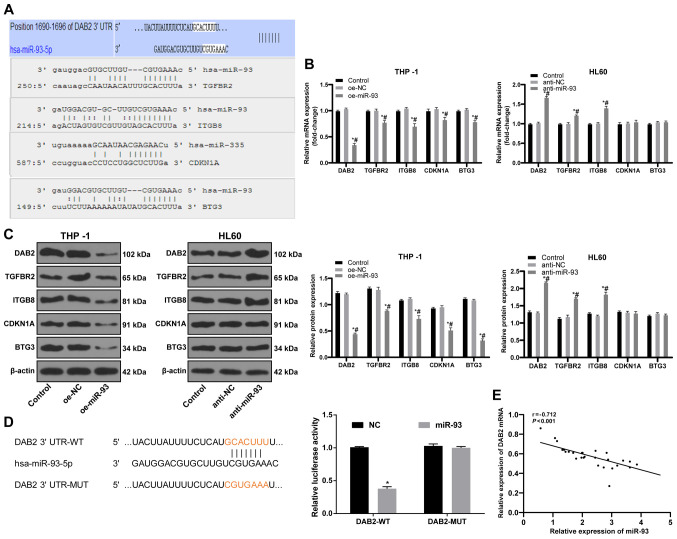
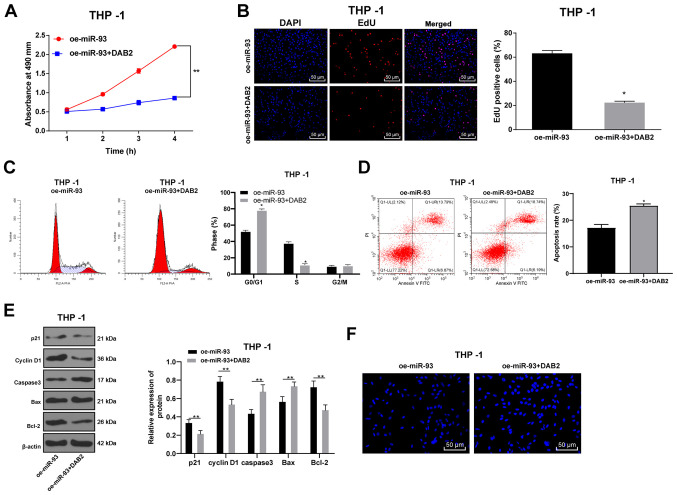
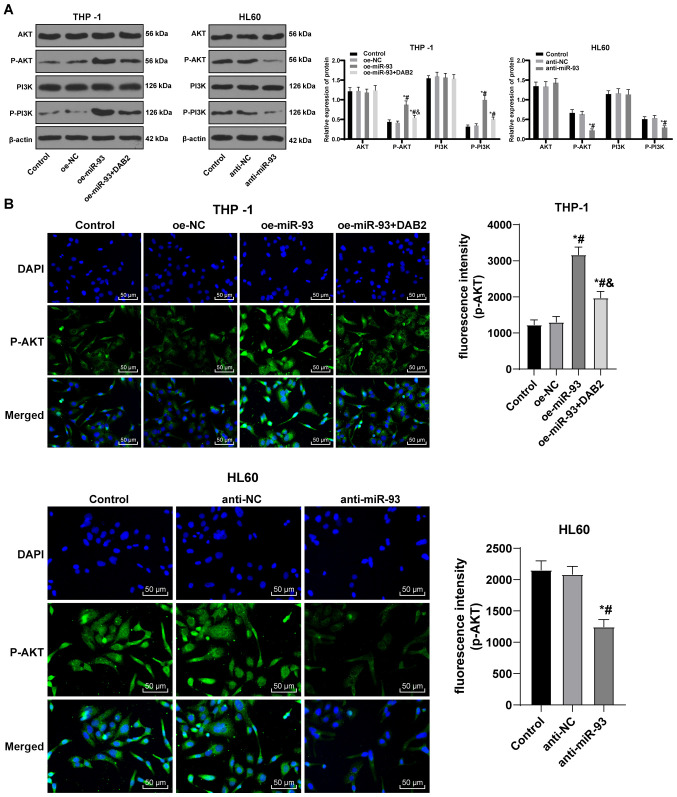
Acute myeloid leukemia (AML) is associated with a poor prognosis in elderly adults and currently lacks optimal treatment strategies. MicroRNAs (miRNAs or miRs) have increasingly been reported to be associated with AML progression; however, the mechanisms of action of miR‑93 in AML with the involvement of disabled 2 (DAB2) are currently unknown. In the present study, miR‑93 expression was assessed in patients with AML and in AML cell lines. The association between miR‑93 expression and the pathological characteristics of patients with AML was analyzed. AML cells were then transfected to knockdown or overexpress miR‑93 in order to elucidate its function in AML progression. The target gene of miR‑93 was assessed using a dual‑luciferase reporter gene assay. The expression levels of miR‑93, DAB2 and phosphatidylinositol 3‑kinase (PI3K)/protein kinase B (AKT) pathway‑related proteins were measured and in vivo experiments were conducted to confirm the results. It was observed that miR‑93 was highly expressed in patients with AML and in AML cells. The knockdown of miR‑93 in HL‑60 cells inhibited AML cell proliferation and resistance to apoptosis, while the overexpression of miR‑93 in THP‑1 cells led to contrasting results. Moreover, miR‑93 targeted DAB2 to inactivate the PI3K/AKT pathway, and the overexpression of DAB2 reversed the effects of miR‑93 on THP‑1 cell growth. Tumor volume, tumor weight, and the positive expression of Ki67, survivin and p53 were increased in THP‑1 cells overexpressing miR‑93. On the whole, the present study demonstrates that miR‑93 is highly expressed in AML cells, and that the suppression of miR‑93 inhibits AML cell growth by targeting DAB2 and inhibiting the PI3K/AKT pathway.
急性髓细胞白血病(AML)与老年人预后不良相关,目前缺乏最佳的治疗策略。越来越多的研究报道表明,microRNAs(miRNAs 或 miRs)与 AML 的进展有关;然而,miR-93 在涉及Disabled 2(DAB2)的 AML 中的作用机制目前尚不清楚。在本研究中,评估了 AML 患者和 AML 细胞系中 miR-93 的表达。分析了 miR-93 表达与 AML 患者病理特征之间的关系。然后通过转染 AML 细胞来敲低或过表达 miR-93,以阐明其在 AML 进展中的作用。使用双荧光素酶报告基因检测评估 miR-93 的靶基因。测定 miR-93、DAB2 和磷脂酰肌醇 3-激酶(PI3K)/蛋白激酶 B(AKT)通路相关蛋白的表达水平,并进行体内实验以验证结果。结果观察到,miR-93 在 AML 患者和 AML 细胞中高表达。在 HL-60 细胞中敲低 miR-93 抑制 AML 细胞增殖和抗凋亡能力,而在 THP-1 细胞中过表达 miR-93 则导致相反的结果。此外,miR-93 靶向 DAB2 以失活 PI3K/AKT 通路,而过表达 DAB2 逆转了 miR-93 对 THP-1 细胞生长的影响。过表达 miR-93 的 THP-1 细胞的肿瘤体积、肿瘤重量以及 Ki67、存活素和 p53 的阳性表达均增加。总的来说,本研究表明 miR-93 在 AML 细胞中高表达,通过靶向 DAB2 抑制 PI3K/AKT 通路抑制 miR-93 可抑制 AML 细胞生长。