National Veterinary Research Institute, Vom, Nigeria.
The Pirbright Institute, Pirbright, UK; European Commission for the Control of Foot-and-Mouth Disease (EuFMD), Food and Agriculture Organization of the United Nations, Rome, Italy.
Prev Vet Med. 2021 Nov;196:105473. doi: 10.1016/j.prevetmed.2021.105473. Epub 2021 Aug 24.
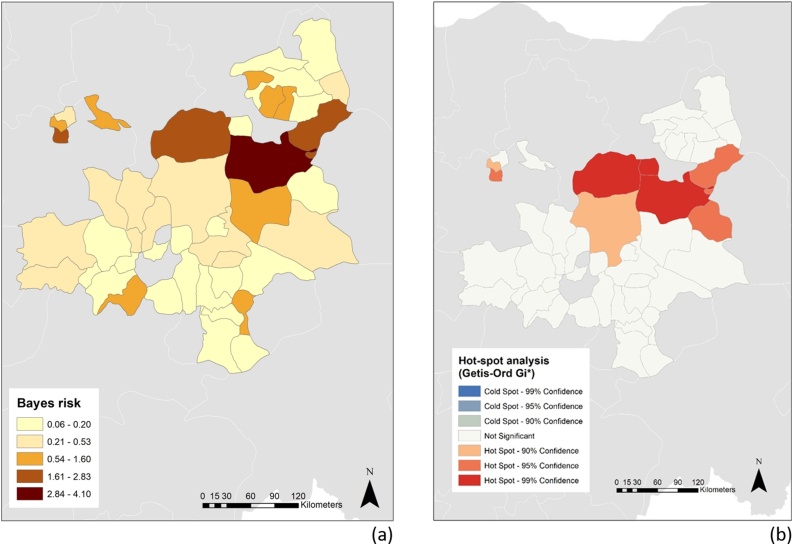
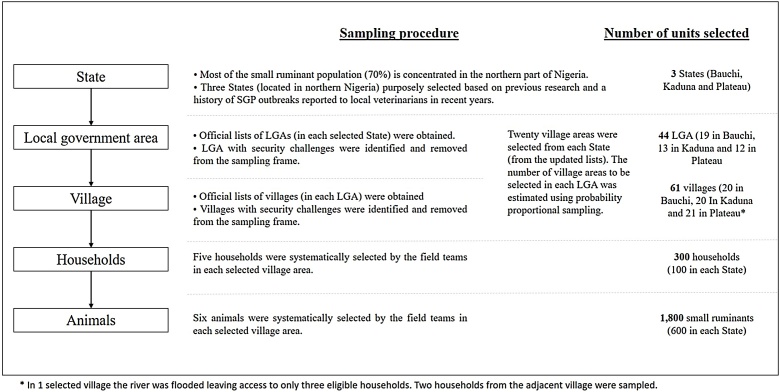
Sheeppox and goatpox (SGP) are transboundary, highly contagious diseases affecting sheep and goats with characteristic clinical signs. SGP affect populations of small ruminants in Africa, Asia and the Middle East and, as a result, threaten farmers' livelihoods. Despite their importance, studies looking at factors that increase the risk of sheeppox-virus (SPPV) and goatpox-virus (GTPV) exposure and infection are limited. A cross-sectional study was conducted in three states of Northern Nigeria (Bauchi, Kaduna and Plateau) to determine the sero-prevalence and spatial patterns of SGP, and identify risk factors for SPPV/GTPV exposure at animal and household level. Sera samples were collected from 1,800 small ruminants from 300 households. Data on putative risk factors were collected using a standardised questionnaire. Twenty-nine small ruminants were sero-positive to SGP - apparent weighted sero-prevalence 2.0 %; 95 % C.I. 1.1-.3.0 %. Sero-positive animals came from 19 (6.3 %) households. Analysis of the questionnaire showed that a fifth (20.3 %) of farmers claimed to have experienced SGP outbreaks previously in their flocks, with 33 (1.8 %) of the individual animals sampled in this study reported to have had clinical signs. At animal level, the odds of being sero-positive were higher in older animals (>24months; OR = 8.0, p = 0.008 vs ≤24 months) and small ruminants with a history of clinical SGP (OR = 16.9, p = 0.01). Bringing new small ruminants into the household and having a history of SGP in the flock were the main factors identified at household level. Households were less likely to be sero-positive if the time between bringing animals into the household and sampling was over a year (PR = 0.31, p = 0.05), while households with a history of SGP were more likely to be sero-positive regardless of the timeframe. Important spatial heterogeneity was found. The Bayes smooth rate ranged from 0.06 to 4.10 % across local government areas (LGA), with LGA in the north-east or north-west of the study area identified as hot-spots for SGP exposure. Results from this study shed new light on the understanding of SGP epidemiology and provide key inputs to design risk-based surveillance and intervention programmes in the area.
绵羊痘和山羊痘(SGP)是具有特征性临床症状的、影响绵羊和山羊的跨界、高度传染性疾病。SGP 影响非洲、亚洲和中东的小反刍动物种群,因此威胁到农民的生计。尽管它们很重要,但研究增加绵羊痘病毒(SPPV)和山羊痘病毒(GTPV)暴露和感染风险的因素的研究有限。在尼日利亚北部的三个州(包奇、卡杜纳和高原)进行了一项横断面研究,以确定 SGP 的血清流行率和空间模式,并确定动物和家庭层面 SPPV/GTPV 暴露的风险因素。从 300 户家庭的 1800 只小反刍动物中采集血清样本。使用标准化问卷收集有关假定风险因素的数据。29 只小反刍动物血清呈 SGP 阳性-明显加权血清流行率为 2.0%;95%置信区间为 1.1-3.0%。血清阳性动物来自 19 户(6.3%)家庭。对问卷的分析表明,五分之一(20.3%)的农民声称他们的羊群以前曾经历过 SGP 暴发,在本研究中抽样的 33 只(1.8%)个体动物报告有临床症状。在动物层面,年龄较大(>24 个月;OR=8.0,p=0.008 与≤24 个月)和有临床 SGP 病史的小反刍动物的血清阳性几率更高(OR=16.9,p=0.01)。将新的小反刍动物带入家庭以及家庭羊群中存在 SGP 病史是在家庭层面确定的主要因素。如果将动物带入家庭和采样之间的时间超过一年,家庭的血清阳性几率较低(PR=0.31,p=0.05),而无论时间框架如何,有 SGP 病史的家庭更有可能呈血清阳性。发现了重要的空间异质性。地方政府区(LGA)的贝叶斯平滑率范围为 0.06 至 4.10%,研究区域东北部或西北部的 LGA 被确定为 SGP 暴露的热点地区。本研究的结果为了解 SGP 流行病学提供了新的见解,并为该地区设计基于风险的监测和干预计划提供了关键投入。