Key Laboratory of Resource Biology and Biotechnology in Western China, Ministry of Education, College of Life Sciences, Institute of Maternal and Infant health, Northwest University, Xi'an, 710069, Shanxi Province, China.
Department of Orthopaedic, Tianjin Medical University General Hospital, Anshan Road No.154, Tianjin, 300052, Heping District, China.
BMC Complement Med Ther. 2021 Sep 3;21(1):222. doi: 10.1186/s12906-021-03389-w.
Increasing attention has been paid to the effect of Epimedium on the nervous system, particularly anti-depression function. In the present study, we applied network pharmacology to introduce a testable hypothesis on the multi-target mechanisms of Epicedium against depression.
By reconstructing the network of protein-protein interaction and drug-component-target, we predicted the key protein targets of Epicedium for the treatment of depression. Then, through molecular docking, the interaction of the main active components of Epicedium and predicted candidate targets were verified.
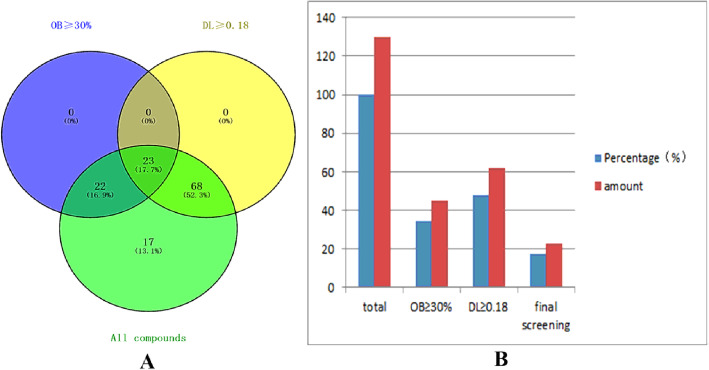
Nineteen active compounds were selected from Epicedium. There were 200 targets associated with Epicedium and 537 targets related to depression. The key targets of Epicedium for treating depression were IL6, VEGFA, AKT1, and EGF. According to gene ontology functional enrichment analysis, 22 items of biological process (BP), 13 items of cell composition (CC) and 9 items of molecular function (MF) were obtained. A total of 56 signaling pathways (P < 0.05) were identified by Kyoto Encyclopedia of Genes and Genomes analysis, mainly involving depression-related pathways such as dopaminergic synapse, TNF signaling pathway, and prolactin signaling pathway. The results of molecular docking showed that the most important activity components, including luteoklin, quercetin and kaempferol, were well combined with the key targets.
Luteoklin, quercetin, kaempferol and other active compounds in Epicedium can regulate multiple signaling pathways and targets such as IL6, AKT1, and EGF, therefore playing therapeutic roles in depression.
越来越多的人关注淫羊藿对神经系统的影响,尤其是抗抑郁作用。本研究应用网络药理学提出淫羊藿多靶抗抑郁作用的可检验假说。
通过构建蛋白质-蛋白质相互作用网络和药物-成分-靶点网络,预测淫羊藿治疗抑郁症的关键靶点。然后,通过分子对接验证淫羊藿主要活性成分与预测候选靶点的相互作用。
从淫羊藿中筛选出 19 个活性化合物,与淫羊藿相关的靶点有 200 个,与抑郁症相关的靶点有 537 个。淫羊藿治疗抑郁症的关键靶点为 IL6、VEGFA、AKT1 和 EGF。根据基因本体论(GO)功能富集分析,共获得 22 项生物过程(BP)、13 项细胞组成(CC)和 9 项分子功能(MF)条目。京都基因与基因组百科全书(KEGG)通路分析共鉴定到 56 条信号通路(P<0.05),主要涉及多巴胺能突触、TNF 信号通路和催乳素信号通路等与抑郁症相关的通路。分子对接结果表明,淫羊藿中最重要的活性成分,如 luteoklin、槲皮素和山奈酚等,与关键靶点结合良好。
淫羊藿中的 luteoklin、槲皮素、山奈酚等活性化合物可调节 IL6、AKT1、EGF 等多个信号通路和靶点,从而发挥抗抑郁作用。