Fourth Oncology Department and Clinical Trials Unit, Henry Dunant Hospital Center, Athens, Greece.
Second Oncology Department, Metropolitan Hospital, Pireaus, Athens, Greece.
ESMO Open. 2021 Oct;6(5):100254. doi: 10.1016/j.esmoop.2021.100254. Epub 2021 Sep 1.
The advanced lung cancer inflammation index [ALI: body mass index × serum albumin/neutrophil-to-lymphocyte ratio (NLR)] reflects systemic host inflammation, and is easily reproducible. We hypothesized that ALI could assist guidance of non-small-cell lung cancer (NSCLC) treatment with immune checkpoint inhibitors (ICIs).
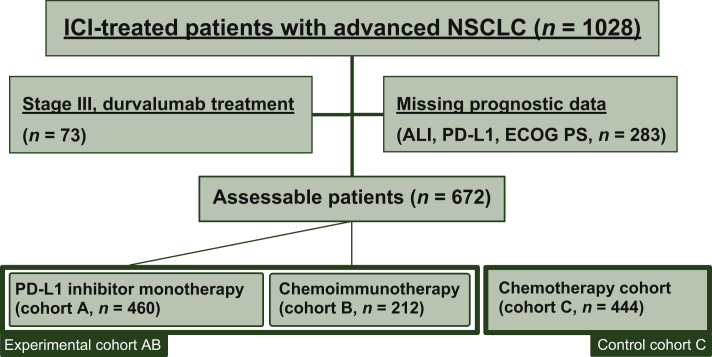
This retrospective study included 672 stage IV NSCLC patients treated with programmed death-ligand 1 (PD-L1) inhibitors alone or in combination with chemotherapy in 25 centers in Greece and Germany, and a control cohort of 444 stage IV NSCLC patients treated with platinum-based chemotherapy without subsequent targeted or immunotherapy drugs. The association of clinical outcomes with biomarkers was analyzed with Cox regression models, including cross-validation by calculation of the Harrell's C-index.
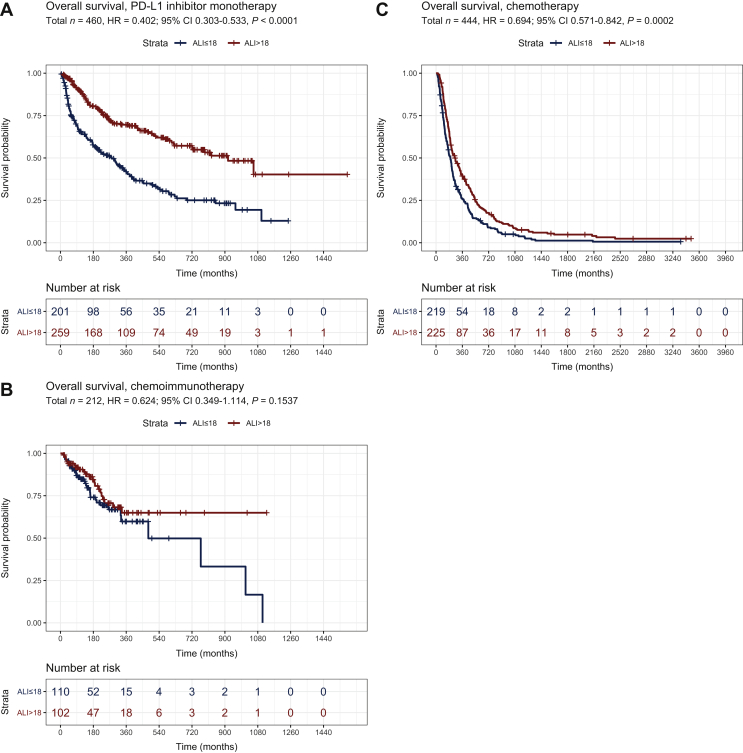
High ALI values (>18) were significantly associated with longer overall survival (OS) for patients receiving ICI monotherapy [hazard ratio (HR) = 0.402, P < 0.0001, n = 460], but not chemo-immunotherapy (HR = 0.624, P = 0.111, n = 212). Similar positive correlations for ALI were observed for objective response rate (36% versus 24%, P = 0.008) and time-on-treatment (HR = 0.52, P < 0.001), in case of ICI monotherapy only. In the control cohort of chemotherapy, the association between ALI and OS was weaker (HR = 0.694, P = 0.0002), and showed a significant interaction with the type of treatment (ICI monotherapy versus chemotherapy, P < 0.0001) upon combined analysis of the two cohorts. In multivariate analysis, ALI had a stronger predictive effect than NLR, PD-L1 tumor proportion score, lung immune prognostic index, and EPSILoN scores. Among patients with PD-L1 tumor proportion score ≥50% receiving first-line ICI monotherapy, a high ALI score >18 identified a subset with longer OS and time-on-treatment (median 35 and 16 months, respectively), similar to these under chemo-immunotherapy.
The ALI score is a powerful prognostic and predictive biomarker for patients with advanced NSCLC treated with PD-L1 inhibitors alone, but not in combination with chemotherapy. Its association with outcomes appears to be stronger than that of other widely used parameters. For PD-L1-high patients, an ALI score >18 could assist the selection of cases that do not need addition of chemotherapy.
高级肺癌炎症指数(ALI:体重指数×血清白蛋白/中性粒细胞与淋巴细胞比值(NLR))反映全身宿主炎症,且易于重现。我们假设 ALI 可辅助指导非小细胞肺癌(NSCLC)的免疫检查点抑制剂(ICI)治疗。
本回顾性研究纳入了在希腊和德国的 25 个中心接受程序性死亡配体 1(PD-L1)抑制剂单药或联合化疗治疗的 672 例 IV 期 NSCLC 患者,以及接受含铂化疗而未接受后续靶向或免疫治疗药物的 444 例 IV 期 NSCLC 患者作为对照队列。使用 Cox 回归模型分析了临床结局与生物标志物之间的关联,包括通过计算 Harrell's C 指数进行交叉验证。
高 ALI 值(>18)与接受 ICI 单药治疗的患者的总生存期(OS)显著延长相关(风险比 [HR] 0.402,P < 0.0001,n = 460),但与化疗免疫治疗无关(HR 0.624,P = 0.111,n = 212)。仅接受 ICI 单药治疗的患者,观察到 ALI 与客观缓解率(36%与 24%,P = 0.008)和治疗时间(HR 0.52,P < 0.001)之间存在类似的正相关关系。在化疗对照组中,ALI 与 OS 的相关性较弱(HR 0.694,P = 0.0002),且在联合分析两个队列时,与治疗类型(ICI 单药治疗与化疗)存在显著交互作用。多变量分析显示,ALI 比 NLR、PD-L1 肿瘤比例评分、肺免疫预后指数和 EPSILoN 评分具有更强的预测作用。在接受一线 ICI 单药治疗且 PD-L1 肿瘤比例评分≥50%的患者中,高 ALI 评分(>18)确定了一组 OS 和治疗时间更长的患者(中位值分别为 35 个月和 16 个月),与接受化疗免疫治疗的患者相似。
ALI 评分是单独接受 PD-L1 抑制剂治疗的晚期 NSCLC 患者的一种强大的预后和预测生物标志物,但与联合化疗治疗无关。其与结局的关联似乎比其他广泛使用的参数更强。对于 PD-L1 高的患者,ALI 评分>18 可辅助选择不需要添加化疗的病例。