Misra Shivani, Barron Emma, Vamos Eszter, Thomas Stephen, Dhatariya Ketan, Kar Partha, Young Bob, Khunti Kamlesh, Valabhji Jonathan
National Diabetes Audit Programme, NHS England and NHS Improvement, London, UK; Division of Metabolism, Digestion, and Reproduction, Imperial College London, London, UK; Department of Diabetes and Endocrinology, St Mary's Hospital, Imperial College Healthcare NHS Trust, London, UK; Clinical Biochemistry, Blood Sciences, North West London Pathology, London, UK.
National Diabetes Audit Programme, NHS England and NHS Improvement, London, UK; NHS England and NHS Improvement, London UK.
Lancet Diabetes Endocrinol. 2021 Oct;9(10):671-680. doi: 10.1016/S2213-8587(21)00208-4. Epub 2021 Sep 2.
Diabetic ketoacidosis (DKA) has been reported to be increasing in frequency during the COVID-19 pandemic. We aimed to examine the rates of DKA hospital admissions and the patient demographics associated with DKA during the pandemic compared with in prepandemic years.
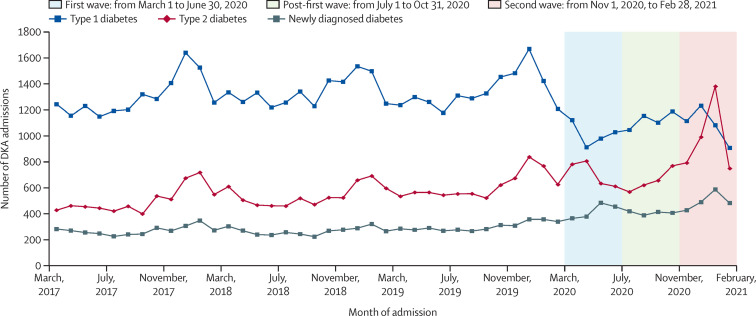
Using a comprehensive, multiethnic, national dataset, the Secondary Uses Service repository, we extracted all emergency hospital admissions in England coded with DKA from March 1 to June 30, 2020 (first wave of the pandemic), July 1 to Oct 31, 2020 (post-first wave), and Nov 1, 2020, to Feb 28, 2021 (second wave), and compared these with DKA admissions in the equivalent periods in 2017-20. We also examined baseline characteristics, mortality, and trends in patients who were admitted with DKA.
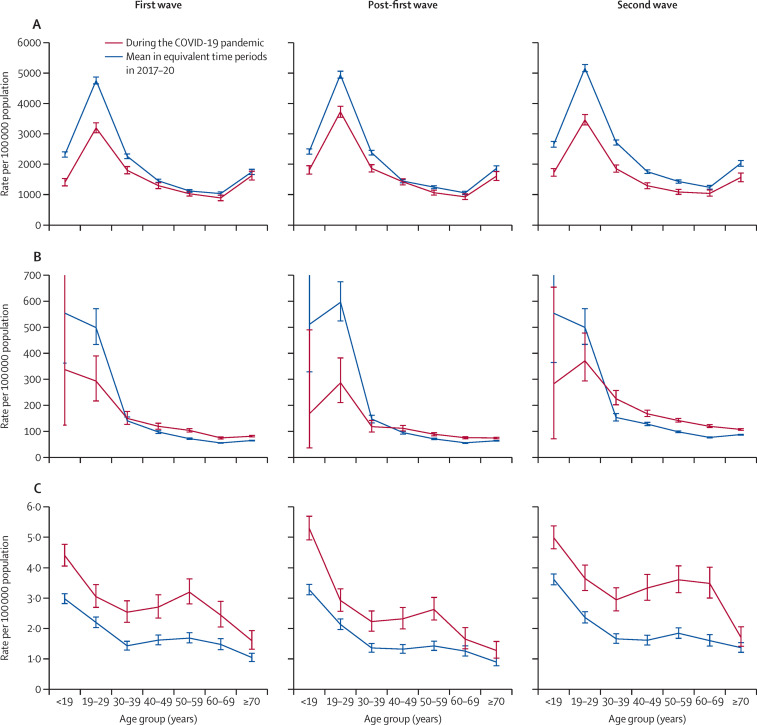
There were 8553 admissions coded with DKA during the first wave, 8729 during the post-first wave, and 10 235 during the second wave. Compared with preceding years, DKA admissions were 6% (95% CI 4-9; p<0·0001) higher in the first wave of the pandemic (from n=8048), 6% (3-8; p<0·0001) higher in the post-first wave (from n=8260), and 7% (4-9; p<0·0001) higher in the second wave (from n=9610). In the first wave, DKA admissions reduced by 19% (95% CI 16-21) in those with pre-existing type 1 diabetes (from n=4965 to n=4041), increased by 41% (35-47) in those with pre-existing type 2 diabetes (from n=2010 to n=2831), and increased by 57% (48-66) in those with newly diagnosed diabetes (from n=1072 to n=1681). Compared with prepandemic, type 2 diabetes DKA admissions were similarly common in older individuals and men but were higher in those of non-White ethnicities during the first wave. The increase in newly diagnosed DKA admissions occurred across all age groups and these were significantly increased in men and people of non-White ethnicities. In the post-first wave, DKA admissions did not return to the baseline level of previous years; DKA admissions were 14% (11-17) lower in patients with type 1 diabetes (from n=5208 prepandemic to n=4491), 30% (24-36) higher in patients with type 2 diabetes (from n=2011 to n=2613), and 56% (47-66) higher in patients with newly diagnosed diabetes (from n=1041 to n=1625). During the second wave, DKA admissions were 25% (22-27) lower in patients with type 1 diabetes (from n=5769 prepandemic to n=4337), 50% (44-56) higher in patients with type 2 diabetes (from n=2608 to n=3912), and 61% (52-70) higher in patients with newly diagnosed diabetes (from n=1234 to n=1986).
Our results provide evidence for differences in the numbers and characteristics of people presenting with DKA during the COVID-19 pandemic compared with in the preceding 3 years. Greater awareness of risk factors for DKA in type 2 diabetes and vigilance for newly diagnosed diabetes presenting with DKA during the COVID-19 pandemic might help mitigate the increased impact of DKA.
None.
据报道,在新冠疫情期间,糖尿病酮症酸中毒(DKA)的发病率呈上升趋势。我们旨在研究疫情期间DKA的住院率以及与DKA相关的患者人口统计学特征,并与疫情前几年进行比较。
我们使用综合、多民族的全国性数据集——二次利用服务库,提取了2020年3月1日至6月30日(疫情第一波)、2020年7月1日至10月31日(第一波后)以及2020年11月1日至2021年2月28日(第二波)在英格兰所有编码为DKA的急诊住院病例,并将这些数据与2017 - 2020年同期的DKA住院病例进行比较。我们还研究了DKA住院患者的基线特征、死亡率和趋势。
第一波期间有8553例编码为DKA的住院病例,第一波后为8729例,第二波为10235例。与前几年相比,疫情第一波期间DKA住院率高出6%(95%置信区间4 - 9;p<0.0001)(之前为n = 8048),第一波后高出6%(3 - 8;p<0.0001)(之前为n = 8260),第二波高出7%(4 - 9;p<0.0001)(之前为n = 9610)。在第一波中,既往有1型糖尿病的患者DKA住院率下降了19%(95%置信区间16 - 21)(从n = 4965降至n = 4041),既往有2型糖尿病的患者住院率上升了41%(35 - 47)(从n = 2010升至n = 2831),新诊断糖尿病患者住院率上升了57%(48 - 66)(从n = 1072升至n = 1681)。与疫情前相比,2型糖尿病DKA住院病例在老年人和男性中同样常见,但在第一波期间非白人种族的患者中更高。新诊断DKA住院病例的增加发生在所有年龄组,男性和非白人种族的患者显著增加。在第一波后,DKA住院率未恢复到前几年的基线水平;1型糖尿病患者的DKA住院率降低了14%(11 - 17)(疫情前n = 5208,降至n = 4491),2型糖尿病患者升高了30%(24 - 36)(从n = 2011升至n = 2613),新诊断糖尿病患者升高了56%(47 - 66)(从n = 1041升至n = 1625)。在第二波期间,1型糖尿病患者的DKA住院率降低了25%(22 - 27)(疫情前n = 5769,降至n = 4337),2型糖尿病患者升高了50%(44 - 56)(从n = 2608升至n = 3912),新诊断糖尿病患者升高了61%(52 - 70)(从n = 1234升至n = 1986)。
我们的结果证明,与前3年相比,新冠疫情期间出现DKA的人数和特征存在差异。提高对2型糖尿病中DKA危险因素的认识以及对新冠疫情期间出现DKA的新诊断糖尿病的警惕性,可能有助于减轻DKA增加带来的影响。
无。