Division of Diabetes Translation, National Center for Chronic Disease Prevention and Health Promotion, Centers for Disease Control and Prevention, Atlanta, GA
Division of Diabetes Translation, National Center for Chronic Disease Prevention and Health Promotion, Centers for Disease Control and Prevention, Atlanta, GA.
Diabetes Care. 2020 May;43(5):1057-1064. doi: 10.2337/dc19-2449. Epub 2020 Mar 11.
To report U.S. national population-based rates and trends in diabetic ketoacidosis (DKA) and hyperglycemic hyperosmolar state (HHS) among adults, in both the emergency department (ED) and inpatient settings.
We analyzed data from 1 January 2006 through 30 September 2015 from the Nationwide Emergency Department Sample and National Inpatient Sample to characterize ED visits and inpatient admissions with DKA and HHS. We used corresponding year cross-sectional survey data from the National Health Interview Survey to estimate the number of adults ≥18 years with diagnosed diabetes to calculate population-based rates for DKA and HHS in both ED and inpatient settings. Linear trends from 2009 to 2015 were assessed using Joinpoint software.
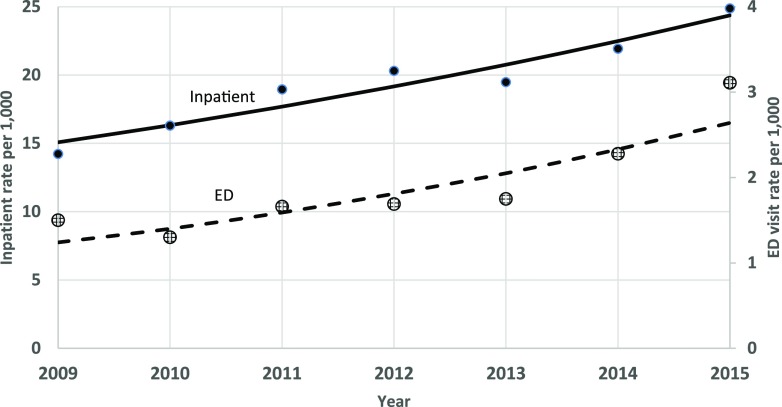
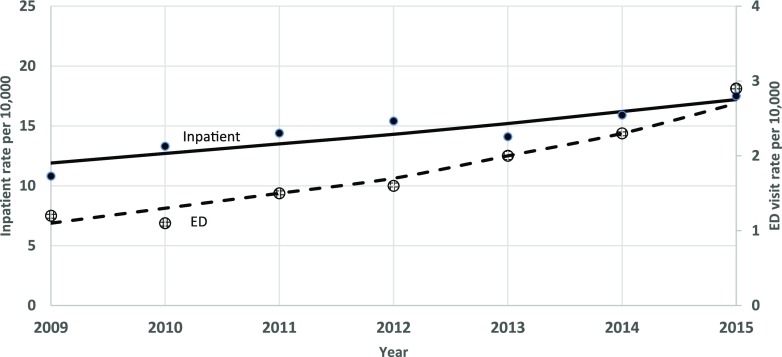
In 2014, there were a total of 184,255 and 27,532 events for DKA and HHS, respectively. The majority of DKA events occurred in young adults aged 18-44 years (61.7%) and in adults with type 1 diabetes (70.6%), while HHS events were more prominent in middle-aged adults 45-64 years (47.5%) and in adults with type 2 diabetes (88.1%). Approximately 40% of the hyperglycemic events were in lower-income populations. Overall, event rates for DKA significantly increased from 2009 to 2015 in both ED (annual percentage change [APC] 13.5%) and inpatient settings (APC 8.3%). A similar trend was seen for HHS (APC 16.5% in ED and 6.3% in inpatient). The increase was in all age-groups and in both men and women.
Causes of increased rates of hyperglycemic events are unknown. More detailed data are needed to investigate the etiology and determine prevention strategies.
报告美国全国范围内成人在急诊室(ED)和住院环境中糖尿病酮症酸中毒(DKA)和高血糖高渗状态(HHS)的基于人群的发生率和趋势。
我们分析了 2006 年 1 月 1 日至 2015 年 9 月 30 日期间来自全国急诊室样本和全国住院样本的数据,以描述 DKA 和 HHS 的 ED 就诊和住院情况。我们使用来自全国健康访谈调查的相应年度横断面调查数据来估计≥18 岁的成年糖尿病患者人数,以计算 ED 和住院环境中 DKA 和 HHS 的基于人群的发生率。使用 Joinpoint 软件评估 2009 年至 2015 年的线性趋势。
2014 年,DKA 和 HHS 的总事件数分别为 184255 例和 27532 例。大多数 DKA 事件发生在 18-44 岁的年轻成年人(61.7%)和 1 型糖尿病患者(70.6%)中,而 HHS 事件则更为突出在 45-64 岁的中年成年人(47.5%)和 2 型糖尿病患者(88.1%)中。大约 40%的高血糖事件发生在低收入人群中。总体而言,2009 年至 2015 年期间,DKA 在 ED(年百分比变化[APC]13.5%)和住院环境(APC 8.3%)中的事件发生率均显著增加。HHS 也出现了类似的趋势(ED 中的 APC 为 16.5%,住院中的 APC 为 6.3%)。这种增长发生在所有年龄段以及男性和女性。
导致高血糖事件发生率增加的原因尚不清楚。需要更详细的数据来研究病因并确定预防策略。