Scorcia Vincenzo, Giannaccare Giuseppe, Gatti Valentina, Vaccaro Sabrina, Piccoli Gabriele, Villì Annarita, Toro Mario Damiano, Yu Angeli Christy, Iovino Claudio, Simonelli Francesca, Carnevali Adriano
Department of Ophthalmology, University of Magna Graecia of Cantazaro, Viale Europa, Loc. Germaneto, 88100, Catanzaro, Calabria, Italy.
Department of Ophthalmology, University Hospital of Zurich, University of Zurich, 9081, Zurich, Switzerland.
Ophthalmol Ther. 2021 Dec;10(4):1015-1024. doi: 10.1007/s40123-021-00395-6. Epub 2021 Sep 5.
To compare the functional and anatomic outcomes between eyes in patients with diabetic macular edema (DME) who underwent a complete anti-vascular endothelial growth factor (VEGF) loading dose with aflibercept and those who were switched to dexamethasone intravitreal (DEX) implant after an incomplete anti-VEGF treatment regimen during the coronavirus disease 2019 (COVID-19) pandemic.
This was a retrospective and comparative study conducted on patients with DME. Main outcome measures were mean change in best corrected visual acuity (BCVA) and central retinal thickness (CRT) from baseline to month 4.
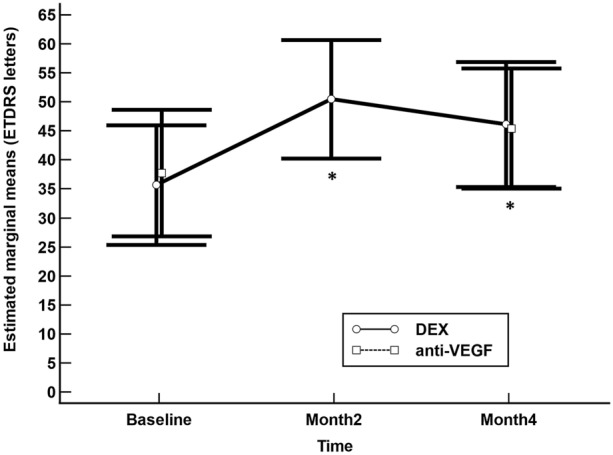
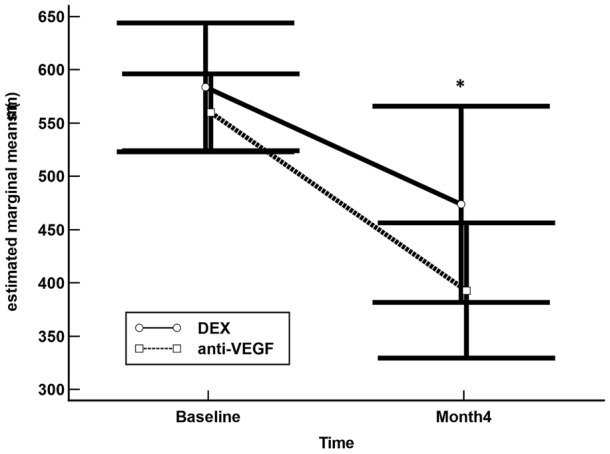
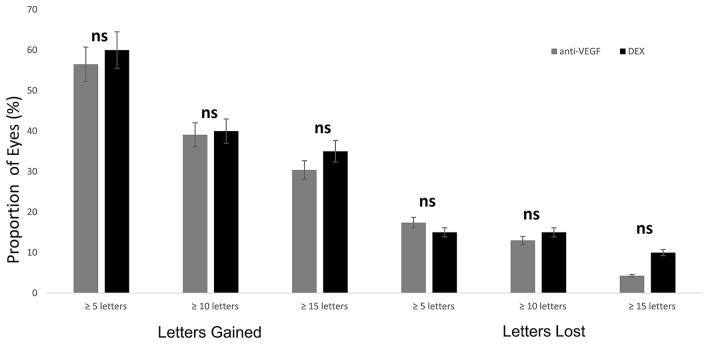
Forty-three eyes (23 eyes in the anti-VEGF group and 20 eyes in the DEX group) were included. Mean BCVA significantly improved from 37.7 ± 25.3 and 35.7 ± 22.0 letters at baseline to 45.4 (23.9) (mean adjusted BCVA improvement 7.6 ± 20.8 letters, p = 0.033) and 46.1 ± 26.0 (mean adjusted BCVA improvement 10.6 ± 15.9 letters, p = 0.049) at month 4 in the anti-VEGF and DEX groups, respectively, with no significant differences between study groups (mean adjusted BCVA difference 2.8 letters, 95% CI - 9.4 to 14.9 letters, p = 0.648). There were no statistically significant differences in the proportion of eyes that achieved a BCVA improvement of ≥ 5, ≥ 10, and ≥ 15 letters between groups. CRT was significantly reduced from baseline to month 4 in both DEX (mean adjusted CRT reduction 167.3 ± 148.2 µm, p = 0.012) and anti-VEGF groups (mean adjusted CRT reduction 109.9 ± 181.9 µm, p < 0.001), with no differences between them (mean adjusted CRT difference 56.1 µm, 95% CI - 46.0 to 158.2 µm, p = 0.273). Of 20 eyes in the DEX group, 16 (80.0%) and 9 (45.0%) eyes achieved a CRT reduction of ≥ 20% from baseline at 2 months and at 4 months, respectively.
Our results seem to suggest that DEX implant can significantly improve both functional and anatomic clinical outcomes in patients who were unable to complete anti-VEGF loading dose during the COVID-19 pandemic.
比较在2019年冠状病毒病(COVID-19)大流行期间,接受阿柏西普完整抗血管内皮生长因子(VEGF)负荷剂量治疗的糖尿病性黄斑水肿(DME)患者与在抗VEGF治疗方案不完整后改用玻璃体内地塞米松(DEX)植入物的患者眼部的功能和解剖学结局。
这是一项针对DME患者的回顾性比较研究。主要结局指标是从基线到第4个月最佳矫正视力(BCVA)和中心视网膜厚度(CRT)的平均变化。
共纳入43只眼(抗VEGF组23只眼,DEX组20只眼)。抗VEGF组和DEX组的平均BCVA在基线时分别为37.7±25.3和35.7±22.0字母,在第4个月时分别显著提高至45.4(23.9)(平均调整后BCVA改善7.6±20.8字母,p = 0.033)和46.1±26.0(平均调整后BCVA改善10.6±15.9字母,p = 0.049),研究组之间无显著差异(平均调整后BCVA差异2.8字母,95%CI -9.4至14.9字母,p = 0.648)。两组间BCVA改善≥5、≥10和≥15字母的眼比例无统计学显著差异。DEX组(平均调整后CRT降低167.3±148.2μm,p = 0.012)和抗VEGF组(平均调整后CRT降低109.9±181.9μm,p<0.001)从基线到第4个月CRT均显著降低,两组间无差异(平均调整后CRT差异56.1μm,95%CI -46.0至158.2μm,p = 0.273)。DEX组的20只眼中,分别有16只(80.0%)和9只(45.0%)眼在2个月和4个月时CRT较基线降低≥20%。
我们的结果似乎表明,在COVID-19大流行期间无法完成抗VEGF负荷剂量的患者中,DEX植入物可显著改善功能和解剖学临床结局。