Arab Ali, Christie Gregory J, Mansouri Mehrdad, Ahmadzadeh Maryam, Sixsmith Andrew, Ester Martin, Moreno Sylvain
School of Computing Science, Simon Fraser University, Burnaby, BC, Canada.
School of Interactive Arts and Technology, Simon Fraser University, Burnaby, BC, Canada.
Front Aging Neurosci. 2021 Aug 16;13:693791. doi: 10.3389/fnagi.2021.693791. eCollection 2021.
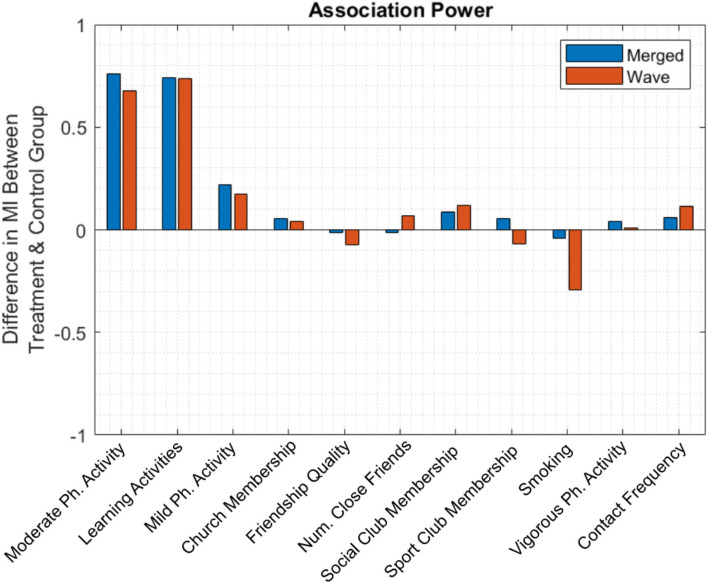
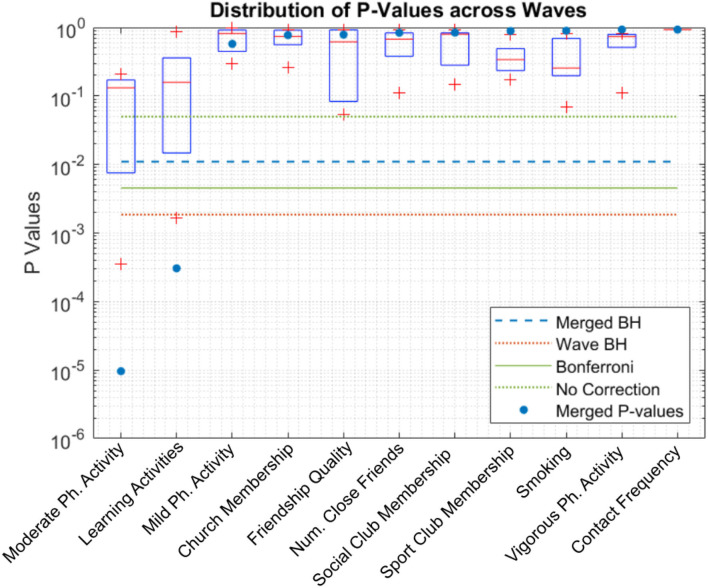
Rates of dementia are projected to increase over the coming years as global populations age. Without a treatment to slow the progression of dementia, many health policies are focusing on preventing dementia by slowing the rate of cognitive decline with age. However, it is unclear which lifestyle changes in old age meaningfully reduce the rate of cognitive decline associated with aging. Use existing, multi-year longitudinal health data to determine if engagement in a variety of different lifestyle activities can slow the rate of cognitive decline as older adults age. Data from the English Longitudinal Study of Aging was analyzed using a quasi-experimental, efficient matched-pair design inspired by the clinical trial methodology. Changes in short-term memory scores were assessed over a multi-year interval for groups who undertook one of 11 different lifestyle activities, compared to control groups matched across confounding socioeconomic and lifestyle factors. Two factors, moderate-intensity physical activity and learning activities, resulted in significant positive impact on cognitive function. Our analysis brings cognitive benefit arguments in favor of two lifestyle activities, moderate-intensity physical activity and learning activities, while rejecting other factors advanced by the literature such as vigorous-intensity physical activity. Those findings justify and encourage the development of new lifestyle health programs by health authorities and bring forward the new health system solution, social prescribing.
随着全球人口老龄化,预计未来几年痴呆症的发病率将会上升。由于没有治疗方法能减缓痴呆症的进展,许多卫生政策都聚焦于通过减缓与年龄相关的认知衰退速度来预防痴呆症。然而,目前尚不清楚老年时期哪些生活方式的改变能切实降低与衰老相关的认知衰退速度。利用现有的多年纵向健康数据,以确定参与各种不同的生活方式活动是否能减缓老年人认知衰退的速度。采用受临床试验方法启发的准实验性、高效匹配对设计,对英国老龄化纵向研究的数据进行了分析。在多年的时间跨度内,对参与11种不同生活方式活动之一的人群与在社会经济和生活方式混杂因素方面相匹配的对照组进行比较,评估短期记忆分数的变化。有两个因素,即中等强度的体育活动和学习活动,对认知功能产生了显著的积极影响。我们的分析支持了有利于两种生活方式活动(中等强度的体育活动和学习活动)的认知益处观点,同时否定了文献中提出的其他因素,如高强度体育活动。这些发现为卫生当局制定新的生活方式健康计划提供了依据并给予鼓励,同时提出了新的卫生系统解决方案——社会处方。