Pieterman Elsbet J, Princen Hans M G, Jarke Annica, Nilsson Ralf, Cavallin Anders, Bergenholm Linnéa, Henricsson Marcus, Gopaul V Sashi, Agrawal Rahul, Nissen Steven E, Hurt-Camejo Eva
The Netherlands Organisation for Applied Scientific Research (TNO), Metabolic Health Research, Leiden, Netherlands.
Advanced Drug Delivery, Pharmaceutical Sciences, BioPharmaceuticals R&D, AstraZeneca, Gothenburg, Sweden.
Front Pharmacol. 2021 Aug 16;12:681455. doi: 10.3389/fphar.2021.681455. eCollection 2021.
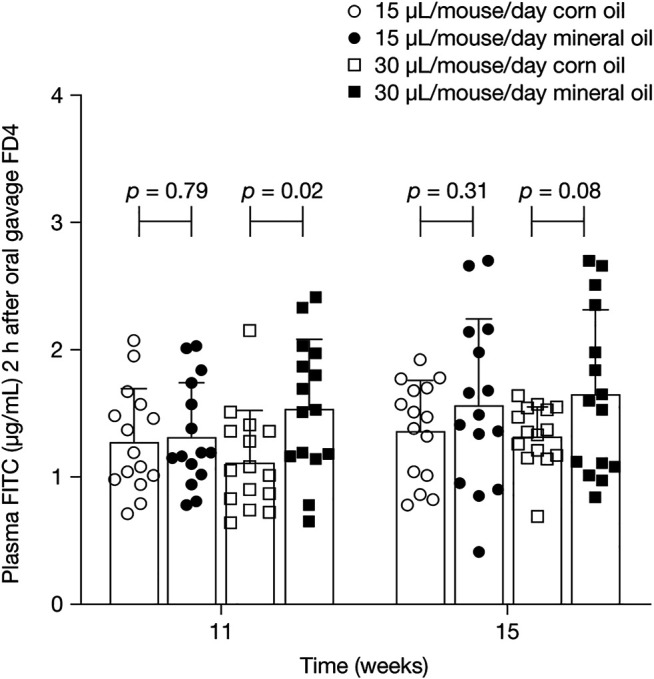
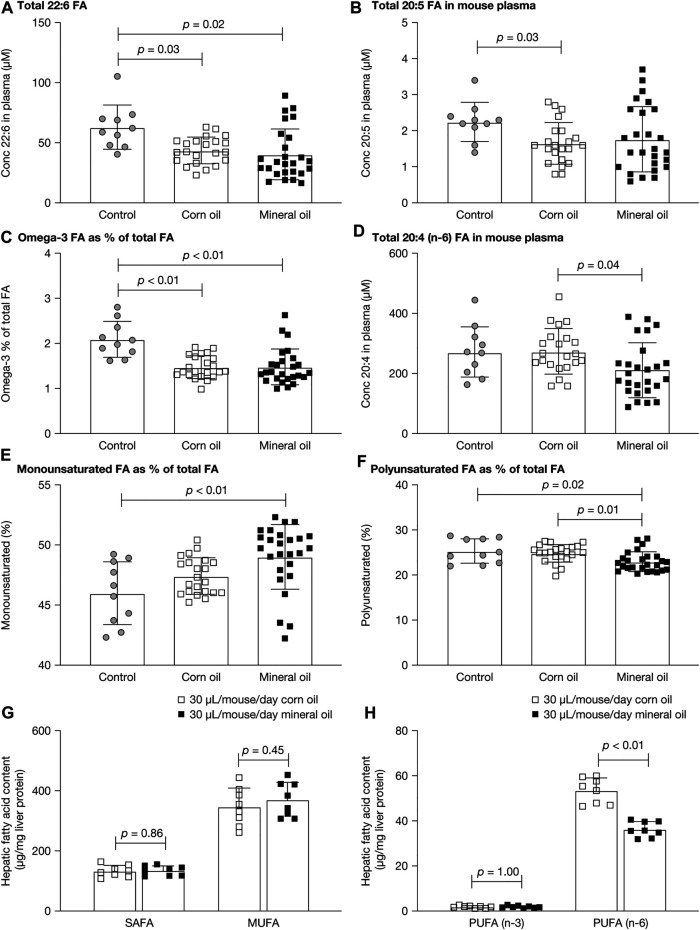
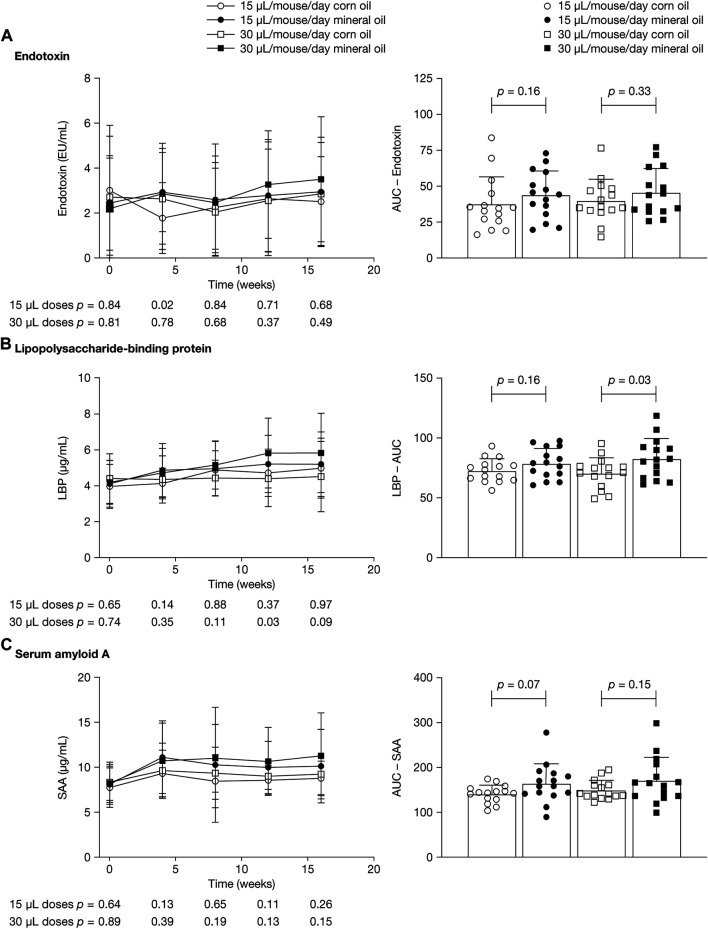
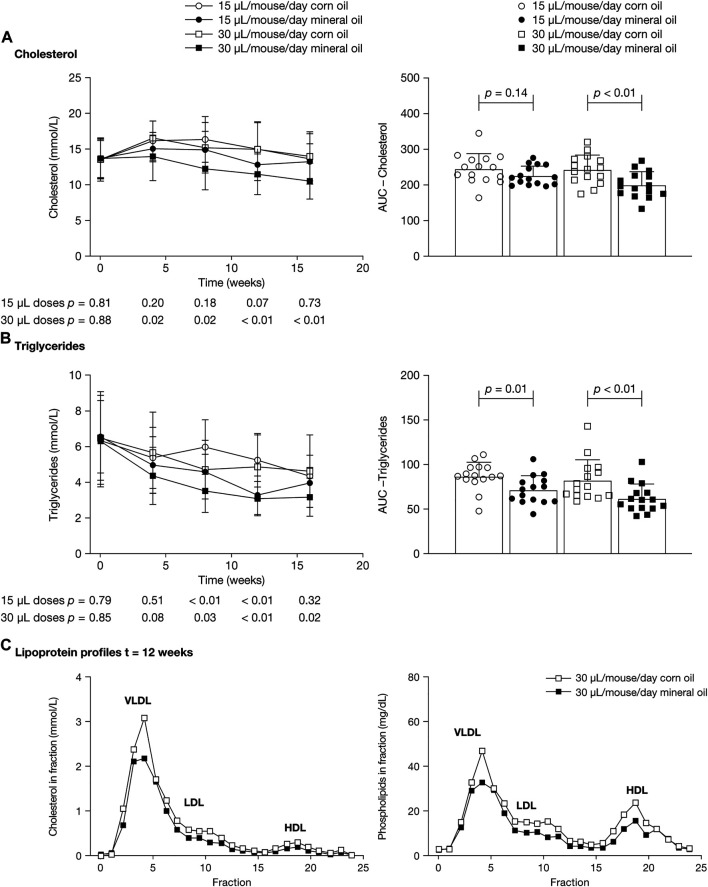
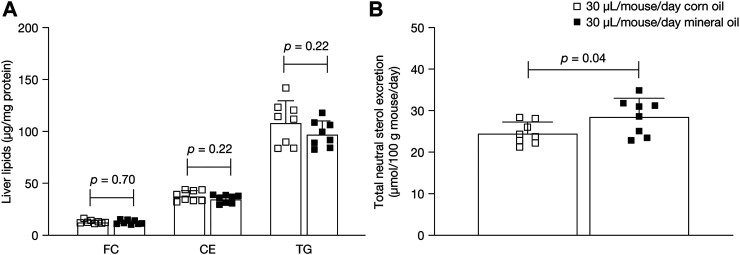
We investigated the effects of chronic oral administration of mineral oil, versus corn oil as control, on intestinal permeability, inflammatory markers, and plasma lipids in APOE3-Leiden.CETP mice. Mice received mineral oil or corn oil 15 or 30 μL/mouse/day for 16 weeks (15 mice/group). Intestinal permeability was increased with mineral versus corn oil 30 µL/day, shown by increased mean plasma FITC-dextran concentrations 2 h post-administration (11 weeks: 1.5 versus 1.1 μg/ml, = 0.02; 15 weeks: 1.7 versus 1.3 μg/ml, = 0.08). Mean plasma lipopolysaccharide-binding protein levels were raised with mineral versus corn oil 30 µL/day (12 weeks: 5.8 versus 4.4 μg/ml, = 0.03; 16 weeks: 5.8 versus 4.5 μg/ml, = 0.09), indicating increased intestinal bacterial endotoxin absorption and potential pro-inflammatory effects. Plasma cholesterol and triglyceride concentrations were decreased with mineral oil, without affecting liver lipids among treated groups. Fecal neutral sterol measurements indicated increased fecal cholesterol excretion with mineral oil 30 µL/day (+16%; = 0.04). Chronic oral administration of mineral oil in APOE3-Leiden.CETP mice increased intestinal permeability, with potential pro-inflammatory effects, and decreased plasma cholesterol and triglyceride levels. Our findings may raise concerns about the use of mineral oil as a placebo in clinical studies.
我们研究了长期口服矿物油(以玉米油作为对照)对APOE3-莱顿.CETP小鼠肠道通透性、炎症标志物和血脂的影响。小鼠每天每只接受15或30微升矿物油或玉米油,持续16周(每组15只小鼠)。与玉米油相比,每天30微升矿物油会增加肠道通透性,这在给药后2小时血浆中异硫氰酸荧光素-葡聚糖浓度升高得到体现(11周时:1.5微克/毫升对1.1微克/毫升,P = 0.02;15周时:1.7微克/毫升对1.3微克/毫升,P = 0.08)。与玉米油相比,每天30微升矿物油会提高血浆脂多糖结合蛋白水平(12周时:5.8微克/毫升对4.4微克/毫升,P = 0.03;16周时:5.8微克/毫升对4.5微克/毫升,P = 0.09),表明肠道细菌内毒素吸收增加以及潜在的促炎作用。矿物油可降低血浆胆固醇和甘油三酯浓度,且不影响各治疗组的肝脏脂质。粪便中性固醇测量表明,每天30微升矿物油可使粪便胆固醇排泄增加(+16%;P = 0.04)。在APOE3-莱顿.CETP小鼠中,长期口服矿物油会增加肠道通透性,具有潜在的促炎作用,并降低血浆胆固醇和甘油三酯水平。我们的研究结果可能会引发对在临床研究中使用矿物油作为安慰剂的担忧。