Department of Medical Oncology, Shanghai Pulmonary Hospital, Thoracic Cancer Institute, Tongji University School of Medicine, Shanghai 200433, China.
Department of Thoracic Surgery, Tongji University Affiliated Shanghai Pulmonary Hospital, Shanghai 200433, China.
Dis Markers. 2021 Aug 26;2021:3776854. doi: 10.1155/2021/3776854. eCollection 2021.
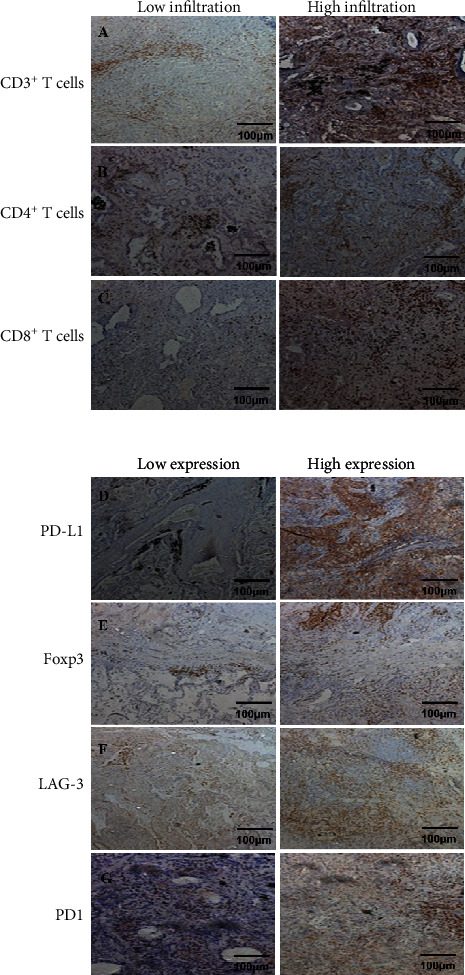
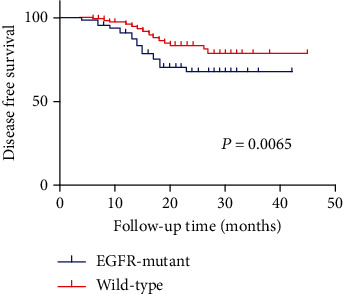
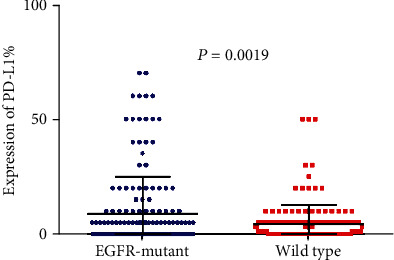
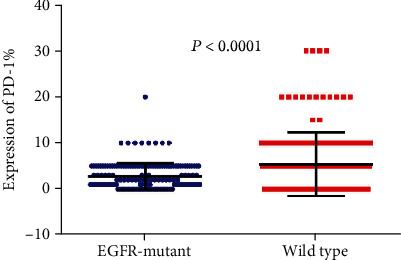
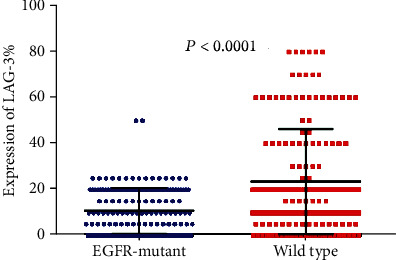
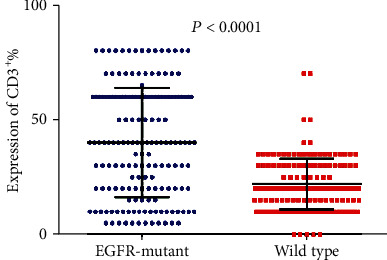
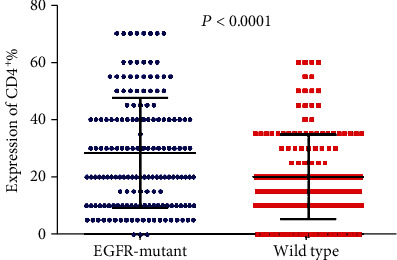
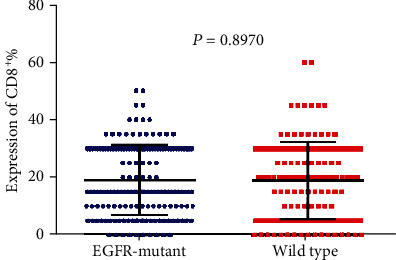
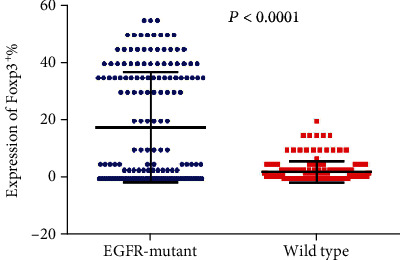
Recent clinical trials of lung adenocarcinoma with immune checkpoint inhibitors revealed that lung adenocarcinoma patients with mutations have a poor response to immunotherapy. However, the mechanisms have not been addressed. We performed immunohistochemistry analyses of resected lung adenocarcinoma tissues with and without mutations to investigate and compare the characteristics of the tumor microenvironment (TME). We retrospectively enrolled a total of 323 lung adenocarcinoma patients (164 had mutations), and their corresponding tissue samples were analyzed by the mutation test and immunohistochemistry. We selected the markers of the immune checkpoint molecule (PD1, PD-L1, and LAG-3) and immune cell (CD3, CD4, CD8, and Foxp3) as markers of the tumor microenvironment. Our results revealed that patients had a distinct tumor microenvironment between -mutant and wild-type lung adenocarcinomas; the expression of CD3, CD4, PD-L1, and Foxp3 in -mutant tumors was significantly higher than that in wild-type tumors, while the expression of LAG3 and PD-1 showed a positive correlation with -wild-type tumors. In survival analysis, -wild-type patients had longer disease-free survival (DFS) than -mutant patients ( = 0.0065). Our research demonstrates significant differences in tumor microenvironment composition between -mutant and wild-type patients. Our findings provide novel evidence that contributes to understanding the mechanism underlying the poor efficacy of immune checkpoint inhibitors.
最近的免疫检查点抑制剂治疗肺腺癌的临床试验表明, 突变的肺腺癌患者对免疫治疗反应不佳。然而,其机制尚未得到解决。我们对有和无 突变的肺腺癌组织进行了免疫组织化学分析,以研究和比较肿瘤微环境(TME)的特征。我们回顾性地招募了总共 323 例肺腺癌患者(164 例有 突变),并对其相应的组织样本进行了 突变检测和免疫组织化学分析。我们选择了免疫检查点分子(PD1、PD-L1 和 LAG-3)和免疫细胞(CD3、CD4、CD8 和 Foxp3)的标志物作为肿瘤微环境的标志物。我们的结果表明,-突变和野生型肺腺癌患者的肿瘤微环境存在明显差异;-突变肿瘤中 CD3、CD4、PD-L1 和 Foxp3 的表达明显高于野生型肿瘤,而 LAG3 和 PD-1 的表达与 -野生型肿瘤呈正相关。在生存分析中,-野生型患者的无病生存期(DFS)长于 -突变患者(=0.0065)。我们的研究表明,-突变和野生型患者的肿瘤微环境组成存在显著差异。我们的发现为理解免疫检查点抑制剂疗效不佳的机制提供了新的证据。