Bolt Janne W, van Ansenwoude Chaja M J, Hammoura Ihsan, van de Sande Marleen G, van Baarsen Lisa G M
Department of Rheumatology & Clinical Immunology, Amsterdam Institute for Infection & Immunity, Amsterdam UMC, University of Amsterdam, Amsterdam, Netherlands.
Department of Experimental Immunology, Amsterdam Institute for Infection & Immunity, Amsterdam UMC, University of Amsterdam, Amsterdam, Netherlands.
Front Med (Lausanne). 2021 Aug 17;8:711823. doi: 10.3389/fmed.2021.711823. eCollection 2021.
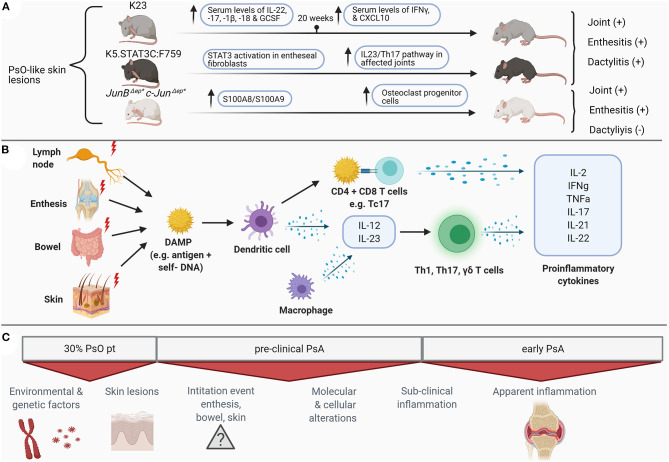
Patients with psoriatic arthritis (PsA) are suffering from a decreased quality of life despite currently available treatments. In the latest years, novel therapies targeting the IL-17/IL-23 and TNF pathways improved clinical outcome. Despite this, remission of disease is not achieved in a considerable group of patients, continuous treatment is very often required to reach clinical remission, and prevention of PsA in patients with psoriasis (PsO) is currently impossible. A better understanding of PsA pathogenesis is required to develop novel treatment strategies that target inflammation and destruction more effectively and at an early stage of the disease, or even before clinically manifest disease. The skin is considered as one of the sites of onset of immune activation, triggering the inflammatory cascade in PsA. PsO develops into PsA in 30% of the PsO patients. Influenced by environmental and genetic factors, the inflammatory process in the skin, entheses, and/or gut may evolve into synovial tissue inflammation, characterized by influx of immune cells. The exact role of the innate and adaptive immune cells in disease pathogenesis is not completely known. The involvement of activated IL-17A+ T cells could implicate early immunomodulatory events generated in lymphoid organs thereby shaping the pathogenic inflammatory response leading to disease. In this perspective article, we provide the reader with an overview of the current literature regarding the immunological changes observed during the earliest stages of PsA. Moreover, we will postulate future areas of translational research aimed at increasing our knowledge on the molecular mechanisms driving disease development, which will aid the identification of novel potential therapeutic targets to limit the progression of PsA.
尽管目前有可用的治疗方法,但银屑病关节炎(PsA)患者的生活质量仍在下降。近年来,针对IL-17/IL-23和TNF通路的新型疗法改善了临床结局。尽管如此,相当一部分患者仍未实现疾病缓解,往往需要持续治疗才能达到临床缓解,而且目前无法预防银屑病(PsO)患者发生PsA。需要更好地了解PsA的发病机制,以开发更有效且能在疾病早期甚至在临床症状出现之前就针对炎症和破坏的新型治疗策略。皮肤被认为是免疫激活的起始部位之一,触发了PsA中的炎症级联反应。30%的PsO患者会发展为PsA。受环境和遗传因素影响,皮肤、附着点和/或肠道中的炎症过程可能演变为滑膜组织炎症,其特征是免疫细胞浸润。先天免疫细胞和适应性免疫细胞在疾病发病机制中的确切作用尚不完全清楚。活化的IL-17A+ T细胞的参与可能意味着在淋巴器官中发生的早期免疫调节事件,从而形成导致疾病的致病性炎症反应。在这篇观点文章中,我们向读者概述了目前关于PsA最早阶段观察到的免疫变化的文献。此外,我们将推测未来转化研究的领域,旨在增加我们对驱动疾病发展的分子机制的了解,这将有助于确定新的潜在治疗靶点,以限制PsA的进展。