Centre for Experimental Medicine and Rheumatology, William Harvey Research Institute, Barts and The London School of Medicine and Dentistry, Queen Mary University of London, London, UK.
Rheumatology Department, Mile End Hospital, Barts Health NHS Trust, London, UK.
Ann Rheum Dis. 2021 May;80(5):591-597. doi: 10.1136/annrheumdis-2020-218186. Epub 2020 Nov 26.
To determine the relationship between synovial versus skin transcriptional/histological profiles in patients with active psoriatic arthritis (PsA) and explore mechanistic links between diseased tissue pathology and clinical outcomes.
Twenty-seven active PsA patients were enrolled in an observational/open-label study and underwent biopsies of synovium and paired lesional/non-lesional skin before starting anti-tumour necrosis factor (TNF) (if biologic-naïve) or ustekinumab (if anti-TNF inadequate responders). Molecular analysis of 80-inflammation-related genes and protein levels for interleukin (IL)-23p40/IL-23p19/IL-23R were assessed by real-time-PCR and immunohistochemistry, respectively.
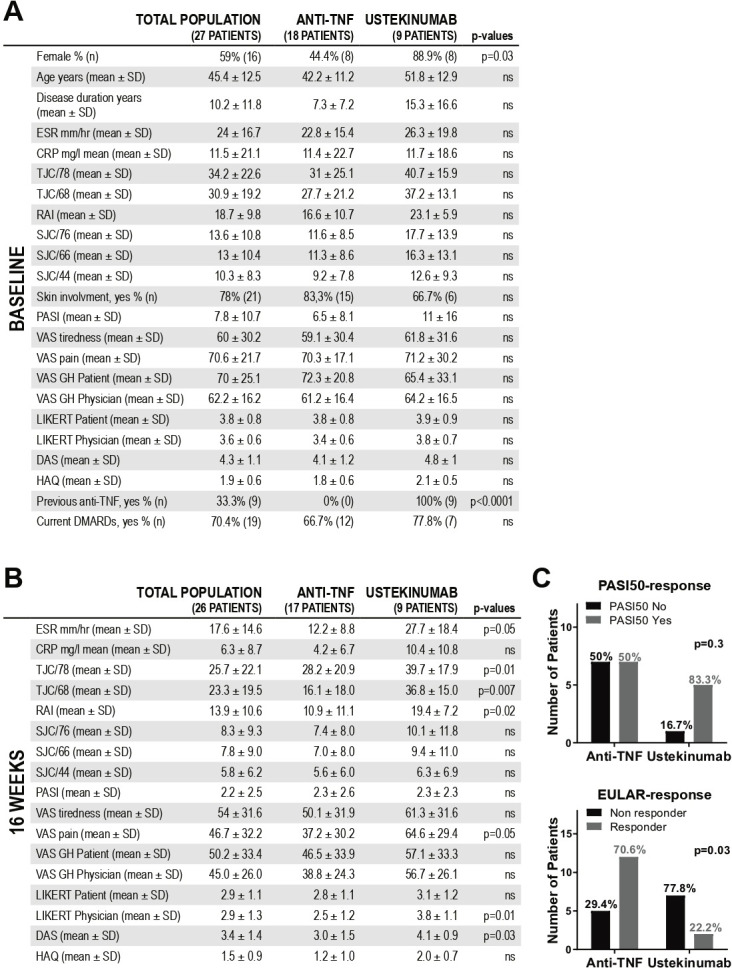
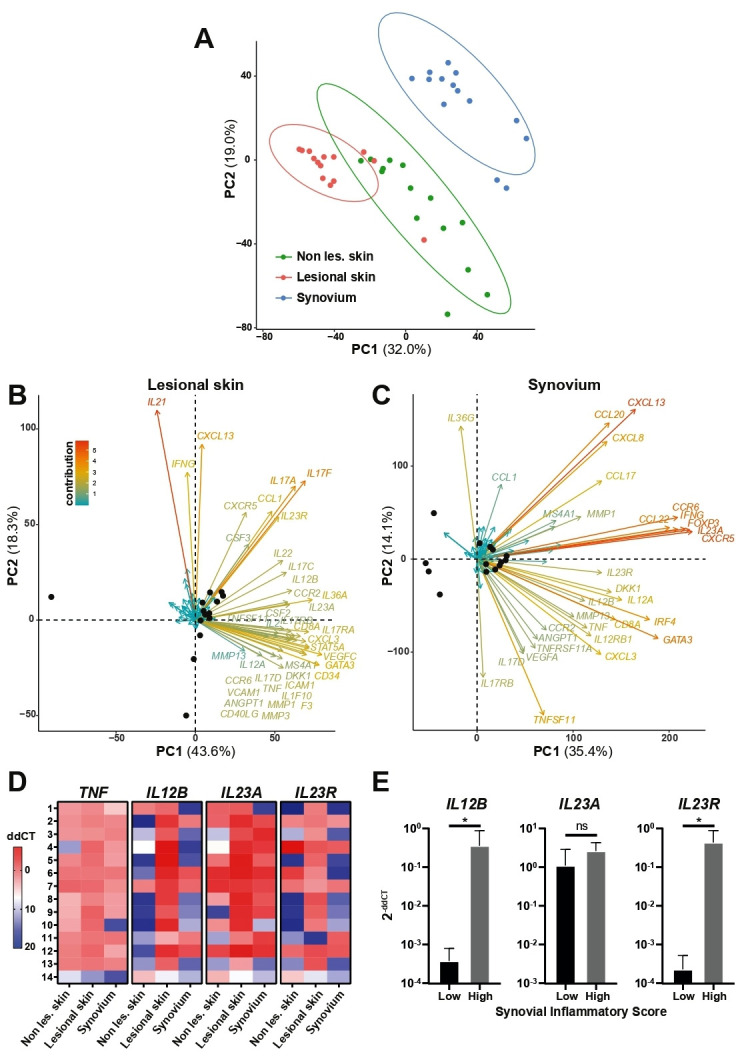
At baseline, all patients had persistent active disease as per inclusion criteria. At primary end-point (16-weeks post-treatment), skin responses favoured ustekinumab, while joint responses favoured anti-TNF therapies. Principal component analysis revealed distinct clustering of synovial tissue gene expression away from the matched skin. While and were homogeneously expressed in lesional skin, their expression was extremely heterogeneous in paired synovial tissues. Here, IL-23 transcriptomic/protein expression was strongly linked to patients with high-grade synovitis who, however, were not distinguishable by conventional clinimetric measures.
PsA synovial tissue shows a heterogeneous IL-23 axis profile when compared with matched skin. Synovial molecular pathology may help to identify among clinically indistinguishable patients those with a greater probability of responding to IL-23 inhibitors.
确定活跃型银屑病关节炎(PsA)患者滑膜与皮肤转录/组织学特征之间的关系,并探讨疾病组织病理学与临床结果之间的机制联系。
27 名活跃型 PsA 患者参与了一项观察性/开放性研究,并在开始使用抗肿瘤坏死因子(TNF)(如果为生物制剂初治)或乌司奴单抗(如果为抗 TNF 应答不足)之前,接受滑膜和配对的病变/非病变皮肤活检。通过实时 PCR 和免疫组织化学分别评估 80 个炎症相关基因的分子分析和白细胞介素(IL)-23p40/IL-23p19/IL-23R 的蛋白水平。
根据纳入标准,所有患者在基线时均存在持续的活跃疾病。在主要终点(治疗后 16 周)时,皮肤反应对乌司奴单抗有利,而关节反应对抗 TNF 治疗有利。主成分分析显示滑膜组织基因表达与匹配皮肤明显分离。虽然 和 在病变皮肤中均匀表达,但在配对的滑膜组织中表达则极其不均一。在这里,IL-23 转录组/蛋白表达与高等级滑膜炎患者密切相关,但这些患者无法通过常规临床计量学措施区分。
与匹配皮肤相比,PsA 滑膜组织显示出异质性的 IL-23 轴特征。滑膜分子病理学可能有助于在临床上无法区分的患者中识别出对 IL-23 抑制剂反应可能性更大的患者。