Department of Emergency, Renmin Hospital of Wuhan University, Wuhan, Hubei, China.
Department of Critical Care Medicine, Renmin Hospital of Wuhan University, Wuhan, Hubei, China.
J Immunol Res. 2021 Aug 26;2021:5061570. doi: 10.1155/2021/5061570. eCollection 2021.
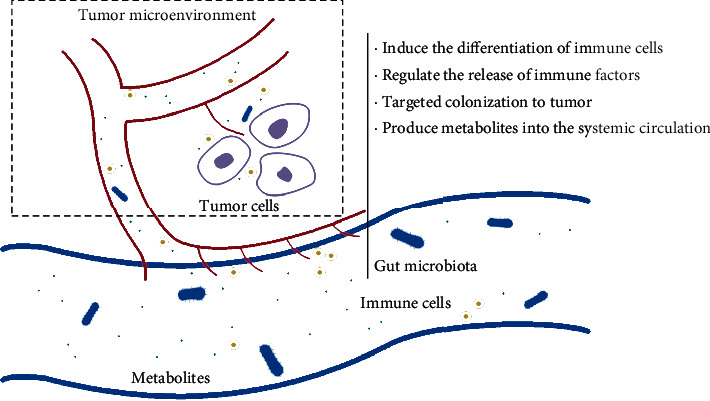
Tumor immunotherapy is the fourth therapy after surgery, chemotherapy, and radiotherapy. It has made great breakthroughs in the treatment of some epithelial tumors and hematological tumors. However, its adverse reactions are common or even more serious, and the response rate in some solid tumors is not satisfactory. With the maturity of genomics and metabolomics technologies, the effect of intestinal microbiota in tumor development and treatment has gradually been recognized. The microbiota may affect tumor immunity by regulating the host immune system and tumor microenvironment. Some bacteria help fight tumors by activating immunity, while some bacteria mediate immunosuppression to help cancer cells escape from the immune system. More and more studies have revealed that the effects and complications of tumor immunotherapy are related to the composition of the gut microbiota. The composition of the intestinal microbiota that is sensitive to treatment or prone to adverse reactions has certain characteristics. These characteristics may be used as biomarkers to predict the prognosis of immunotherapy and may also be developed as "immune potentiators" to assist immunotherapy. Some clinical and preclinical studies have proved that microbial intervention, including microbial transplantation, can improve the sensitivity of immunotherapy or reduce adverse reactions to a certain extent. With the development of gene editing technology and nanotechnology, the design and development of engineered bacteria that contribute to immunotherapy has become a new research hotspot. Based on the relationship between the intestinal microbiota and immunotherapy, the correct mining of microbial information and the development of reasonable and feasible microbial intervention methods are expected to optimize tumor immunotherapy to a large extent and bring new breakthroughs in tumor treatment.
肿瘤免疫治疗是继手术、化疗和放疗之后的第四种疗法。它在某些上皮肿瘤和血液肿瘤的治疗中取得了重大突破。然而,其不良反应较为常见,甚至更为严重,且在某些实体瘤中的反应率并不理想。随着基因组学和代谢组学技术的成熟,肠道微生物群在肿瘤发生和治疗中的作用逐渐得到认可。微生物群可能通过调节宿主免疫系统和肿瘤微环境来影响肿瘤免疫。一些细菌通过激活免疫来帮助对抗肿瘤,而另一些细菌则介导免疫抑制,以帮助癌细胞逃避免疫系统。越来越多的研究表明,肿瘤免疫治疗的效果和并发症与肠道微生物群的组成有关。对治疗敏感或易发生不良反应的肠道微生物群组成具有一定特征。这些特征可作为预测免疫治疗预后的生物标志物,也可开发为“免疫增强剂”来辅助免疫治疗。一些临床和临床前研究已经证明,微生物干预,包括微生物移植,在一定程度上可以提高免疫治疗的敏感性或降低不良反应。随着基因编辑技术和纳米技术的发展,有助于免疫治疗的工程菌的设计和开发已成为新的研究热点。基于肠道微生物群与免疫治疗的关系,正确挖掘微生物信息并开发合理可行的微生物干预方法有望在很大程度上优化肿瘤免疫治疗,为肿瘤治疗带来新的突破。