Francis Sheena, Frank Chelsea, Buchanan Luke, Green Sean, Stennett-Brown Roxann, Gordon-Strachan Georgiana, Rubio-Palis Yasmin, Grant Charles, Alexander-Lindo Ruby Lisa, Nwokocha Chukwuemeka, Robinson Dwight, Delgoda Rupika
Natural Products Institute, University of the West Indies, Mona, Jamaica.
Mosquito Control Research Unit, University of the West Indies, Jamaica.
One Health. 2021 Aug 24;13:100316. doi: 10.1016/j.onehlt.2021.100316. eCollection 2021 Dec.
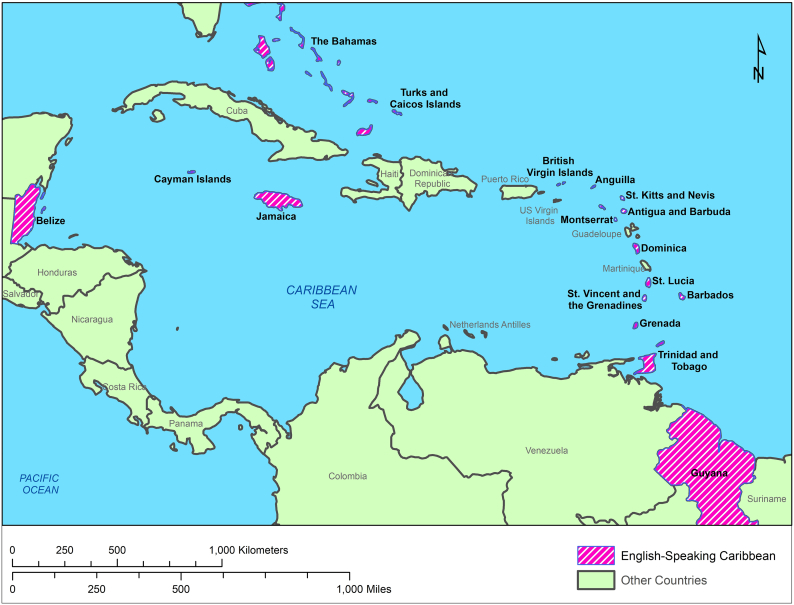
Neglected tropical diseases (NTDs) in developing countries like the Caribbean, negatively affect multiple income-generating sectors, including the tourism industry upon which island states are highly dependent. Insect-transmitted NTDs include, but are not limited to, malaria, dengue and lymphatic filariasis. Control measures for these disease, are often ignored because of the associated cost. Many of the developing country members are thus retained in a financially crippling cycle, balancing the cost of prophylactic measures with that of controlling an outbreak.The purpose of the paper is to bring awareness to NTDs transmitted by insects of importance to humans, and to assess factors affecting such control, in the English-speaking Caribbean.
Comprehensive literature review on reports pertaining to NTDs transmitted by insects in the Caribbean and Latin America was conducted. Data search was carried out on PubMed, and WHO and PAHO websites.
Potential risk factors for NTDs transmitted by arthropods in the English-speaking Caribbean are summarised. The mosquito appears to be the main insect-vector of human importance within the region of concern. Arthropod-vectors of diseases of veterinary importance are also relevant because they affect the livelihood of farmers, in highly agriculture based economies. Other NTDs may also be in circulation gauged by the presence of antibodies in Caribbean individuals. However, routine diagnostic tests for specific diseases are expensive and tests may not be conducted when diseases are not prevalent in the population. It appears that only a few English-speaking Caribbean countries have examined secondary reservoirs of pathogens or assessed the effectivity of their insect control methods. As such, disease risk assessment appears incomplete. Although continuous control is financially demanding, an integrated and multisectoral approach might help to deflect the cost. Such interventions are now being promoted by health agencies within the region and various countries are creating and exploring the use of novel tools to be incorporated in their insect-vector control programmes.
在加勒比地区等发展中国家,被忽视的热带病对多个创收部门产生负面影响,其中包括岛国高度依赖的旅游业。昆虫传播的被忽视的热带病包括但不限于疟疾、登革热和淋巴丝虫病。由于相关成本问题,这些疾病的控制措施常常被忽视。因此,许多发展中国家成员国陷入了经济困境,在预防措施成本和控制疫情成本之间权衡。本文旨在提高人们对昆虫传播的、对人类具有重要意义的被忽视的热带病的认识,并评估加勒比英语国家影响此类疾病控制的因素。
对加勒比地区和拉丁美洲有关昆虫传播的被忽视的热带病的报告进行了全面的文献综述。在PubMed、世界卫生组织(WHO)和泛美卫生组织(PAHO)网站上进行了数据检索。
总结了加勒比英语国家节肢动物传播的被忽视的热带病的潜在风险因素。在相关区域内,蚊子似乎是对人类具有重要意义的主要昆虫传播媒介。对兽医具有重要意义的疾病的节肢动物传播媒介也很重要,因为它们影响以农业为主的经济体中农民的生计。根据加勒比地区人群中抗体的存在情况判断,其他被忽视的热带病可能也在传播。然而,针对特定疾病的常规诊断检测费用昂贵,而且当疾病在人群中不流行时可能不会进行检测。似乎只有少数加勒比英语国家检查过病原体的二次宿主或评估过其昆虫控制方法的有效性。因此,疾病风险评估似乎并不完整。尽管持续控制在经济上要求很高,但综合多部门方法可能有助于转移成本。该区域的卫生机构目前正在推广此类干预措施,各国正在创建并探索使用新工具纳入其昆虫传播媒介控制方案。