Falanga Anna, Gal Grégoire Le, Carrier Marc, Abdel-Razeq Hikmat, Ay Cihan, Martin Andrés J Muñoz, Rocha Ana Thereza Cavalcanti, Agnelli Giancarlo, Elalamy Ismail, Brenner Benjamin
Department of Medicine and Surgery, School of Medicine, University of Milano-Bicocca, Monza, Italy.
Department of Immunohematology and Transfusion Medicine, Thrombosis and Hemostasis Center, Hospital Papa Giovanni XXIII, Bergamo, Italy.
TH Open. 2021 Aug 31;5(3):e376-e386. doi: 10.1055/s-0041-1736037. eCollection 2021 Jul.
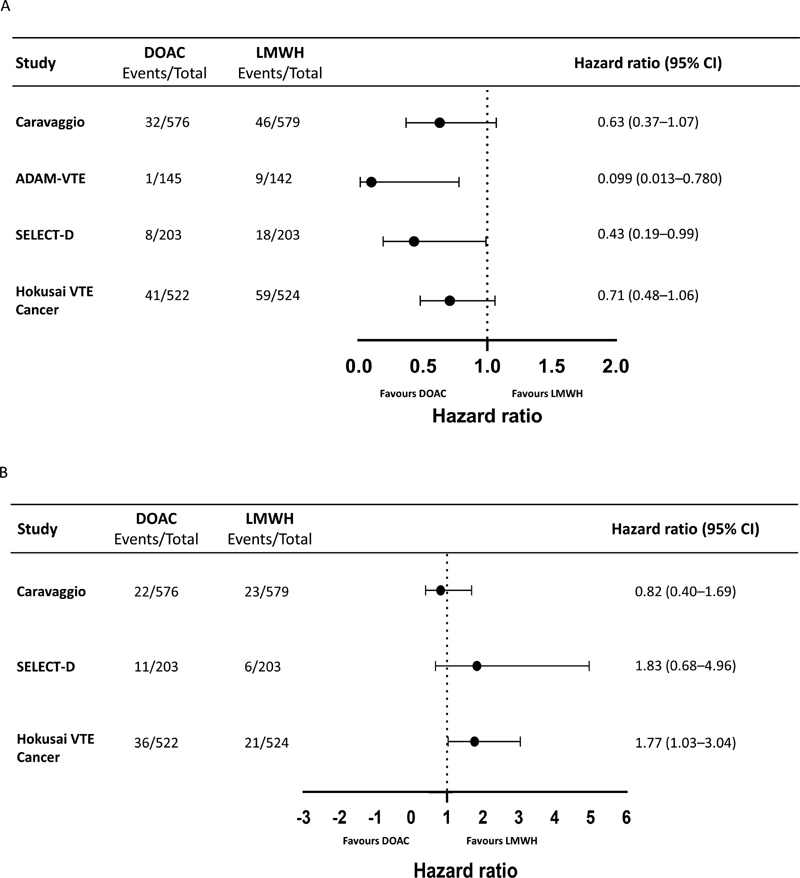
Patients with cancer are at a high risk of symptomatic venous thromboembolism (VTE), which is a common cause of morbidity and mortality in this patient population. Increased risk of recurrent VTE and bleeding complications are two major challenges associated with therapeutic anticoagulation in these patients. Long-term therapy with low-molecular-weight heparins (LMWHs) has been the standard of care for the treatment of cancer-associated VTE given its favorable risk-benefit ratio in comparison with vitamin K antagonists. Direct oral anticoagulants (DOACs), which offer the convenience of oral administration and have a rapid onset of action, have recently emerged as a new treatment option for patients with cancer-associated thrombosis (CT). Randomized clinical trial data with head-to-head comparisons between DOACs and LMWHs showed that overall, DOACs have a similar efficacy profile but a higher risk of bleeding was observed in some of these studies. This review aims to identify unmet needs in the treatment of CT. We discuss important considerations for clinicians tailoring anticoagulation (1) drug-drug interactions, (2) risk of bleeding (e.g., gastrointestinal bleeding), (3) thrombocytopenia, hematological malignancies, (4) metastatic or primary brain tumors, and (5) renal impairment. Additional research is warranted in several clinical scenarios to help clinicians on the best therapeutic approach.
癌症患者发生有症状静脉血栓栓塞(VTE)的风险很高,这是该患者群体发病和死亡的常见原因。复发性VTE风险增加和出血并发症是这些患者抗凝治疗相关的两大挑战。鉴于与维生素K拮抗剂相比其风险效益比良好,低分子肝素(LMWH)长期治疗一直是癌症相关VTE治疗的标准。直接口服抗凝剂(DOAC)具有口服方便、起效迅速的特点,最近已成为癌症相关血栓形成(CT)患者的一种新治疗选择。DOAC与LMWH进行直接对比的随机临床试验数据表明,总体而言,DOAC具有相似的疗效,但在其中一些研究中观察到出血风险较高。本综述旨在确定CT治疗中未满足的需求。我们讨论了临床医生在调整抗凝治疗时的重要考虑因素:(1)药物相互作用,(2)出血风险(如胃肠道出血),(3)血小板减少、血液系统恶性肿瘤,(4)转移性或原发性脑肿瘤,以及(5)肾功能损害。在几种临床情况下有必要进行更多研究,以帮助临床医生确定最佳治疗方法。