Wenlock R D, Tausan M, Mann R, Garr W, Preston R, Arnold A, Hoban J, Webb L, Quick C, Beckett A, Loveson K, Glaysher S, Elliott S, Malone C, Cogger B, Easton L, Robson S C, Hassan-Ibrahim M O, Sargent C
Brighton and Sussex University Hospitals NHS Trust, Brighton, UK.
Centre for Enzyme Innovation, University of Portsmouth, Portsmouth, UK.
Infect Prev Pract. 2021 Sep;3(3):100165. doi: 10.1016/j.infpip.2021.100165. Epub 2021 Aug 28.
COVID-19 has the potential to cause outbreaks in hospitals. Given the comorbid and elderly cohort of patients hospitalized, hospital-acquired COVID-19 infection is often fatal. Pathogen genome sequencing is becoming increasingly important in infection prevention and control (IPC).
To inform the understanding of in-hospital SARS-CoV-2 transmission in order to improve IPC practices and to inform the future development of virological testing for IPC.
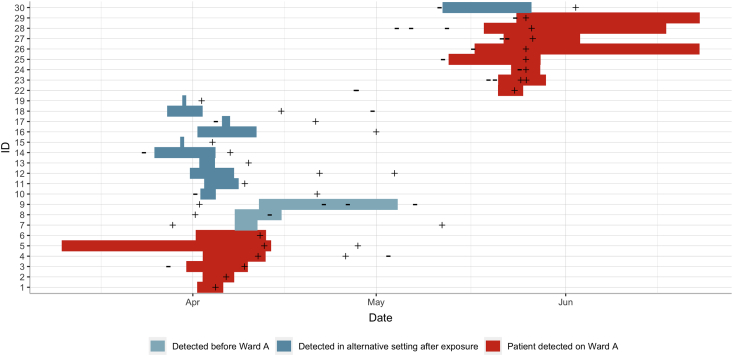
Patients detected COVID-19 positive by polymerase chain reaction on Ward A in April and May 2020 were included with contact tracing to identify other potential cases. Genome sequencing was undertaken for a subgroup of cases. Epidemiological, genomic, and cluster analyses were performed to describe the epidemiology and to identify factors contributing to the outbreak.
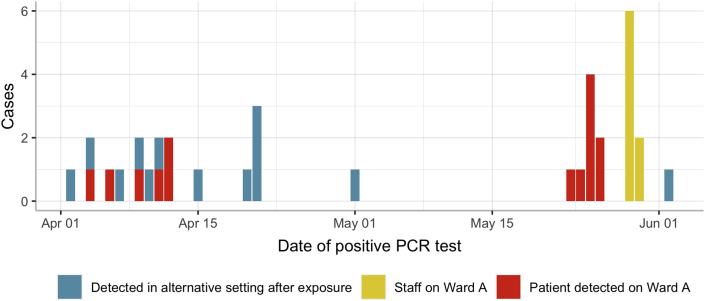
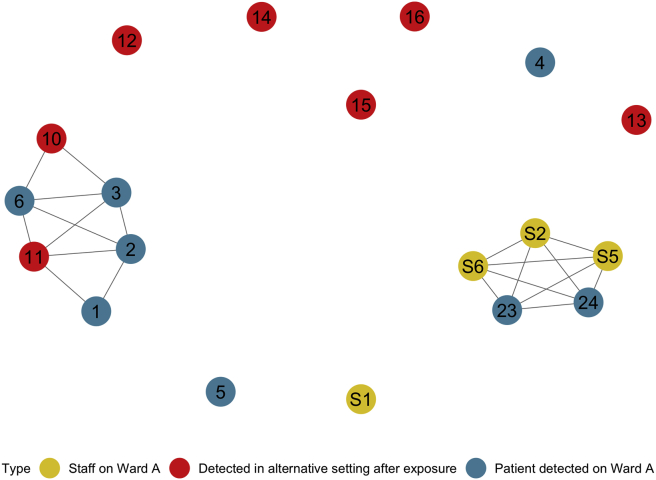
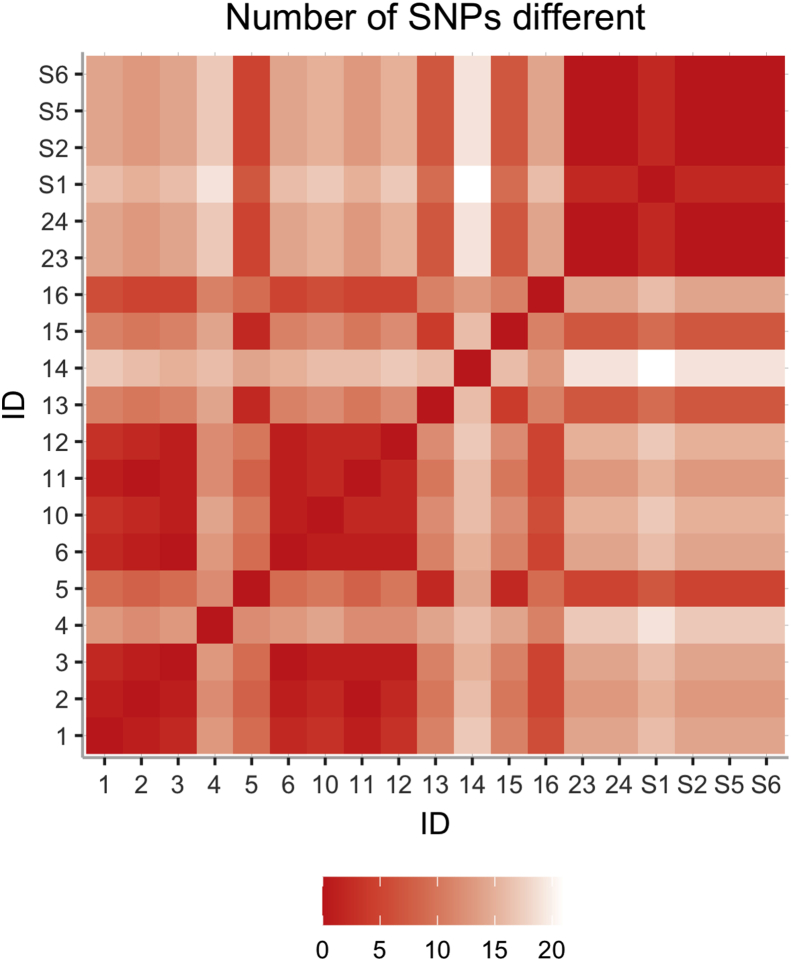
Fourteen cases were identified on Ward A. Contact tracing identified 16 further patient cases; in addition, eight healthcare workers (HCWs) were identified as being COVID-19 positive through a round of asymptomatic testing. Genome sequencing of 16 of these cases identified viral genomes differing by two single nucleotide polymorphisms or fewer, with further cluster analysis identifying two groups of infection (a five-person group and a six-person group).
Despite the temporal relationship of cases, genome sequencing identified that not all cases shared transmission events. However, 11 samples were found to be closely related and these likely represented in-hospital transmission. This included three HCWs, thereby confirming transmission between patients and HCWs.
新型冠状病毒肺炎(COVID-19)有可能在医院引发疫情。鉴于住院患者存在合并症且年龄较大,医院获得性COVID-19感染往往是致命的。病原体基因组测序在感染预防与控制(IPC)中变得越来越重要。
增进对医院内严重急性呼吸综合征冠状病毒2(SARS-CoV-2)传播的了解,以改进IPC措施,并为IPC病毒学检测的未来发展提供信息。
纳入2020年4月和5月在A病房通过聚合酶链反应检测出COVID-19呈阳性的患者,并进行接触者追踪以识别其他潜在病例。对部分病例亚组进行基因组测序。进行了流行病学、基因组和聚类分析,以描述流行病学特征并确定导致疫情爆发的因素。
在A病房共识别出14例病例。接触者追踪又发现了16例患者病例;此外,通过一轮无症状检测,确定8名医护人员(HCW)的COVID-19检测呈阳性。对其中16例病例的基因组测序发现,病毒基因组的单核苷酸多态性差异为两个或更少,进一步的聚类分析确定了两组感染(一组5人,一组6人)。
尽管病例之间存在时间关联,但基因组测序表明并非所有病例都存在传播事件。然而,发现11个样本密切相关,这些可能代表医院内传播。这其中包括3名医护人员,从而证实了患者与医护人员之间的传播。