Wang Xingyi, Chen Yanlong, Li Gongke
School of Chemistry, Sun Yat-sen University, Guangzhou 510275, China.
School of Biology and Chemistry, Xingyi Normal University for Nationalities, Xingyi 562400, China.
Se Pu. 2021 Sep;39(9):1012-1020. doi: 10.3724/SP.J.1123.2021.06027.
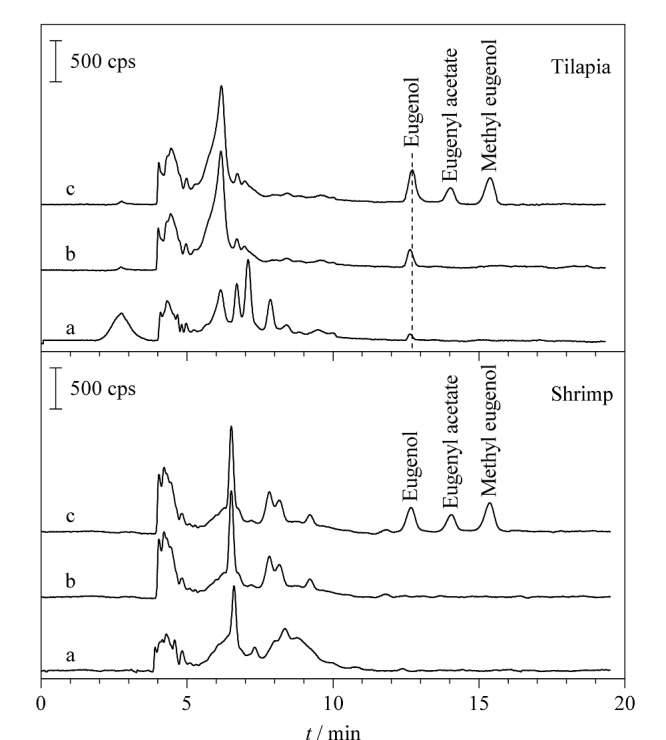
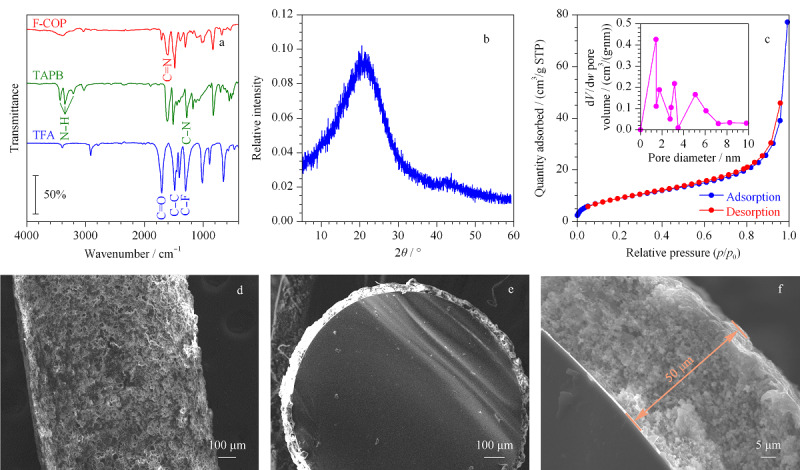
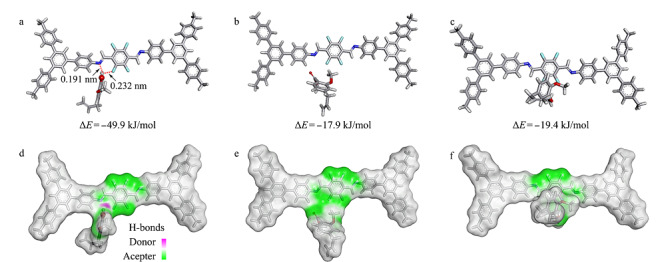
Fluorinated covalent organic polymers (F-COPs) constitute a new class of porous materials with a topological structure, large surface area, and potential superiority over other types of polymers in sample preparation. In this study, a F-COP was rapidly synthesized by a simple Schiff-based reaction using 2,3,5,6-tetrafluoroterephthalaldehyde (TFA) and 1,3,5-tris(4-aminophenyl)benzene (TAPB) as monomers, and by adding scandium (Ⅲ) triflate (Sc(OTf)) as the metal catalyst at room temperature. The prepared F-COP was applied as a coating adsorbent for solid phase microextraction (SPME) to enrich three kinds of eugenol anesthetics in aquatic products. The extraction performance of an enrichment medium is an important factor for practical application in real analytical projects. This F-COP adsorbent with rich -stacking electrons contained abundant phenyl rings and imine (-C=N) groups throughout the molecular framework. The adsorption mechanism was explored and discussed based on the affinity and hydrogen bonding interaction, which contributed to its strong recognition affinity to targets. The F-COP was characterized by Fourier transform infrared (FT-IR) spectroscopy, X-ray diffraction (XRD), nitrogen adsorption-desorption isotherms, and scanning electron microscopy (SEM). The results indicated that the novel F-COP-SPME bar exhibited a rough and porous surface structure, good preparation reproducibility, and high stability. High performance liquid chromatography (HPLC) was performed with an ultraviolet-visible (UV-vis) wavelength detector. A Diamonsil plus C18 column (250 mm×4.6 mm, 5 μm) was used as the analytical column. The mobile phase comprised 60% methanol and 40% ultrapure water, and was flowed at 0.800 mL/min. The injected volume of the sample was 20.0 μL. The column temperature was maintained at 30 ℃ and the detection wavelength was set to 280 nm. Further, the SPME conditions (including extraction time, stirring rate, desorption solvent, and desorption time) that influenced the extraction efficiencies of the eugenol anesthetics were investigated in detail. Thus, the optimized F-COP-SPME bar conditions were established as follows: extraction time: 30 min; stirring rate: 700 r/min; desorption solvent: acetonitrile; desorption time: 10 min. By combining F-COP-based SPME with HPLC-UV analysis, an effective method was developed for the extraction and determination of eugenol, eugenyl acetate, and methyl eugenol residues in aquatic products. The method demonstrated good linearity in the range of 10-1000 μg/L for eugenol and eugenyl acetate, and 10-1500 μg/L for methyl eugenol, with correlation coefficients () greater than 0.9961, low limits of detection (2.9-4.5 μg/kg, =3), and excellent precision (relative standard deviations lower than 8.7%, =5). Finally, the method was applied for the effective extraction of three kinds of eugenol anesthetics from tilapia and shrimp samples. The obtained recoveries were in the range of 76.7%-98.7% and 80.3%-104% with relative standard deviations of 8.5%-11.8% and 8.6%-12.4% (=5), respectively. These results demonstrated that the F-COP is promising for use as an adsorbent in SPME for the determination of eugenol anesthetics in aquatic products. The developed method was suitable for the qualitative and quantitative determination of three kinds of eugenol anesthetics in aquatic products, yielding a satisfactory purification effect and sensitivity.

氟化共价有机聚合物(F-COPs)是一类新型多孔材料,具有拓扑结构、大表面积,且在样品制备方面比其他类型的聚合物具有潜在优势。在本研究中,以2,3,5,6-四氟对苯二甲醛(TFA)和1,3,5-三(4-氨基苯基)苯(TAPB)为单体,通过简单的席夫碱反应,并在室温下添加三氟甲磺酸钪(Sc(OTf))作为金属催化剂,快速合成了一种F-COP。将制备的F-COP用作固相微萃取(SPME)的涂层吸附剂,以富集水产品中的三种丁香酚类麻醉剂。富集介质的萃取性能是实际分析项目中实际应用的一个重要因素。这种具有丰富π-堆积电子的F-COP吸附剂在整个分子框架中含有大量苯环和亚胺(-C=N)基团。基于亲和力和氢键相互作用对吸附机理进行了探索和讨论,这有助于其对目标物具有较强的识别亲和力。通过傅里叶变换红外(FT-IR)光谱、X射线衍射(XRD)、氮气吸附-脱附等温线和扫描电子显微镜(SEM)对F-COP进行了表征。结果表明,新型F-COP-SPME棒呈现出粗糙多孔的表面结构、良好的制备重现性和高稳定性。采用高效液相色谱(HPLC)结合紫外-可见(UV-vis)波长检测器进行分析。使用Diamonsil plus C18柱(250 mm×4.6 mm,5 μm)作为分析柱。流动相由60%甲醇和40%超纯水组成,流速为0.800 mL/min。进样体积为20.0 μL。柱温保持在30℃,检测波长设定为280 nm。此外,详细研究了影响丁香酚类麻醉剂萃取效率的SPME条件(包括萃取时间、搅拌速率、解吸溶剂和解吸时间)。因此,优化后的F-COP-SPME棒条件如下:萃取时间:30 min;搅拌速率:700 r/min;解吸溶剂:乙腈;解吸时间:10 min。通过将基于F-COP的SPME与HPLC-UV分析相结合,建立了一种有效测定水产品中丁香酚、乙酸丁香酯和甲基丁香酚残留量的方法。该方法在丁香酚和乙酸丁香酯10 - 1000 μg/L以及甲基丁香酚10 - 1500 μg/L范围内具有良好的线性,相关系数(r)大于0.9961,检测限低(2.9 - 4.5 μg/kg,n = 3),精密度良好(相对标准偏差低于8.7%,n = 5)。最后,将该方法应用于罗非鱼和虾样品中三种丁香酚类麻醉剂的有效萃取。获得的回收率分别为76.7% - 98.7%和80.3% - 104%,相对标准偏差分别为8.5% - 11.8%和8.6% - 12.4%(n = 5)。这些结果表明,F-COP有望用作SPME中的吸附剂,用于测定水产品中的丁香酚类麻醉剂。所建立的方法适用于水产品中三种丁香酚类麻醉剂的定性和定量测定,具有令人满意的净化效果和灵敏度。