
[采用共价有机框架材料的磁性固相萃取-超高效液相色谱-串联质谱法测定水中的四种杀菌剂]
[Determination of four fungicides in water by magnetic solid phase extraction-ultrahigh performance liquid chromatography-tandem mass spectrometry using covalent organic framework material].
作者信息
Wang Pan, Ma Jiping, Li Shuang, Cheng Jiawen, Zou Zongyue
机构信息
School of Environmental and Municipal Engineering, Qingdao University of Technology, Qingdao 266520, China.
出版信息
Se Pu. 2022 Nov;40(11):988-997. doi: 10.3724/SP.J.1123.2022.08023.
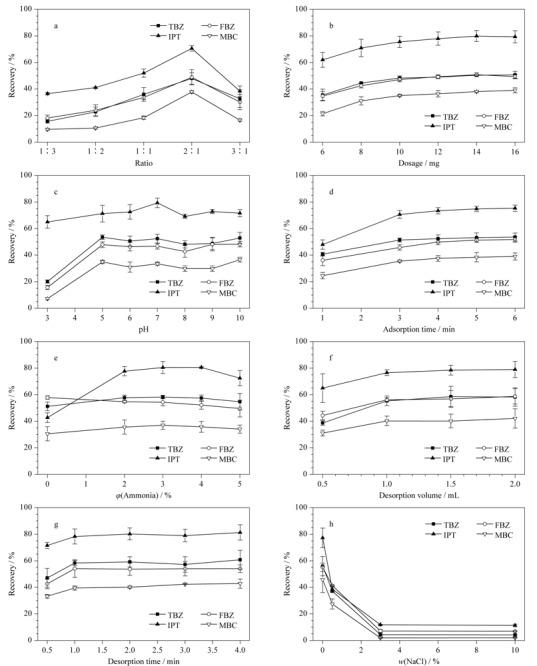
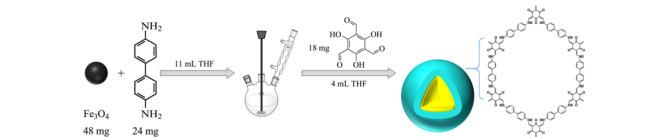
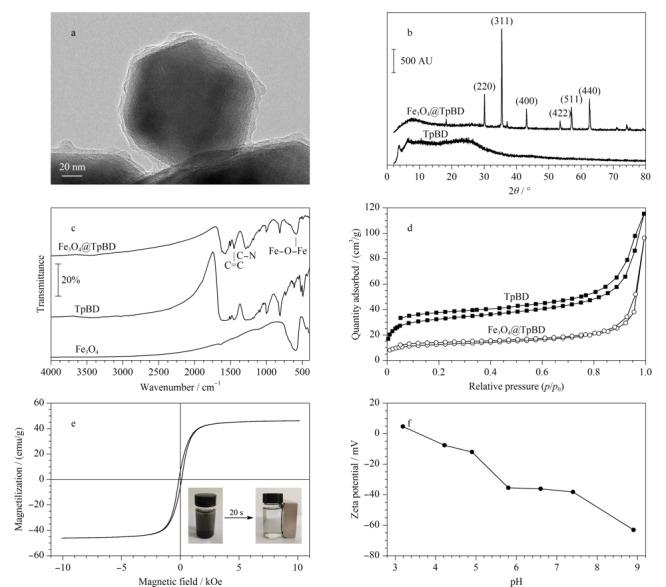
Fungicides can lead to soil and plant diseases after long-term enrichment in the environment; they can also penetrate deeper into the soil and groundwater by rainwater or irrigation, threatening the water environment and human health. Therefore, it is crucial to develop a simple, rapid, efficient, and sensitive analytical method for the detection of fungicides in the water environment. Sample pretreatment is important for the extraction and enrichment of pollutants from environmental water. Magnetic solid phase extraction (MSPE) is a new sample pretreatment method, which uses magnetic materials as adsorbents dispersed in solution, and rapid separation can be achieved by the aid of external magnets. Because of its advantages of short analytical time, less organic solvent consumption, and easy separation of adsorbents, MSPE has attracted much attention. The key to MSPE is the preparation of highly selective magnetic adsorbents. Covalent organic frameworks have the advantages of large surface area, good chemical and thermal stability, tunable porous structure, low density, and easy functionalization, all of which are ideal for adsorbing fungicides. The concentration of fungicides in environmental water is low. Ultrahigh performance liquid chromatography-tandem mass spectrometry (UHPLC-MS/MS) has high sensitivity and high selectivity, which is suitable for the analysis of fungicides. In this work, a magnetic covalent organic framework FeO@TpBD was prepared by an method, as the MSPE sorbent material to enrich of benzimidazole fungicides (thiabendazole, carbendazim, fuberidazole) and organic sulfur fungicide (isoprothiolane) in environmental water. An extraction method based on conjugation, hydrogen bonding, and electrostatic interaction between FeO@TpBD and the fungicides, in combination with UHPLC-MS/MS, was developed for the determination of four trace fungicides in water. Transmission electron microscopy (TEM), X-ray diffractometry (XRD), and Fourier transform-infrared spectroscopy (FT-IR) were performed to confirm the successful synthesis of FeO@TpBD and to characterize this material. A series of experiments were carried out to decide the optimal extraction conditions, i. e., the magnetic ratio and dosage of FeO@TpBD, pH of the water sample, adsorption time, type and volume of the eluent, elution time, and salinity. Gradient elution was carried out with methanol-water as the mobile phase. The target analytes were separated on an ACQUITY UPLC BEH C18 column (100 mm×2.1 mm, 1.7 μm), and multiple reaction monitoring (MRM) was conducted in the positive electrospray ionization mode. The ion source temperature and ion source voltage were set to 500 ℃ and 5 kV, respectively. The analytical method was established under the optimized extraction conditions. The four fungicides showed good linearity in the range of 3-1200 ng/L, with linear correlation coefficients greater than 0.998. The limits of detection (LODs) and limits of quantification (LOQs) of this developed method were 0.06-0.28 ng/L and 0.20-0.92 ng/L, respectively. Recovery tests were performed at three spiked levels of 15, 150, and 600 ng/L, with relative standard deviations of 2.8% to 10.0% (intra-day) and 4.4% to 15.7% (inter-day). The accuracy of the established analytical method was investigated by using it to test real water samples, and satisfactory recoveries for the four analytes were achieved within 77.1% to 119.1%. Trace amounts of carbendazim were detected in the reservoir water at 27.5 ng/L. The method has good sensitivity, accuracy, and precision, and the operation process is convenient.
杀菌剂在环境中长期富集后会引发土壤和植物病害;它们还可通过雨水或灌溉深入渗透到土壤和地下水中,威胁水环境和人类健康。因此,开发一种简单、快速、高效且灵敏的分析方法用于检测水环境中的杀菌剂至关重要。样品预处理对于从环境水中提取和富集污染物很重要。磁性固相萃取(MSPE)是一种新的样品预处理方法,它使用磁性材料作为分散在溶液中的吸附剂,并借助外部磁铁实现快速分离。由于其分析时间短、有机溶剂消耗少以及吸附剂易于分离等优点,MSPE备受关注。MSPE的关键在于制备高选择性的磁性吸附剂。共价有机框架具有比表面积大、化学和热稳定性好、多孔结构可调控、密度低以及易于功能化等优点,所有这些都使其成为吸附杀菌剂的理想材料。环境水中杀菌剂的浓度较低。超高效液相色谱 - 串联质谱(UHPLC - MS/MS)具有高灵敏度和高选择性,适用于杀菌剂的分析。在这项工作中,通过一种方法制备了磁性共价有机框架FeO@TpBD,作为MSPE吸附剂材料用于富集环境水中的苯并咪唑类杀菌剂(噻菌灵、多菌灵、呋菌唑)和有机硫杀菌剂(异稻瘟净)。基于FeO@TpBD与杀菌剂之间的共轭、氢键和静电相互作用,结合UHPLC - MS/MS,开发了一种用于测定水中四种痕量杀菌剂的萃取方法。进行了透射电子显微镜(TEM)、X射线衍射(XRD)和傅里叶变换红外光谱(FT - IR)分析以确认FeO@TpBD的成功合成并对该材料进行表征。开展了一系列实验以确定最佳萃取条件,即FeO@TpBD的磁性比例和用量、水样的pH值、吸附时间、洗脱剂的类型和体积、洗脱时间以及盐度。以甲醇 - 水作为流动相进行梯度洗脱。目标分析物在ACQUITY UPLC BEH C18柱(100 mm×2.1 mm,1.7 μm)上分离,并在正电喷雾电离模式下进行多反应监测(MRM)。离子源温度和离子源电压分别设置为500℃和5 kV。在优化的萃取条件下建立了分析方法。四种杀菌剂在3 - 1200 ng/L范围内呈现良好的线性,线性相关系数大于0.998。该方法的检测限(LOD)和定量限(LOQ)分别为0.06 - 0.28 ng/L和0.20 - 0.92 ng/L。在15、150和600 ng/L三个加标水平下进行回收率测试,日内相对标准偏差为2.8%至10.0%,日间相对标准偏差为4.4%至15.7%。通过使用该方法检测实际水样来研究所建立分析方法的准确性,四种分析物的回收率在77.1%至119.1%之间,令人满意。在水库水中检测到痕量的多菌灵,浓度为27.5 ng/L。该方法具有良好的灵敏度、准确性和精密度,且操作过程简便。


 Zotero 插件