Liu Xiaolan, Gao Wei, Liang Chao, Qiao Junqin, Wang Kang, Lian Hongzhen
State Key Laboratory of Analytical Chemistry for Life Science, School of Chemistry & Chemical Engineering and Center of Materials Analysis, Nanjing University, Nanjing 210023, China.
Taizhou Medical High-Tech Industrial Zone Public Platform Service Center, Taizhou 225300, China.
Se Pu. 2021 Sep;39(9):1021-1029. doi: 10.3724/SP.J.1123.2021.06044.
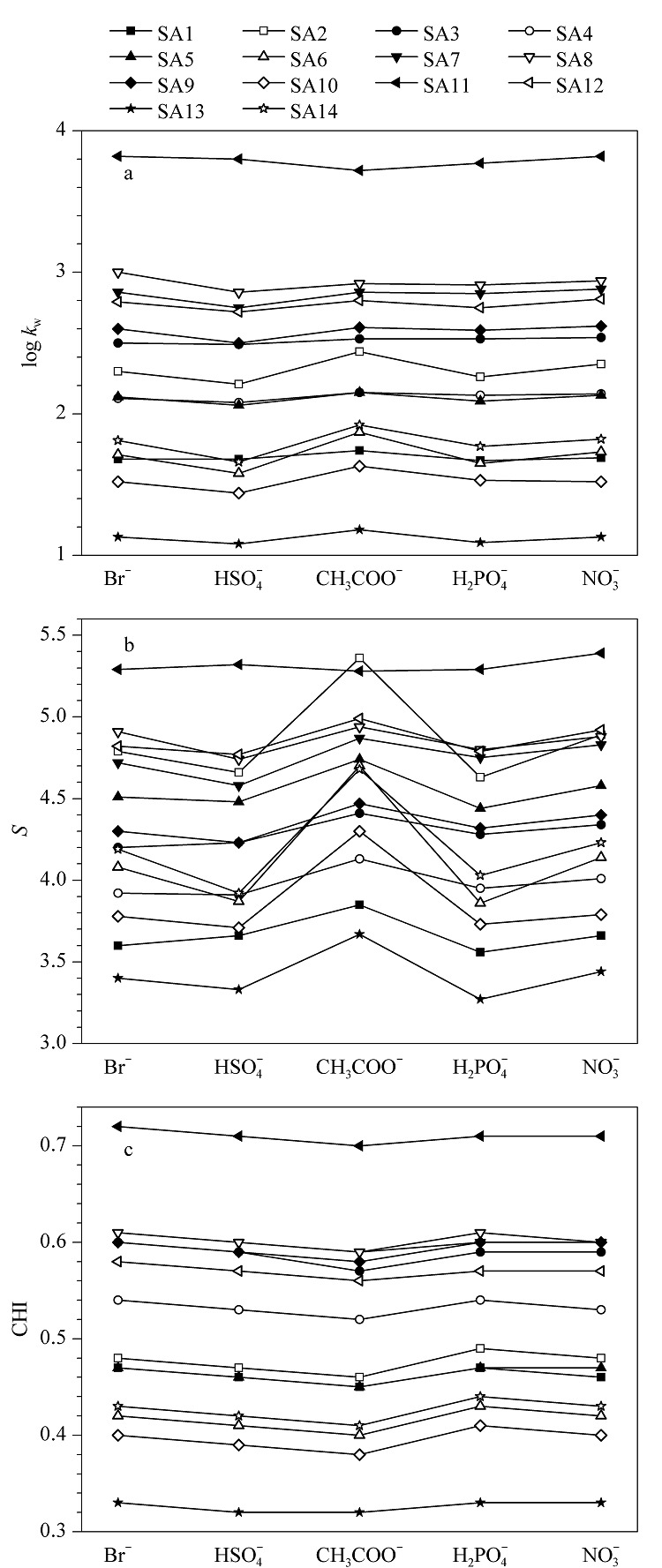
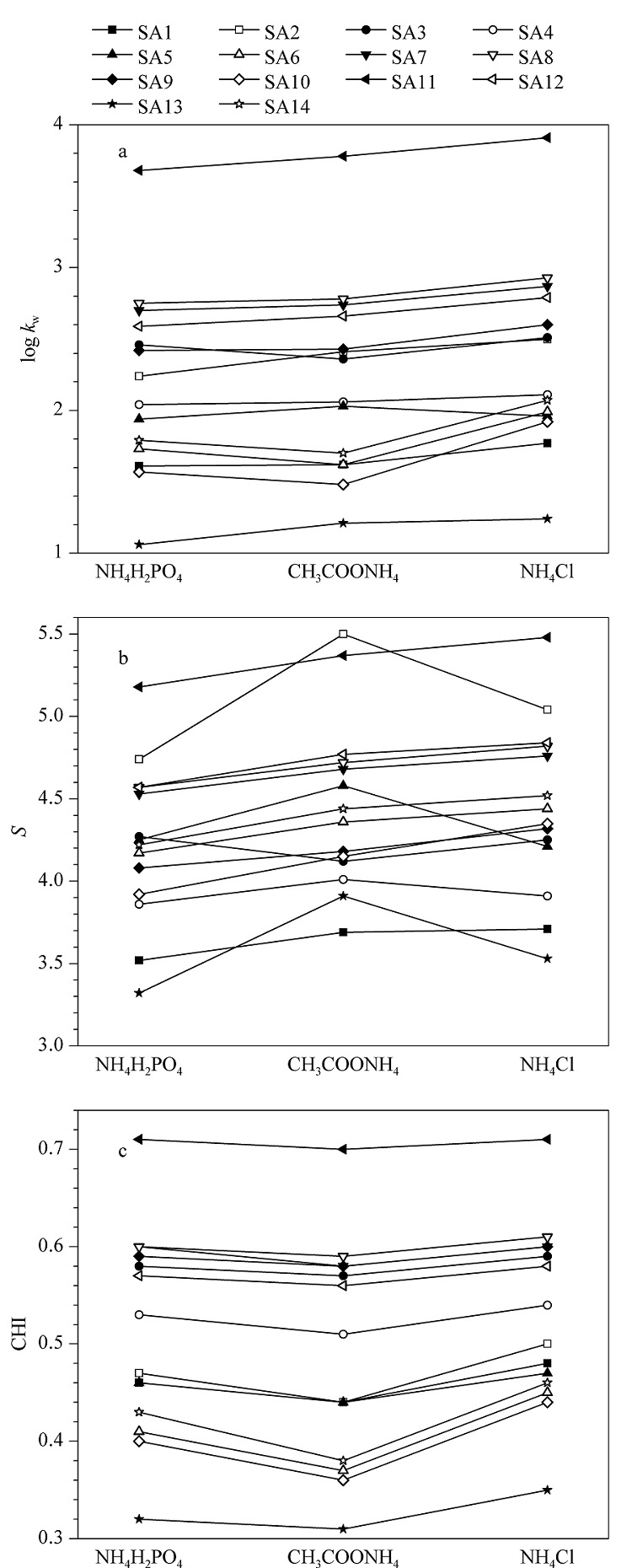
Ion-pair reversed-phase liquid chromatography (IP-RPLC) enhances separation by adding ion-pair reagents to the mobile phase, thereby improving the retention of oppositely charged solutes. IP-RPLC is primarily used for the separation and analysis of strongly ionized compounds. In IP-RPLC, researchers often focus more on the influence of the counter-ion type and concentration, buffer salt concentration and pH, and column temperature, on the retention behavior of solutes. However, the effects of the buffer salt type and non-counter ions in ion-pair reagents on the retention behavior of solutes have rarely been investigated. Accordingly, in this work, the effects of buffer salt types and non-counter ions on the retention behavior of strongly ionized compounds were investigated by IP-RPLC using 14 sulfonic acid compounds as model compounds. Experiments were performed using a silica-based C18 column with methanol as the organic modifier. In the first type of experiment, tetrabutylammonium bromide was kept unchanged as the ion-pair reagent in the mobile phase, and ammonium dihydrogen phosphate, ammonium chloride, and ammonium acetate were used as buffer salts, respectively. The retention factor () was obtained at different methanol ratios, and linear solvent strength (LSS) models were established to determine the log (logarithm of retention factors of solutes when 100% aqueous phases were used as the mobile phase) and (intercept of the LSS model) values of each solute. All solutes exhibited the highest log with the ammonium chloride buffer system; most compounds also exhibited the highest values with this system, except for 1,5-naphthalenedisulfonic acid, 4-methylbenzenesulfonic acid, 5-amino-2-nanphthalenesulfonic acid, and 4-hydroxybenzenesulfonic acid. However, the chromatographic hydrophobic indices (CHIs, log /) of the solutes with different buffer salts were approximately equal. In the second type of experiment, ammonium dihydrogen phosphate was kept unchanged as the buffer salt in the mobile phase, and tetrabutylammonium bromide, tetrabutylammonium dihydrogen phosphate, tetrabutylammonium hydrogen sulfate, tetrabutylammonium nitrate, and tetrabutylammonium acetate were used as ion-pair reagents, respectively. Almost all solutes exhibited the highest with the tetrabutylammonium acetate system, indicating that weakly ionized anions (such as acetate ions) in ion-pair reagents will improve the values of sulfonic acid compounds. Interestingly, the CHIs of the solutes were almost the same for solutes with different non-counter ions. These results suggest that both, the buffer salt types and non-counter ions, influence the log and values of sulfonic acid compounds. Comparison of the retention behavior of solutes with different mobile phases suggested ion-pair mechanisms as well as dynamic ion-exchange mechanisms plays role in the IP-RPLC retention of sulfonic acid compounds. In addition, with all the experimental mobile phases, the apparent -octanol/water partition coefficient (log ) presented a good linear correlation with log , , and CHI, respectively, by the introduction of structure-related descriptors such as charge (), Abraham solvation parameters ( and ), and the polar surface area (PSA). Considering the differences in the log and values obtained with different buffer salts and non-counter ions, the CHIs were relatively stable; therefore, the CHI is more suitable for establishing a quantitative structure-retention relationship (QSRR) model in IP-RPLC, compared to log and .
离子对反相液相色谱法(IP-RPLC)通过向流动相中添加离子对试剂来增强分离效果,从而提高带相反电荷溶质的保留率。IP-RPLC主要用于强电离化合物的分离和分析。在IP-RPLC中,研究人员通常更关注反离子类型和浓度、缓冲盐浓度和pH值以及柱温对溶质保留行为的影响。然而,缓冲盐类型和离子对试剂中的非反离子对溶质保留行为的影响鲜有研究。因此,在本研究中,以14种磺酸化合物为模型化合物,采用IP-RPLC研究了缓冲盐类型和非反离子对强电离化合物保留行为的影响。实验使用以硅胶为基质的C18柱,以甲醇作为有机改性剂。在第一类实验中,流动相中作为离子对试剂的四丁基溴化铵保持不变,分别使用磷酸二氢铵、氯化铵和醋酸铵作为缓冲盐。在不同甲醇比例下获得保留因子(),并建立线性溶剂强度(LSS)模型以确定每种溶质的log (当使用100%水相作为流动相时溶质保留因子的对数)和 (LSS模型的截距)值。所有溶质在氯化铵缓冲体系中表现出最高的log ;除1,5-萘二磺酸、4-甲基苯磺酸、5-氨基-2-萘磺酸和4-羟基苯磺酸外,大多数化合物在该体系中也表现出最高的 值。然而,不同缓冲盐条件下溶质的色谱疏水指数(CHIs,log /)大致相等。在第二类实验中,流动相中作为缓冲盐的磷酸二氢铵保持不变,分别使用四丁基溴化铵、磷酸二氢四丁基铵、硫酸氢四丁基铵、硝酸四丁基铵和醋酸四丁基铵作为离子对试剂。几乎所有溶质在醋酸四丁基铵体系中表现出最高的 值,这表明离子对试剂中弱电离的阴离子(如醋酸根离子)会提高磺酸化合物的 值。有趣的是,不同非反离子的溶质的CHIs几乎相同。这些结果表明,缓冲盐类型和非反离子均会影响磺酸化合物的log 和 值。不同流动相条件下溶质保留行为的比较表明,离子对机制以及动态离子交换机制在磺酸化合物的IP-RPLC保留中起作用。此外,对于所有实验流动相,通过引入与结构相关的描述符,如电荷()、亚伯拉罕溶剂化参数( 和 )以及极性表面积(PSA),表观正辛醇/水分配系数(log )分别与log 、 和CHI呈现良好的线性相关性。考虑到不同缓冲盐和非反离子条件下获得的log 和 值存在差异,CHIs相对稳定;因此,与log 和 相比,CHI更适合在IP-RPLC中建立定量结构-保留关系(QSRR)模型。