The Public Health Research Institute and Department of Medicine, Rutgers New Jersey Medical School, Newark, NJ 07103, USA.
University Hospital, Newark, NJ 07103, USA.
J Med Microbiol. 2021 Sep;70(9). doi: 10.1099/jmm.0.001380.
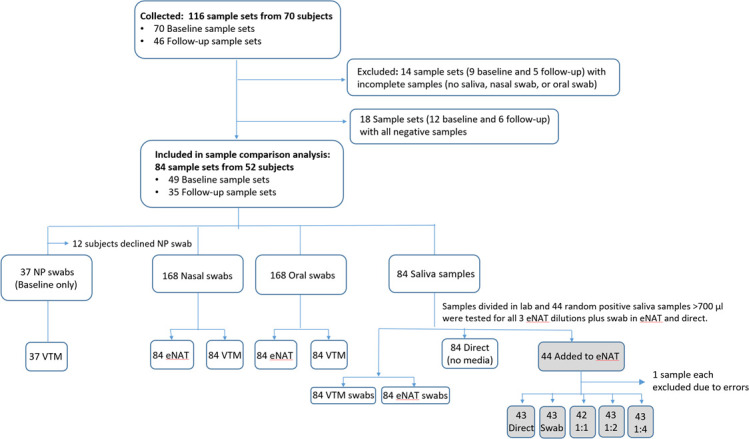
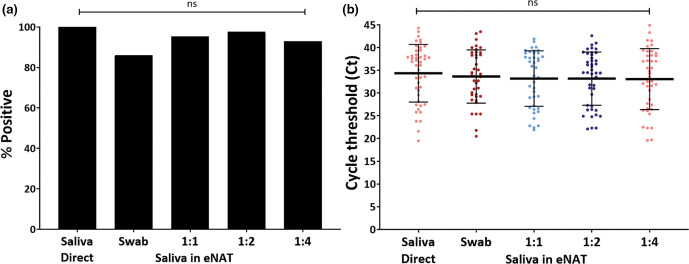
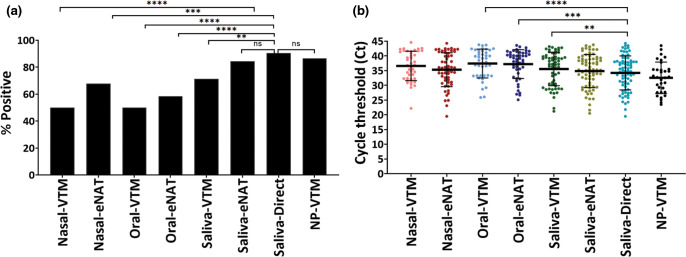
Non-invasive sample collection and viral sterilizing buffers have independently enabled workflows for more widespread COVID-19 testing by reverse-transcriptase polymerase chain reaction (RT-PCR). The combined use of sterilizing buffers across non-invasive sample types to optimize sensitive, accessible, and biosafe sampling methods has not been directly and systematically compared. We aimed to evaluate diagnostic yield across different non-invasive samples with standard viral transport media (VTM) versus a sterilizing buffer eNAT- (Copan diagnostics Murrieta, CA) in a point-of-care diagnostic assay system. We prospectively collected 84 sets of nasal swabs, oral swabs, and saliva, from 52 COVID-19 RT-PCR-confirmed patients, and nasopharyngeal (NP) swabs from 37 patients. Nasal swabs, oral swabs, and saliva were placed in either VTM or eNAT, prior to testing with the Xpert Xpress SARS-CoV-2 (Xpert). The sensitivity of each sampling strategy was compared using a composite positive standard. Swab specimens collected in eNAT showed an overall superior sensitivity compared to swabs in VTM (70 % vs 57 %, =0.0022). Direct saliva 90.5 %, (95 % CI: 82 %, 95 %), followed by NP swabs in VTM and saliva in eNAT, was significantly more sensitive than nasal swabs in VTM (50 %, <0.001) or eNAT (67.8 %, =0.0012) and oral swabs in VTM (50 %, <0.0001) or eNAT (58 %, <0.0001). Saliva and use of eNAT buffer each increased detection of SARS-CoV-2 with the Xpert; however, no single sample matrix identified all positive cases. Saliva and eNAT sterilizing buffer can enhance safe and sensitive detection of COVID-19 using point-of-care GeneXpert instruments.
非侵入性样本采集和病毒消毒缓冲液已独立实现了通过逆转录聚合酶链反应(RT-PCR)进行更广泛的 COVID-19 检测的工作流程。尚未直接和系统地比较过在非侵入性样本类型中联合使用消毒缓冲液来优化敏感、易于获取和生物安全的采样方法。我们旨在评估在床边诊断检测系统中,使用标准病毒转运培养基(VTM)与消毒缓冲液 eNAT-(加利福尼亚州库帕诊断公司)对不同非侵入性样本的诊断效果。我们前瞻性地收集了 52 例经 COVID-19 RT-PCR 确诊的患者的 84 套鼻腔拭子、口腔拭子和唾液,以及 37 例患者的鼻咽拭子。在进行 Xpert Xpress SARS-CoV-2(Xpert)检测之前,将鼻腔拭子、口腔拭子和唾液分别置于 VTM 或 eNAT 中。使用复合阳性标准比较了每种采样策略的灵敏度。与 VTM 相比,eNAT 中采集的拭子标本总体上具有更高的灵敏度(70%对 57%,=0.0022)。直接唾液 90.5%(95%CI:82%,95%),其次是 VTM 中的 NP 拭子和 eNAT 中的唾液,比 VTM 中的鼻腔拭子(50%,<0.001)或 eNAT(67.8%,=0.0012)以及 VTM 中的口腔拭子(50%,<0.0001)或 eNAT(58%,<0.0001)的灵敏度更高。唾液和使用 eNAT 缓冲液均增加了 Xpert 对 SARS-CoV-2 的检测;然而,没有单一的样本基质可以识别所有阳性病例。唾液和 eNAT 消毒缓冲液可增强使用床边 GeneXpert 仪器对 COVID-19 的安全和敏感检测。