Department of General Surgery and Medical Surgical Specialties, Section of Orthopaedics and Traumatology, University Hospital Policlinico-San Marco, University of Catania, Catania, Italy.
Acta Biomed. 2021 Sep 2;92(4):e2021198. doi: 10.23750/abm.v92i4.11394.
Proximal humeral fracture is one of the most common osteoporotic fractures in elderly people. The proper treatment choice is controversial. Open reduction and internal fixation (ORIF) with plate and screws is currently the most common treatment for the majority of displaced proximal humeral fractures. The aim of this systematic review is to investigate the surgical treatment outcomes of PHFs, focusing on main used devices and surgical approaches.
From the earliest record up to 21 July 2020, two independent authors conducted a systematic review of two medical electronic database (PubMed and Science Direct). To achieve the maximum sensitivity of the search strategy, the following terms were combined: "(proximal NOT shaft NOT distal) AND humeral AND fracture AND (plate OR locking plate OR osteosynthesis NOT nail NOT arthroplasty)" as either key words or MeSH terms. The risk of bias of the included studies was assessed, agreeing to the Cochrane Handbook guidelines.
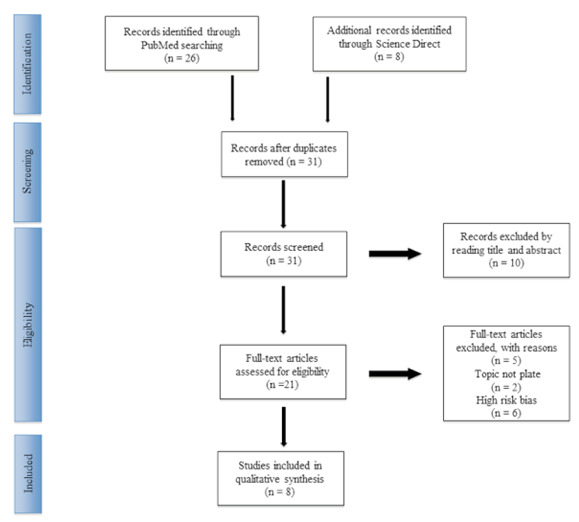
Thirty-four articles were initially noticed after the term string research in the two electronic databases. Finally, after full-text reading and analyzing the reference list, 8 studies were selected. The mean age recorded was 69.5 years (Range 67-72). All the studies included two-, three-, four-fragments fracture. Seven studies investigated PHILOS (Synthes, Bettlach, Switzerland) implants results, while one investigated CFR-PEEK plate (PEEK Power Humeral Fracture Plate; Arthrex, Naples, Florida, USA) outcomes or other plates. Deltopectoral and Transdeltoid approaches were the more common used.
Both deltopectoral and transdeltoid approaches are valid approach in plating after proximal humerus fractures, for these reasons, the surgeon experience is crucial in the choice. The more valid implant is still unclear. The develop of prospective randomized comparative studies is strongly encourages.
肱骨近端骨折是老年人中最常见的骨质疏松性骨折之一。适当的治疗选择存在争议。目前,对于大多数移位的肱骨近端骨折,切开复位内固定(ORIF)加钢板和螺钉是最常见的治疗方法。本系统评价旨在研究 PHF 的手术治疗结果,重点关注主要使用的设备和手术方法。
从最早的记录到 2020 年 7 月 21 日,两名独立作者对两个医学电子数据库(PubMed 和 Science Direct)进行了系统评价。为了使搜索策略具有最大的敏感性,将以下术语组合在一起:“(近端而非骨干而非远端)和肱骨和骨折和(钢板或锁定钢板或骨接合术而非钉而非关节成形术)”作为关键词或 MeSH 术语。根据 Cochrane 手册指南评估纳入研究的偏倚风险。
在这两个电子数据库的术语串研究后,最初注意到 34 篇文章。最后,经过全文阅读和分析参考文献列表,选择了 8 项研究。记录的平均年龄为 69.5 岁(范围 67-72)。所有研究均包括 2 、 3 、 4 个骨折块。7 项研究调查了 PHILOS ( Synthes , Bettlach ,瑞士)植入物的结果,而 1 项研究调查了 CFR-PEEK 板( PEEK Power Humeral Fracture Plate ; Arthrex ,佛罗里达州那不勒斯,美国)的结果或其他板。肩峰下入路和肩峰前入路是更常用的方法。
肩峰下入路和肩峰前入路在肱骨近端骨折后钢板固定中都是有效的入路,因此,医生的经验在选择中至关重要。更有效的植入物尚不清楚。强烈鼓励开展前瞻性随机对照研究。